Repetition — whether a toddler insists on the same book, a preschooler rebuilds the same block tower, or an infant babbles the same syllable — is one of the most reliable behaviors you will observe in early care. Far from being merely annoying or boring, repeated activity is a primary engine of learning: it scaffolds #repetition into new vocabulary, motor skills, routines, and patterns of attention that become durable knowledge. This article explains the developmental logic and neuroscience behind repetition, describes what it looks like in the classroom, and gives practical, enumerated steps providers and directors can use to design repetition into purposeful learning.
Why this matters:
1) Repetition builds neural pathways and supports long-term retention by strengthening synapses and integrating experience across senses (see How Play Supports Brain Development and Early Childhood and Neuroscience). 2) Repetition creates safety and predictability so children can move from simply coping to refining skills. 3) Practical takeaway: design short, frequent, varied repeats for #brain growth, #play-rich moments, and stronger #language outcomes.
1) What is repetition doing inside a child's brain?
Repetition strengthens circuits. Each time a child performs an action (say, stacking a block) or hears a word, synapses involved in that skill are potentiated and become more likely to fire together in the future. Contemporary neuroscience emphasizes that repetition interacts with temporal patterning: the order, spacing, and intensity of repeats matters for whether short-term experiences become long-term memories (NYU/PNAS study).
Enumerated mechanisms (quick):
- 🔁 Hebbian strengthening: repeated co-activation of neurons makes the connection stronger.
- 🧠 Multisensory encoding: repeating with vision, touch, movement, and sound creates richer memory traces (see Nemours).
- 🕰️ Temporal spacing & order: spaced and escalating practice often outperforms massed practice; the sequence can gate memory consolidation (PNAS).
Why it matters for providers: targeted repeats (short, sensory-rich, and spaced across the day) produce faster, more durable learning than simply “doing it again” without variation. Link practice to meaning by connecting the repeated activity to daily routines and relationships (see ChildCareEd on repetition).
2) Why do children repeat activities—what learning goals does it serve?
Children repeat for several developmentally important reasons. Understanding these reasons helps you transform apparent ritual into instruction.
Top purposes of repetition (enumerated):
- 🎯 Skill practice: Fine/gross motor, phonology, and sequencing (e.g., stacking blocks, pronouncing a new sound).
- 🗣️ Language rehearsal: Echoic imitation helps children map sounds to meaning; evidence links musical and rhythmic repetition to vocabulary growth (ECRP music program).
- 🔒 Comfort & regulation: Repeating routines reduces anxiety and frees cognitive resources to experiment.
- 🤝 Social engagement: Repeated phrases and games invite turn-taking and joint attention (see How Play Supports Brain Development).
- 🔬 Conceptual consolidation: Repetition across contexts (books, play, music) builds abstract categories and early math concepts (math games review).
Practical note: intentionally change one variable each repeat (material, verb label, or tempo) so repetition becomes refinement rather than rote repetition. This principle is central to effective lesson planning (ChildCareEd guide on repetition).
3) When is repetition a sign of healthy development—and when should providers be concerned?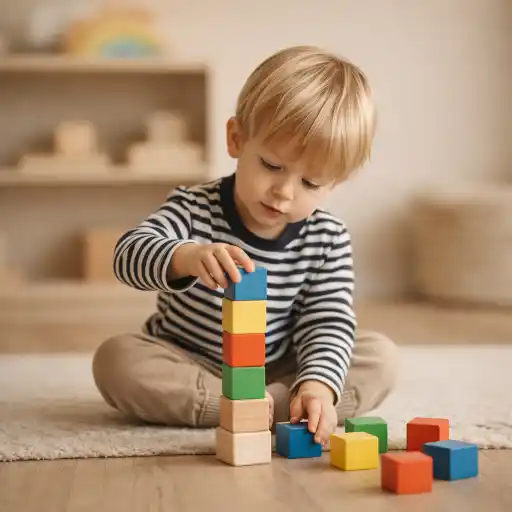
Most repetition is adaptive. Watch for positive signs and red flags so you can respond thoughtfully and involve families early when needed.
Signs repetition is productive (enumerated):
- 🙂 Expansion: child adds new words or actions over days/weeks (e.g., "ball" → "big ball"). See ChildCareEd.
- 📈 General progress: clearer communication, longer play sequences, varied problem solving.
- 🎵 Embedded in routines: songs, books, and predictable transitions support learning (Nemours).
Red flags that merit follow-up (enumerated):
- ⚠️ No growth in gestures, words, or play over months.
- ⚠️ Long, non-functional echolalia without apparent communicative intent.
- ⚠️ Loss of previously gained skills or restricted, distressing repetition.
If you see red flags, take these steps (enumerated):
- 📝 Document specific examples with dates and contexts.
- 🤝 Share observations with families using strengths-based language; offer classroom strategies you already use.
- 🏥 Recommend pediatric screening and, if indicated, referral to early intervention (remember: state requirements vary - check your state licensing agency).
Citations: CDC milestone resources and ASD guidance inform screening and referral timing (CDC Milestones, CDC ASD overview).
4) How can you design routines and classroom activities so repetition intentionally builds learning?
Turn repetition into curriculum design. The following numbered, classroom-ready strategies are low-prep and research-aligned.
- 🎶 Use multisensory repeats: pair songs with gestures, props, and movement to strengthen retention (see music & vocabulary research and Nemours). Consider each child's preferred learning style (visual, auditory, kinesthetic) when selecting modalities; for practical guidance on identifying and adapting to these preferences, see our article on learning styles.
- 📚 Purposeful book routines: read the same short book multiple times across a week; each read adds a small new target (vocabulary, prediction, or a counting task) (ChildCareEd lesson planning).
- 🔁 Scaffolded repetition: plan three levels—familiar, slightly harder, and challenge—so children can repeat and succeed at increasing complexity (Toddler activities).
- 🧭 Routine mapping: embed short repeats into transitions (counting steps, tidy songs, predictable clean-up roles) to practice executive function and self-regulation (ChildCareEd on routines).
- 📸 Quick data loop: choose 1–2 children and 1 target per week; use a photo and a 1-sentence note to record progress and share with families.
Classroom tip: rotate materials every 3–5 days but keep 1–2 anchor routines constant so children can practice gradually. For activity ideas, see ChildCareEd's play and STEM collections (Playful Learning, Classroom Activities).
5) What common mistakes do programs make and how can you avoid pitfalls?
Awareness of common errors helps programs convert repetition into meaningful growth.
Common mistakes and fixes (enumerated):
- ❌ Mistake: Repeating without variation → Fix: Change one variable each repeat (prop, verb, or spatial layout).
- ❌ Mistake: Over-correction that discourages attempts → Fix: Use expansion: model a slightly richer phrase rather than direct correction (see ChildCareEd strategies).
- ❌ Mistake: Making supports only for one child → Fix: Universal visuals and routines normalize use and reduce stigma.
- ❌ Mistake: Ignoring spacing/order effects → Fix: Space repeats across the day and escalate difficulty when appropriate (see PNAS).
FAQ (quick):
- ❓ How long should a repeated activity be? A: Short, frequent bursts—5–15 minutes—embedded in play and routines (ChildCareEd).
- ❓ Are screens useful for repetition? A: Hands-on, interactive repeats are superior for infants and toddlers; screens are not recommended for under-2 learning (CDC).
- ❓ When to refer? A: If repetition is rigid, non-functional, or accompanied by loss of skills, document and suggest screening/early intervention; remember state rules for referrals (state requirements vary - check your state licensing agency).
- ❓ How to share with families? A: Use strengths-based language, short examples, and one practical suggestion they can try at home (e.g., read the same book 3 times this week and add one new word each read).
Why it matters (closing): embedding purposeful #repetition into your program is cost-free, evidence-based, and scalable. It supports #language, #development, and self-regulation and is a practical lever for improving outcomes across classrooms.
Conclusion
Repetition is not an obstacle to learning; it is a core learning mechanism. Use multisensory, spaced, and scaffolded repeats; choose one child and one target each week; document and share progress; and partner with families early when you see red flags. For classroom-ready tools and deeper guidance, consult ChildCareEd resources such as Why Do Kids Repeat Themselves, Why Do Children Need So Much Repetition?, and play-based planning articles (Playful Learning). Your intentional repetitions turn everyday moments into durable brain development.
- 45 Hour Child Growth and Development
- Lesson Planning for Preschoolers
- 45 Hour Infant and Toddler Methods and Materials
- 45 Hour School Age Methods and Materials
- CDA Bridge Bundle: Infant/Toddler
- Creating Environments that Nurture Growth and Community
- Texas Director Credential
- 45 hour Growth and Development Birth-age 12 ONLINE
- CDA Certification en Español: Recursos y Consejos para Educadores Bilingües
- Boosting Language Through Play
- 🌙 ¿Cómo afecta el tiempo frente a las pantallas el sueño y el comportamiento infantil? 😴
- 🔍 ¿Qué ves cuando observas a un niño aprender?
- Cómo Abrir Una Quardería En Casa Sin Dinero?
- ¿Cómo puedo usar escenarios de juego de roles de primeros auxilios en mi aula?
- Capacitación en Salud y Seguridad Preventiva en Línea para Proveedores de Cuidado Infantil
- Lista para Abrir una Guardería en Casa en Virginia: Cómo Empezar
- Lista para Guardería en Casa en Illinois: Cómo Iniciar una Guardería en el Hogar
- How can classroom activities support early learning?
- Cómo simplificar la capacitación para sus empleados de daycare
- Why do repeated books, songs, and activities help children master new concepts?
- Why do children repeat activities and how does repetition support brain development?
- How Can Revisiting the Same Activity Throughout the Year Improve Learning and Classroom Practice?
- How Can Child Care Providers Support Memory Development in Young Children?
- How Can Child Care Providers Plan Infant Activities Around Developmental Milestones?
- What Are Simple Ways to Support Memory and Recall in Young Children?
