When shelves are crowded but children spend little time exploring what is on them, it helps to look closely at what each material offers. Use the Classroom Supply Inventory Resource Guide Buy Now $1.49 to take stock of your supplies, then consider which items children return to, which support current learning goals, and which may be ready to rotate out. The CDA: Curriculum Alignment & Materials  Buy Now $16.00 course offers practical guidance for selecting developmentally appropriate resources for varied ages, abilities, and classroom centers. Read on for ways to decide which materials earn their shelf space through the play, exploration, and learning they invite.
Why does the right material mix matter?
Classroom materials are not merely things to occupy children. They shape what children can choose, investigate, communicate, and create. Thoughtfully selected resources can invite meaningful play across language, mathematics, science, physical development, and social-emotional learning. By contrast, a packed shelf of similar or single-purpose toys may make it harder for children to see possibilities or stay with an idea.
Research and professional guidance emphasize that the value of a material depends on its relationship to children’s development, interests, and learning goals—not its price or novelty. NAEYC’s overview of toys, materials, and games highlights open-ended materials and intentional teaching as valuable companions in playful learning. The Virtual Lab School’s guidance on environments and materials similarly prompts educators to consider relevance, varied uses, and opportunities for exploration.
A useful shelf supports both continuity and discovery. Children often need repeated experiences with familiar resources to deepen understanding, while a few purposeful additions can extend an emerging interest. Think of each item as earning its place by helping children do something meaningful.
- Does it invite sustained, active #play?
- Can children use it in more than one way?
- Does it connect to children’s lives, strengths, or interests?
- Can children access and use it safely and with growing independence?
Which materials offer the strongest learning possibilities?
Open-ended materials often earn their space because children can transform them to suit their ideas. Blocks can become a bridge, a shop counter, or a home for small figures. Fabric can become a cape, a landscape, or a curtain. Clay, paint, recycled boxes, and natural objects invite experimenting and representation without prescribing a single finished product. NAEYC’s article on the joy of open-ended materials describes how children’s use of simple objects can move from sensory exploration to purposeful creation and symbolic thinking.
Useful collections need not be expensive or extensive. Consider a balanced mix that reflects your group and curriculum:
- Construction: blocks, tubes, sturdy boxes, and safe loose parts.
- Art and expression: paper, crayons, washable paint, clay, and varied tools.
- Literacy and storytelling: books, puppets, picture cards, and writing materials.
- Discovery and STEAM: magnifiers, measuring cups, droppers, and natural specimens.
- Dramatic play: authentic, safe household props and figures representing varied identities and abilities.
The strongest collections can support multiple domains. Sorting shells can prompt counting, descriptive language, patterns, and conversations about nature. A cardboard box may become a vehicle, a stage, or a structure to test. Choose for possibility, not simply for category labels. As Good2Know’s overview of open-ended materials explains, flexible resources can encourage creativity, reasoning, coordination, collaboration, and self-expression.
How can you decide whether an item deserves to stay?
Use a practical decision filter before purchasing, keeping, or rotating materials. First, ask what children are actually doing with the item. Are they returning to it, developing a play story, testing ideas, or using it with peers? Next, identify its learning potential: does it support a meaningful goal, an observed interest, or a skill children are ready to practice? Materials do not need to teach a narrow lesson, but their possible uses should be worth the space and supervision they require.
Then assess fit and condition. A material should be appropriate for the ages and abilities of the children who will use it, accessible to those children, intact, cleanable as needed, and safe under active supervision. Consider whether adaptations—larger pieces, accessible placement, visual labels, or fewer items—could make it more usable for a wider range of learners.
- Keep: Children use it with purpose, and it supports varied exploration.
- Adapt: It has potential but needs a different quantity, placement, pairing, or access support.
- Rotate: Interest has faded, but the item may become useful again with a related inquiry.
- Repair or remove: It is damaged, unsafe, incomplete, or unsuitable for the group.
Observation helps prevent decisions based only on adult preference. A material that appears untouched might need a more accessible location or a thoughtful invitation; another that is popular may be creating conflict because too few pieces are available. Keep brief notes on engagement and revisit the decision. The Virtual Lab School’s materials lesson also recommends linking choices to children’s interests, developmental needs, and learning goals.
How do access, inclusion, and safety affect shelf choices?
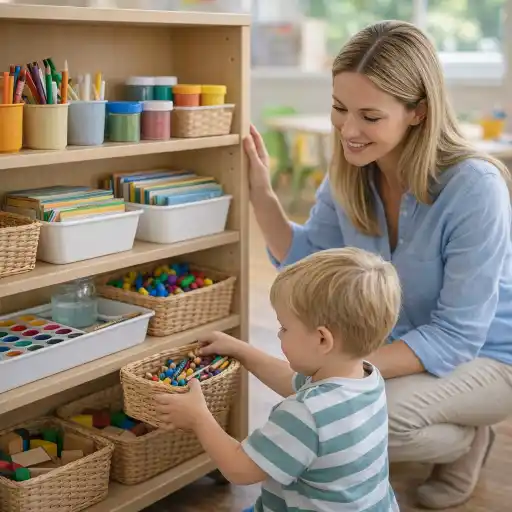
A material can be educationally rich and still fail to earn shelf space if children cannot reach or use it comfortably. Place frequently used resources where children can see and access them, use picture-and-word labels, and arrange furniture so that pathways stay clear. Accessibility includes more than shelf height: consider grip, weight, sensory qualities, language representation, and whether children can participate in different ways. The IRIS Center’s physical-environment guidance recommends accessible placement, appropriate materials, clear organization, and consideration of children’s varied experiences.
Representation matters too. Materials, books, images, and dramatic-play props can reflect the identities, languages, cultures, and abilities of the children and families in your program. Invite family knowledge and children’s interests into decisions, while avoiding tokenism: representation should be present throughout the environment, not limited to a single theme or special event.
Safety is a non-negotiable part of the selection process. Inspect items regularly for broken parts, sharp edges, splinters, choking hazards, and cleanliness concerns. Natural and recycled materials require particular attention to suitability and condition. Keep small parts out of reach of children for whom they pose a hazard, and supervise materials that need closer adult support. Follow manufacturer directions and your program’s cleaning procedures. State requirements vary - check your state licensing agency for age-specific rules and requirements concerning classroom materials.
- Choose durable, non-toxic items intended or suitable for the children using them.
- Check that shelves are stable and heavier materials are placed safely.
- Offer adaptations or alternative tools so more children can take part.
- Keep materials and displays purposeful rather than visually overwhelming.
How can providers keep shelves purposeful without constant purchasing?
Start with an inventory of what you already own. Sort materials by learning area or use, then note condition, quantity, accessibility, and how often children engage with them. This simple review often reveals duplicates, overlooked resources, and useful materials stored out of reach. Set aside safe, clean items that can be introduced later, and remove damaged or unsuitable items promptly.
Keep a dependable core of familiar materials and rotate a small number of complementary resources in response to observation. There is no universal rotation schedule: children may need more time with some materials, while other collections may lose their appeal sooner. Change one area or a few items at a time, and explain predictable changes to children. This lets you see whether the new material meaningfully extends play without disrupting the whole environment.
- 🧺 Present a manageable selection in open baskets or trays so choices are visible.
- Pair related materials to suggest possibilities while leaving the play open-ended.
- Use children’s questions and play themes to guide additions.
- Ask families for specific, safe contributions rather than broad donations that can create clutter.
- Record what children do with an item before deciding to buy a replacement.
Be cautious about treating “new” as synonymous with “better.” A fresh set of blocks, loose parts, or books may be more valuable than a costly, highly specialized toy if it supports multiple kinds of play. Directors can help teams by scheduling brief shelf reviews and making purchasing decisions alongside curriculum planning. For further professional learning on selecting age-appropriate materials and aligning them with classroom goals, explore the CDA: Curriculum Alignment & Materials course Buy Now $16.00.
What common shelf-planning mistakes can you avoid?
One common pitfall is equating a full shelf with a well-resourced classroom. Too many visible choices can obscure what is available, complicate cleanup, and make it harder for children to engage deeply. Reduce duplicates and present a carefully chosen portion, keeping additional materials organized out of sight. The aim is not minimalism for its own sake; it is clarity, accessibility, and useful variety.
Another mistake is choosing materials without considering the children who will use them. A resource may be popular online or attractive to adults yet poorly matched to children’s ages, abilities, interests, or cultural experiences. Likewise, keeping a damaged or incomplete item because it was expensive does not make it useful. Repair it safely, replace missing parts when appropriate, or remove it from circulation.
- Buying before checking storage: inventory and repurpose what is already available.
- Over-directing play: demonstrate safe use, then allow children to develop their own ideas.
- Rotating by the calendar alone: observe engagement and adapt timing to the group.
- Ignoring safety or access: inspect materials and adjust placement, quantity, or design.
- Using a single kind of material: balance active, quiet, sensory, social, and independent options.
Finally, do not confuse an open-ended environment with a hands-off teaching role. Observe closely, describe children’s actions, and ask genuine questions such as, “What could make that bridge stronger?” Then give children time to test their thinking. Intentional materials and responsive adults work together: neither a perfectly arranged shelf nor a sophisticated toy replaces attentive relationships.
How can you tell what truly earns its shelf space?
Classroom materials earn their shelf space when they are safe, accessible, relevant, and rich in possibilities for the children in your care. Prioritize open-ended resources and meaningful representation, connect decisions to observation and developmental goals, and keep a balanced selection rather than an overwhelming display. Maintain familiar materials for continuity, rotate thoughtfully, and purchase only when a genuine gap remains.
Ultimately, the question is not “How much can we fit on this shelf?” but “What can children meaningfully do, discover, and express with what is here?” A brief, regular review can help your team answer that question with confidence. State requirements vary - check your state licensing agency, and consider the CDA: Curriculum Alignment & Materials Buy Now $16.00 course for focused learning on matching materials to children and classroom goals.
- CDA Home Visitor Subject Area 3 Part 3 Birth to 5
- Birth to Five CDA Credential with Portfolio Review
- 45 Hour School Age Methods and Materials
- CDA Bridge Bundle: Family Child Care without Portfolio Review
- CDA Bridge Bundle: Infant/Toddler without Portfolio Review
- CDA Bridge Bundle: Preschool without Portfolio Review
- Emergent Learning & Development
- Creating Environments that Nurture Growth and Community
- 45-Hour Infant and Toddler Curriculum
- Every Moment Matters: Schedules and Transitions
- CDA Certification en Español: Recursos y Consejos para Educadores Bilingües
- ❄️ ¿Qué actividades al aire libre funcionan bien para los niños de Illinois en cada estación? 🌷🍂
- ¿Cuáles son los pasos, los requisitos y las opciones en línea para la certificación de 90 horas para cuidado escolar en Maryland?
- ¿Cuáles son los pasos, requisitos y opciones en línea para la certificación de 90 horas en cuidado de Infantes/Toddlers en Maryland?
- ¿Cómo empiezo mi certificación CDA en Florida en línea?
- How can I create engaging learning centers in my classroom?
- Home Daycare Ideas That Make Your Space Feel Safe, Fun, and Professional
- How Can You Build a Preschool Literacy Center Without Spending Hours Planning?
- How Can You Set Up Learning Centers in a Preschool Classroom?
- Can Every Toddler Reach and Recognize Their Own Storage Space?
- When a Block Building and a Toy Truck Route Need the Same Space, How Can Providers Plan Shared Play?
- How Can You Fix a Supply Shelf That Creates a Classroom Traffic Jam?
- Does an Empty Classroom Space Need to Stay Empty?
- How Can Toddlers Contribute to Classroom Jobs Without Turning Them into Rewards?
- How Can You Set Up a Reading Corner Preschoolers Can Use Independently?
- How Can You Reduce Classroom Setup Time Without Taking Away Children’s Choices?
- ¿Faltan Materiales o Falta una Nueva Estrategia? Cómo Revisar los Rincones del Aula
- How Can Classroom Organization Strengthen Active Supervision?
