Water play can be joyful, educational, and safe when every adult follows the same clear expectations. Pair this guidance with ChildCareEd’s Everyday Safety: Creating Healthy Environments  Buy Now $55.00 to strengthen daily routines, transitions, sanitation, and preventive practices while building practical professional knowledge.
Use the Water Safety Rules Poster as a visible reminder near water tables, outdoor play areas, bathrooms, and program exits. A poster cannot replace supervision or training, but it can help children, staff, and families remember the same safety language.
Why must water safety be treated as an everyday program responsibility?
Drowning can happen in seconds and is often silent. The CDC identifies drowning as a leading cause of death for children ages 1–4 and emphasizes that children can drown anywhere water is accessible, including pools, bathtubs, buckets, and small play containers. Early childhood programs therefore need layered prevention rather than a single rule or occasional reminder.
Water safety is also a quality-of-care issue. Children need opportunities to explore, pour, splash, and investigate, while adults remain responsible for designing environments that reduce preventable risk. A thoughtful plan protects children without eliminating developmentally meaningful experiences.
The CDC recommends that early care and education providers address water safety, prevent serious injuries, teach foundational safety skills, and communicate practical guidance to families. Directors can turn these recommendations into daily routines by combining physical controls, active supervision, staff preparation, and child-friendly instruction.
State requirements vary - check your state licensing agency before establishing ratios, water-depth limits, permission procedures, or field-trip policies.
What simple water safety rules should children learn?
Young children learn best through brief phrases, modeling, repetition, and practice. Rules should be concrete enough for a toddler to understand and consistent enough for every classroom to use.
- Ask an adult first. Children wait for permission before approaching pools, water tables, sprinklers, or other water areas.
- Walk near water. Running increases the chance of slips, collisions, and falls.
- Stay where adults can see you. Children learn that visibility is part of staying safe.
- Keep hands gentle. No pushing, dunking, grabbing, or splashing another child’s face.
- Tell an adult if someone needs help. Children should not attempt a rescue themselves.
Use the poster during circle time, before outdoor play, and whenever the group transitions near water. Invite children to act out safe choices with puppets or role-play. For example, one child can ask, “May I play?” while another practices pointing to the supervising adult.
Children should not be expected to supervise one another. Buddy language can support social awareness, but responsibility remains with trained adults. Similarly, swim lessons may build skills but never replace close, constant supervision.
How should staff supervise water play and swimming activities?
Active supervision means watching, listening, positioning, counting, interacting, and anticipating problems. It is more than being physically present. The supervising adult must be able to see all children clearly and respond immediately.
- Assign a dedicated water watcher whose primary responsibility is the water area.
- Maintain an unobstructed view and remove furniture, equipment, or landscaping that creates blind spots.
- Stay within arm’s reach for infants, toddlers, and children who need touch supervision.
- Count children before water play, during transitions, and immediately after the activity ends.
- Keep phones, paperwork, food preparation, and unrelated conversations away from the watcher’s role.
- Rotate staff during lengthy activities to reduce fatigue and attention lapses.
The Child Care Technical Assistance Network recommends active supervision whenever children are in or around water. It identifies touch supervision during wading or water play and describes especially close staffing for infants and toddlers. Programs should compare these recommendations with current licensing requirements and adopt the most protective practice that their setting can consistently implement.
Supervision should be planned, not improvised. A one-page water-play plan can list the activity location, participating children, staff positions, head-count procedure, start and end times, emergency equipment, and communication responsibilities.
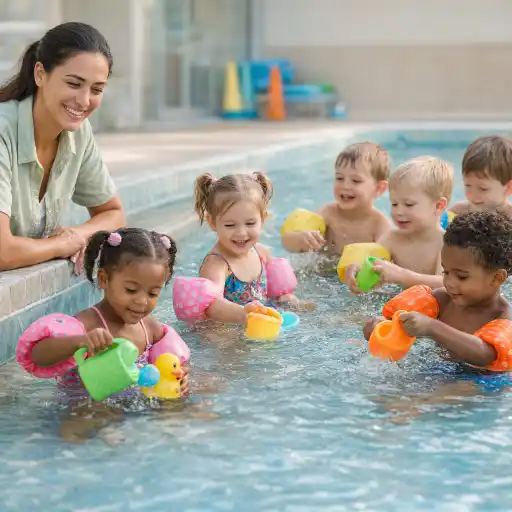
How can programs reduce hazards in pools, water tables, and outdoor areas?
Environmental design is a powerful prevention strategy because it reduces the number of unsafe situations adults must manage in real time. Before children arrive, inspect every location where water may collect or be used.
- Secure pool gates and doors with appropriate barriers that prevent unsupervised access.
- Keep rescue equipment, a charged phone, first-aid supplies, and emergency contacts immediately accessible.
- Use non-slip mats or surfaces around water tables and splash areas, and clean spills promptly.
- Keep water shallow and use containers designed for the children’s age and abilities.
- Empty and clean portable pools, buckets, tubs, and water tables according to program procedures after use.
- Remove toys from closed pool areas so children are not tempted to enter.
- Inspect permanent pools, drain covers, fencing, gates, and surrounding surfaces regularly.
- Include coolers, pet bowls, ditches, fountains, and rain-filled containers in environmental checks.
For natural-water outings, children should wear properly fitted, U.S. Coast Guard-approved life jackets when appropriate. Inflatable toys and water wings are not safety devices. The CDC also notes that life jackets are especially important around lakes, rivers, oceans, and other open water.
Use a brief pre-activity checklist: barriers secure, watcher assigned, head count complete, permissions available, equipment accessible, and surfaces safe. Document repairs and near misses so the program can improve rather than relying on memory.
How should staff prepare for a water-related emergency?
Emergency readiness begins before the first splash. Every staff member should know the program’s address, how to call 911, where emergency equipment is located, and who is responsible for the other children while assistance is provided.
- Check the water first if a child is missing. Do not spend valuable time searching elsewhere before checking nearby water.
- Activate the emergency plan. One adult calls 911 and provides the exact location; another responds to the child if trained and able.
- Move other children away. A designated staff member maintains group supervision and protects children from witnessing additional danger.
- Begin CPR and rescue breathing when indicated and when trained. Staff should follow their current certification and emergency protocols while waiting for EMS.
- Use an AED if available and trained staff are present. Follow the device prompts and continue care until responders arrive.
- Document and review. Notify families and licensing authorities as required, complete reports, and debrief the team.
Practice short drills that rehearse roles such as rescuer, caller, crowd-control staff, and recorder. Drills should be calm, developmentally appropriate, and followed by a constructive review: What worked? Where was equipment located? Which sightline or transition needs improvement?
ChildCareEd’s Pediatric Blended First Aid & CPR/AED Adult, Child, Infant Buy Now $85.00$80.00 can complement program procedures by supporting first-aid, CPR, choking-response, and emergency-response knowledge. Confirm course format and local requirements before enrolling.
How can directors build a consistent water-safety culture?
Consistency depends on shared language, visible expectations, staff coaching, and family partnership. Post the Water Safety Rules Poster at children’s eye level and place a second copy where staff prepare materials. Review one rule during staff meetings and observe whether it appears in practice.
Directors can use this implementation cycle:
- Review the written water policy before the season and after any incident or near miss.
- Verify staff training, CPR and first-aid records, permissions, medical information, and emergency contacts.
- Assign supervision zones before each water activity and communicate them aloud.
- Coach with strengths-based feedback, such as one specific praise and one practical adjustment.
- Share the same child-friendly rules with families so expectations continue at home.
- Record inspections, drills, equipment concerns, and corrective actions.
Common mistakes include assuming shallow water is harmless, relying on swim lessons, allowing a watcher to multitask, using inflatable toys as protective equipment, and failing to count during transitions. Each mistake has a practical fix: treat all water as a hazard, maintain supervision, assign one focused watcher, use appropriate life jackets, and make head counts routine.
For broader environmental and routine-based prevention, explore ChildCareEd’s Creating Safe & Healthy Child Care Environments Buy Now $55.00. Family child care providers may also benefit from Family Child Care: Building, Premises, and Outdoor Safety Buy Now $16.00, which addresses water risks, outdoor boundaries, environmental checks, and sight-and-sound supervision.
Conclusion: What water safety rules should every early childhood program teach?
Every program should teach children to ask an adult first, walk near water, stay visible, use gentle behavior, and tell an adult when someone needs help. Adults must pair these simple lessons with layered protection: secure barriers, developmentally appropriate activities, dedicated active supervision, reliable head counts, trained staff, accessible emergency equipment, and practiced response procedures.
The central goal is not to make water play frightening or eliminate meaningful exploration. It is to make safety predictable, shared, and visible. A Water Safety Rules Poster supports that goal by giving children and adults a common reminder, while professional training helps staff translate the reminder into dependable daily practice.
Use these five takeaways to strengthen your program:
- 👀 Assign a focused water watcher and maintain touch supervision when appropriate.
- 🔒 Control access with barriers, locked gates, and environmental checks.
- 📋 Use a written plan, permission process, head counts, and clear emergency roles.
- 🛟 Use properly fitted life jackets for appropriate open-water activities; do not rely on inflatable toys.
- 📚 Refresh staff knowledge through relevant training and verify local rules with your licensing agency.
When adults plan carefully and communicate consistently, children can experience water play as joyful learning within a safer, more intentional environment.
Related ChildCareEd courses:
- Everyday Safety: Creating Healthy Environments Buy Now $55.00
- Active Supervision: A Strategy That Works Buy Now $35.00
- Pediatric Blended First Aid & CPR/AED Adult, Child, Infant Buy Now
$85.00$80.00 - Injury Prevention: Their Safety Is In Your Hands Buy Now $24.00
- Stay Alert! Steps for Emergency Prep Buy Now $25.00
- Safe and Sound: Creating Healthy Environments for Every Child
- Birth to Five CDA Credential with Portfolio Review
- Pediatric RSV First Aid & CPR/AED
- Health and Nutrition
- 24 Hour Texas Pre-Service
- Creating Safe & Healthy Child Care Environments
- Wellness in Action: Teaching Healthy Habits to Children
- 10 Hour Health and Safety Orientation Training
- Preventative Health and Safety
- Shoo, Germs! Don't Bother Me!
- 😫🧸 ¿Qué hacer cuando un bebé no quiere dormir la siesta en el aula?
- Recursos en Español sobre el Sueño Seguro del Bebé
- Normas de Licenciamiento de Cuidado Infantil en Virginia para Centros Diurnos Infantiles y Hogares Diurnos Familiares
- Retraso del Habla en la Guardería: Cómo Pueden Ayudar los Proveedores
- Cómo Trabajar en el Cuidado Infantil en Carolina del Norte: Requisitos y Pasos
- Cómo Ser Maestra de Preescolar en Illinois
- Cómo Ser Maestra de Preescolar en California
- Cómo Ser Maestra de Preescolar en Maryland
- Cómo Ser Maestra de Preescolar en Carolina del Norte
- How can Washington early childhood programs keep children safe from poisonous plants and forest wildlife outdoors?
- Safe Temperature Regulations in Daycare: California Rules for Child Care Providers
- How did a backyard pool change water safety at California family child care homes?
- How can child care programs keep playgrounds safe every day?
- Daycare Temperature Regulations in California: What Providers Should Know
- What Certification Do You Need to Teach Pre-K? Public School vs. Child Care Requirements
- What Can Hot vs. Cold Sorting Teach Preschoolers About Safety?
- How Can Child Care Programs Build Effective Sun Safety Practices for Children?
- How Can Child Care Providers Teach Summer Safety Lessons Young Children Can Remember?
- What Water Safety Rules Should Every Early Childhood Program Teach?
- How Can Child Care Programs Turn the Buddy System into a Consistent Water-Safety Habit?
