A flying block can turn ordinary play into a safety concern, but it can also reveal an unmet sensory, emotional, or developmental need. Learn how to respond calmly, protect the group, and teach safer ways to explore while building your professional knowledge through The ABCs of Behavior: Turning Challenges into Learning Opportunities  Buy Now $55.00, a focused course on identifying patterns and using positive guidance strategies.
Why does a child throw toys?
Throwing is not automatically defiance. Young children are experimenting with cause and effect, sound, movement, gravity, and adult reactions. A child may also throw because they are frustrated, tired, overstimulated, seeking attention, avoiding a transition, or lacking the language to request help. The behavior may be developmentally typical, yet the specific action may still be unsafe.
The goal is to separate the child from the behavior. Instead of thinking, “This child is being bad,” consider, “This child is communicating or practicing a skill that needs guidance.” This shift supports #respect while preserving a firm safety boundary.
Use an ABC lens to understand the pattern:
- Antecedent: What happened immediately before the toy was thrown?
- Behavior: What exactly did the child do? Record observable facts.
- Consequence: What happened immediately afterward? Did the child gain attention, escape a task, or access a different activity?
For example, if throwing occurs whenever cleanup begins, the child may need transition support. If it occurs during crowded block play, the environment may need adjustment. Understanding the “why” helps teachers respond more effectively than relying on punishment.
What should teachers do immediately?
When a toy is thrown, respond first to safety. Move nearby children away from hard or heavy materials, retrieve dangerous objects when it is safe to do so, and position yourself so you can supervise the whole group. Keep your voice calm and your words brief. A long lecture is unlikely to help while a child is emotionally overwhelmed.
- Interrupt safely: Block another throw or gently remove unsafe materials without grabbing aggressively.
- State the limit: Say, “I won’t let you throw hard toys. Someone could get hurt.”
- Acknowledge the feeling or impulse: “You really wanted to throw,” or “You are angry that play is ending.”
- Offer a safe alternative: “You may throw this beanbag into the basket.”
- Follow through consistently: If throwing continues, place the toy out of reach temporarily and remain available to help the child regulate.
Avoid shouting, sarcasm, humiliation, threats, or physical punishment. A calm adult response supports #co-regulation: the teacher lends the child emotional steadiness until the child can regain control. If another adult is available, ask for assistance so supervision of the rest of the group remains strong.
When the child is calm, briefly practice the expected action. “Blocks stay on the floor for building. Beanbags are for throwing. Show me how you can place the block gently.”
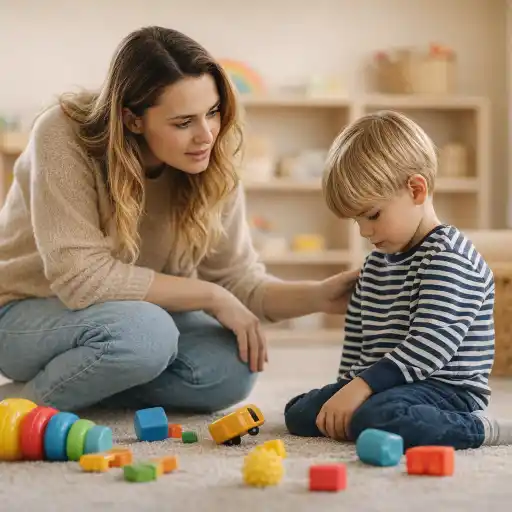
How can teachers redirect throwing without shaming?
Redirection works best when it preserves the child’s interest while changing the unsafe form of play. A child who throws may be seeking movement, sound, sensory feedback, or control. Simply saying “Stop” may interrupt the behavior temporarily without teaching what to do next.
Try language that identifies the safe action:
- “Blocks are for building. Beanbags are for throwing.”
- “You can toss the soft balls into the basket or roll them to me.”
- “If you are finished with the car, place it in the finished-toy basket.”
- “You can stomp on the floor, squeeze a pillow, or ask for help.”
Offer two choices that are both acceptable. Choices provide appropriate control and can reduce power struggles: “Do you want to build with the blocks or throw beanbags outside?” For toddlers, gestures, pictures, and modeling may communicate more effectively than explanations.
Schedule safe throwing opportunities before the child seeks them inappropriately. Use soft balls, scarves, beanbags, paper snowballs, or a target basket. Teach the difference between “throwing materials” and “building materials” during calm moments. The Pennsylvania State University guidance on infant and toddler behavior similarly recommends redirecting block throwing toward safe objects such as beanbags.
Notice appropriate play immediately: “You wanted to throw, and you chose the beanbag. That kept your friends safe.” Specific encouragement strengthens the replacement skill and helps children experience success rather than shame.
How can the classroom environment prevent repeated throwing?
Prevention is not about controlling every movement; it is about making success easier. Examine when, where, and with which materials throwing occurs. A crowded block area, an abrupt cleanup routine, or a long period of waiting may increase the behavior.
- Store heavy or breakable toys where children cannot easily access them during high-energy routines.
- Provide soft throwing materials and a clearly defined throwing area.
- Use picture labels so children know where toys belong.
- Limit clutter and create separate active and quiet play zones.
- Give warnings before transitions: “Five more minutes, then blocks go away.”
- Use a visual schedule, timer, song, or helper job during cleanup.
- Offer duplicates of highly desired toys when possible.
Clear expectations should be taught proactively. Keep rules short and positive, such as “Toys stay low,” “Hands keep friends safe,” and “We throw soft balls in the basket.” Model each rule and practice it when children are calm.
😊 Add movement throughout the day. Dancing, carrying materials, outdoor play, and brief sensory activities can give children appropriate ways to use their bodies. State requirements vary - check your state licensing agency.
When should teachers document, collaborate, or seek additional support?
Occasional throwing is common, but repeated or dangerous throwing deserves careful observation. Document objectively rather than using labels such as “aggressive” or “out of control.” Write, “After the cleanup song began, Maya threw three wooden blocks toward the shelf and cried for two minutes.”
Track patterns across several days:
- Time, location, activity, and people present
- What happened immediately before the throw
- Type, direction, and force of the object
- Adult and peer responses
- What helped the child return to safe participation
Review the information with colleagues and the family. Begin conversations with strengths: “Jordan is imaginative and enjoys construction play.” Then share facts and a plan: “We see throwing most often when block play ends, so we are using a warning, a cleanup job, and a beanbag alternative.” Ask what works at home and whether there are relevant changes in sleep, health, routines, or stress.
Directors should support consistent staff responses. Agree on shared language, identify who supervises the group during an incident, and review whether the environment or schedule needs modification. Consider Mysteries of Challenging Behavior Solved Buy Now $24.00$18.00 for broader training on identifying causes and selecting classroom strategies, or Viewing Guidance in a Positive Light Buy Now $24.00 to strengthen developmentally appropriate guidance and classroom planning.
Seek additional support when throwing causes injury, occurs frequently despite consistent intervention, significantly limits participation, or appears alongside developmental concerns. Consultation is a strength-based step, not a judgment about the child or teacher.
What common mistakes should teachers avoid?
Even skilled providers can fall into reactive patterns during a difficult day. The following pitfalls are understandable, but they often make teaching less effective:
- Repeating “Stop” without instruction: State what the child can do instead.
- Giving intense attention after every throw: Keep safety responses calm and provide enthusiastic attention for safe play.
- Using unrelated punishment: A consequence should be brief, respectful, and connected to restoring safety or practicing the skill.
- Expecting compliance during peak distress: Regulate first; teach and problem-solve afterward.
- Assuming one explanation fits every incident: Throwing may serve different functions at different times.
- Removing all opportunities for exploration: Preserve the child’s interest through safe, intentional materials.
Repair matters after an incident. Help the child retrieve materials, check that peers are safe, or practice placing toys down gently. Avoid forcing an apology. A simple statement such as “The block hit near your friend. Let’s make the space safe and try again” teaches responsibility without shame.
For providers who want a direct positive-discipline framework, Solutions NOT Punishments Buy Now $16.00 focuses on prevention, respectful limits, and classroom-ready alternatives. Professional learning can provide useful training hours, but always confirm whether a course meets your local requirements.
Conclusion: What is the best response when a child throws toys?
The best response combines immediate safety, calm limits, curiosity, and explicit teaching. Stop unsafe throwing without shaming the child, identify the likely need or trigger, redirect toward an acceptable form of movement or play, and reinforce the replacement behavior. Then examine the environment, document patterns, and collaborate with families and colleagues when the behavior continues.
A thrown toy is not a complete picture of a child’s character. It is an opportunity to teach communication, self-regulation, safe exploration, and problem-solving. With consistent #positiveguidance, supportive supervision, and practical prevention, teachers can protect the classroom while helping children grow into more capable participants.
- 45 Hour Child Growth and Development
- CDA Home Visitor Subject Area 3 Part 3 Birth to 5
- 45 Hour Preschool Methods and Materials
- The ABCs of Behavior: Turning Challenges into Learning Opportunities
- Bienvenido! Welcoming All Families
- Children at the Wheel: Emergent Curriculum
- Pediatric RSV First Aid & CPR/AED
- 45 Hour School Age Methods and Materials
- Texas Director Credential
- 🚨 Reporte Obligatorio en Nevada
- Recursos en Español sobre el Sueño Seguro del Bebé
- Capacitación en Salud y Seguridad Preventiva en Línea para Proveedores de Cuidado Infantil
- Lista para Abrir una Guardería en Casa en Virginia: Cómo Empezar
- Lista para Guardería en Casa en California: Cómo Iniciar una Guardería en el Hogar
- Lista para Guardería en Casa en Texas: Cómo Iniciar una Guardería en el Hogar
- Retraso del Habla en la Guardería: Cómo Pueden Ayudar los Proveedores
- Capacitación Previa al Servicio para Proveedores de Cuidado Infantil en Dakota del Norte
- Child Care Discipline Philosophy: Supporting Positive Behavior
- How can we guide behavior without punishment?
- Time-In or Time-Out? 7 Real Classroom Scenarios and What to Try
- When a Child Hits Again and Again: What Should Daycare Teachers Try Next?
- When Learning Feels Hard: Positive Discipline Strategies for Children Who Struggle
- How Can Child Care Providers Use Natural and Logical Consequences with Young Children?
- What Are 10 Positive Guidance Strategies Every Child Care Teacher Should Know?
- When a Child Refuses to Follow Directions, What Should Teachers Do?
- What Is the Difference Between Positive Discipline and Punishment in Early Childhood Education?
- What Should Teachers Do When a Child Throws Toys?
- What Gross Motor Skills Should Children Develop at Each Age?
- Why Do Toddlers Throw Tantrums and How Should Teachers Respond?
