When children choose an activity you did not plan, pause to notice what has captured their attention and where their ideas might lead. Inviting children to share their interests can also shape future plans: during summer planning, the My Summer Bucket List Buy Now $0.25 activity gives them space to draw experiences they hope to try and talk about what matters to them. Build confidence in supporting children’s choices through The Best Promotion is Play  Buy Now $24.00, which explores how play supports development. For guidance on turning those interests into responsive learning experiences, explore From Play to Planning: Building Culturally Competent, Child-Centered Curriculum Buy Now $55.00. Read on for practical ways to respond when children take learning in an unexpected direction.
Why can an unplanned choice become a meaningful learning opportunity?
A child choosing an unexpected activity is not automatically avoiding learning or disrupting the plan. The choice may reveal a question, skill, relationship, or personal experience that matters to the child. A group that bypasses a prepared craft to build a “bus station” from blocks may be exploring transportation, signs, routes, roles, balance, and cooperation all at once.
Children’s self-chosen play offers educators a view of learning in context. The NAEYC guidance on observing, documenting, and assessing children’s development and learning emphasizes that educators use both planned and spontaneous opportunities to notice children’s thinking and let observations inform curriculum. A child’s unexpected activity can provide authentic evidence of what they already know and what they are ready to investigate next.
That does not mean every choice must become a formal lesson. The professional task is to recognize a worthwhile opportunity, preserve children’s ownership, and decide whether a small adjustment can deepen learning without breaking concentration. This responsive stance supports #curiosity and communicates that children’s ideas deserve serious attention.
How can educators decide whether to follow the child’s lead?
Start with a quick check rather than reacting from habit. Ask yourself whether children are safe, engaged, and able to access the activity. Consider whether the choice is compatible with the day’s essential routines and any non-negotiable learning or care responsibilities. When the answer is yes, flexibility may be more productive than redirecting children simply because the activity was not on the written plan.
Use focused observation to understand what is happening before deciding what to do. Notice what children choose, how they use materials, what they say, and whether the play is growing, repeating, or becoming frustrating. ChildCareEd’s guidance on following the child in a busy classroom recommends practical steps such as observing briefly, offering accessible learning areas, and recording concise notes. These small habits can make responsiveness realistic even in a full room.
- ✅ Follow the activity when children are safe, involved, and exploring an idea or relationship.
- Pause and support when a child needs help entering play, communicating, or managing a manageable challenge.
- Set a boundary or redirect when safety, supervision, inclusion, or a required routine calls for it.
Choice does not mean “anything goes.” It means educators use professional judgment to offer meaningful agency within safe, predictable limits. In group settings, stay attentive to the whole room and maintain active supervision as you respond.
How can adults extend learning without taking over?
Think of adult support as a light touch, not a takeover. First, watch long enough to understand the child’s purpose. Then consider whether your presence is needed: the child may be deeply focused, may invite you to join, or may be at a point where a question or resource could open a new possibility. Research on guided play, including a systematic review and meta-analysis of 39 studies, describes a useful balance: adults can hold a learning intention while preserving children’s choice and responding flexibly to their cues.
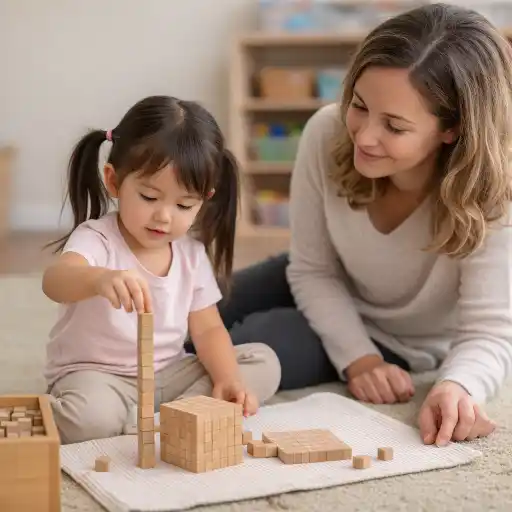
Try a sequence that keeps the child’s idea in the lead:
- Stay nearby and listen before adding directions.
- Comment on what you notice: “You have tested two ways to keep the bridge up.”
- Ask an open question if it fits: “What do you think could happen if we add another block?”
- Offer one relevant material, word, or idea, then allow time for children to respond.
- Step back when children resume their investigation.
For example, if children choose to make pretend soup with outdoor materials, an educator might add a few sturdy containers or introduce words such as “stir,” “pour,” and “measure.” The children still decide what the soup is, who joins, and what happens next. Guidance is most helpful when it supports the children’s own purpose, rather than replacing it with an adult’s finished product.
How can an unplanned activity fit into a planned curriculum?
A flexible curriculum connects children’s interests with intentional goals. You do not need to abandon planning; instead, use a child’s choice as new information for what may come next. If children become absorbed in building a road, you can notice opportunities for spatial language, collaborative problem-solving, mark-making, counting, and pretend roles. Later, you might make maps, signs, books, or photographs available to invite further exploration.
Capture a brief, objective observation while the moment is fresh. The Head Start resource on documenting observations describes how concise records can help educators remember what children did and said and share meaningful moments with families. Record what you saw or heard before adding your interpretation. For instance: “Two children placed three boxes in a line and called them a train; Sam asked, ‘Where is the station?’” This is more useful than a general note that they “played creatively.”
Afterward, reflect: What interests or strengths appeared? Which materials or interactions supported engagement? What might be a helpful next invitation? The NAEYC assessment guidance stresses that observations should inform daily curriculum and teaching, and that assessment should be responsive to children’s languages, experiences, and individual variation. Respect children’s backgrounds and ways of communicating as you interpret what you see.
What common pitfalls should providers avoid?
It can feel uncomfortable when children choose a different path, especially when staff have prepared materials or families expect visible products. Still, a planned activity is a tool—not a reason to override meaningful play without consideration. A few common pitfalls are avoidable with reflection and clear team agreements.
- Redirecting too quickly: Pause and observe before assuming the choice is off-task. Children may be exploring a rich idea in an unexpected form.
- Questioning too often: A steady stream of adult prompts can interrupt concentration. Try a comment, a single open question, or quiet observation.
- Confusing flexibility with a lack of structure: Keep dependable routines, safety expectations, and clear transitions while allowing reasonable choice within them.
- Assuming all children can access the activity in the same way: Adapt materials, communication supports, space, or timing so children with different abilities, languages, and temperaments can participate.
- Documenting only the product: Notice the process—ideas, persistence, peer negotiation, and revisions—not just what children make.
Directors can help by giving staff shared language for responsive practice and room to discuss observations during planning time. If a choice cannot continue because of safety, staffing, or a required transition, explain the limit calmly and offer a meaningful alternative when possible. State requirements vary - check your state licensing agency.
Conclusion: What is the best response when children choose an unplanned activity?
When children choose an activity adults did not plan, begin by observing rather than reflexively redirecting. If children are safe and engaged, their choice may offer a valuable opening for exploration, relationships, and learning. Join or guide lightly when support is useful, then return control to the children; document what you notice and use it to inform future planning.
The central goal is not to choose between adult planning and children’s agency. Strong early learning practice uses intentional plans as a foundation, then adapts when children’s ideas reveal a meaningful direction. With clear boundaries, thoughtful observation, and responsive support, an unexpected choice can become a genuine learning experience. For further professional learning, explore Assessing through Observation Buy Now $35.00, Observing & Assessing in Child Care Buy Now $16.00, and Facilitating Learning in the Preschool Classroom Buy Now $35.00.
- 45 Hour Child Growth and Development
- 45 Hour Preschool Methods and Materials
- Engaging Indoor Activities for Inclement Weather
- Pediatric RSV First Aid & CPR/AED
- 45 Hour School Age Methods and Materials
- Classroom Designers ONLINE
- Texas Director Credential
- Moving About the Classroom: Effective Transitions for Everyday
- CDA Certification en Español: Recursos y Consejos para Educadores Bilingües
- 😫🧸 ¿Qué hacer cuando un bebé no quiere dormir la siesta en el aula?
- Recursos en Español sobre el Sueño Seguro del Bebé
- Cómo Iniciar el Proceso de Obtención de la Licencia de Cuidado Infantil
- Lista para Abrir una Guardería en Casa en Carolina del Norte: Cómo Empezar
- Lista para Guardería en Casa en Illinois: Cómo Iniciar una Guardería en el Hogar
- Consejos de Supervisión Activa para Salones de Preescolar y el Juego al Aire Libre
- Retraso del Habla en la Guardería: Cómo Pueden Ayudar los Proveedores
- Daycare Team-Building Activities That Encourage Cooperation
- How Can You Tell If an Activity Is Developmentally Appropriate?
- How to Write a Lesson Plan for Early Childhood Education: Start With the Skill, Not the Craft
- Child Keeps Hitting Other Kids? Look for These 7 Patterns Before Reacting
- When Learning Feels Hard: Positive Discipline Strategies for Children Who Struggle
- What Do Children Learn When Educators Change Their Minds?
- How Can Child Care Programs Reduce Decision Fatigue for Children and Educators?
- How Can Child Care Programs Turn the Buddy System into a Consistent Water-Safety Habit?
- How Can Child Care Providers Teach Children to Choose Clothing for Weather and Activities?
- What Should Educators Do When Children Choose an Activity Adults Did Not Plan?
- What Should Preschool Educators Do When an Activity Finishes Early?
- How Can Toddlers Contribute to Classroom Jobs Without Turning Them into Rewards?
