When a child is hurt by a peer, a simple, practiced plan can help them feel safer without asking them to handle the situation alone. The ChildCareEd course Addressing Bullying Among School Age Children Buy Now $35.00 helps educators build practical knowledge for recognizing and responding to bullying; continue reading to see how STOP, WALK, TALK can become an age-appropriate classroom skill.
Why teach children a safe response plan?
Unkindness can leave a child feeling embarrassed, frightened, or unsure whether adults will help. Teaching a few clear steps in advance gives children language for self-advocacy while making the adult’s role unmistakable: children can take safe actions, but they are never responsible for stopping bullying on their own.
The Centers for Disease Control and Prevention describes bullying as unwanted aggressive behavior involving a power imbalance and repetition, or a strong likelihood of repetition. It can be physical, verbal, social, or involve property. A one-time disagreement may still need attention and care, but not every difficult interaction meets this definition. With younger children, social roles and skills are still developing, so educators should focus on what they observe rather than assigning a fixed identity. NAEYC’s discussion of bullying in early childhood also emphasizes the challenge of distinguishing developmental conflict from a recurring pattern of harm.
Teaching the sequence #STOP, WALK, TALK is useful because it is brief, repeatable, and adaptable. Children learn that they may set a boundary when it feels safe, move away when behavior continues or danger is present, and tell a trusted adult. Adults, meanwhile, stay attentive, intervene, and follow through.
What do STOP, WALK, and TALK mean in practice?
Present the steps as options children can use when safe—not as a test they must pass. Some children may be ready to speak firmly; others may need to walk directly to an adult. If there is a threat, physical aggression, or fear that speaking could make things worse, skip the verbal step and seek adult help immediately.
- STOP: If it feels safe, use a calm, clear phrase such as “Stop. I don’t like that,” or “Please leave my things alone.” A simple hand signal can support children who find words difficult. They do not need to argue or explain at length.
- WALK: Move toward a supervised, safer place or join a trusted peer. Walking away is a protective choice, not weakness. Do not tell children to stay in an unsafe situation to prove they are brave.
- TALK: Tell a trusted adult what happened, where it happened, and whether it has happened before. Children can say, “I need help. They keep leaving me out,” or “Someone pushed me, and I feel unsafe.”
Make the order flexible: it is fine to tell an adult first. As StopBullying.gov advises, when speaking up does not feel safe, children should walk away and find an adult rather than fight back. The core message is that seeking help is a safety skill—not tattling.
How can educators teach and practice the steps?
Children are more likely to remember a response they have rehearsed in a calm moment. Introduce the steps during a short group discussion, then revisit them through stories, puppets, drawings, and brief role-play. Keep scenarios realistic and manageable: someone grabs a marker, says an unkind name, or repeatedly tells a child they cannot join a game. Ask, “What could the character do to stay safe?” and accept more than one appropriate answer.
- Model a firm but non-threatening voice: “Stop. I need space.”
- Practice walking to a designated trusted adult or visible, supervised area.
- Help children identify several trusted adults, including who is available during outdoor play, transitions, and pickup.
- Use picture cues, home-language phrases, gestures, or communication supports to make the steps accessible.
- Revisit the skill periodically rather than waiting until a child reports a problem.
For kindergarten children, keep language short and use concrete examples; school-age children can discuss repeated behavior, group dynamics, and safe ways to support a peer. Role-play should never require a child to reenact a distressing event or play the target of aggression unwillingly. PACER’s elementary bullying-prevention curriculum offers age-appropriate lesson and activity ideas for ongoing conversation.
What should educators do when a child tells them?
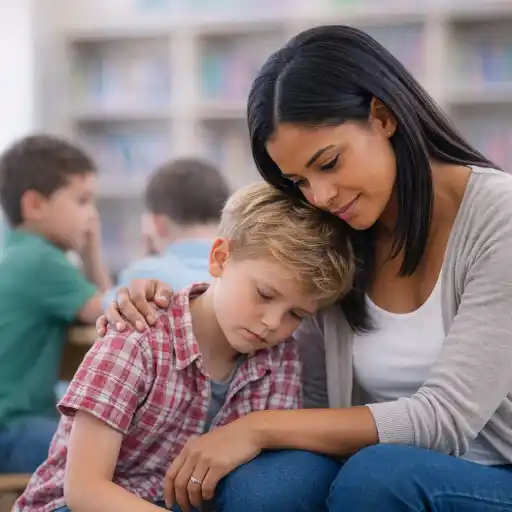
Respond promptly and calmly. Thank the child for telling you, acknowledge their feelings, and make clear that they deserve to feel safe. For example: “I’m glad you came to me. I will help.” Listen without blame or pressing for a complete account on the spot. Avoid promising secrecy; explain that you may need to share information with adults who can help protect children.
If behavior is happening now, interrupt it, separate children when needed, and check for injuries or immediate emotional distress. StopBullying.gov recommends that adults intervene, make sure everyone is safe, remain calm, and model respectful behavior. Speak with children separately while gathering information; avoid public questioning, forced apologies, or requiring the children to resolve a potentially unequal situation together.
- Record observable details: date, time, place, exact words or actions, people present, and the response taken.
- Follow program procedures for notifying a director and communicating with families, while protecting children’s confidentiality.
- Check back with the child and monitor the setting where the concern arose.
- Seek urgent assistance according to program policy if there is serious injury, a weapon, a credible threat, sexual abuse, or another immediate danger.
Use behavior-focused language, not labels. “A group repeatedly blocked one child from joining the activity” supports thoughtful follow-up better than calling a child a bully. Accountability and compassionate teaching can coexist: the child who caused harm may need help learning safer ways to manage frustration or join play.
How can classrooms make help-seeking and peer support safer?
Children are more likely to use their words when adults consistently show that reports are taken seriously. Build an environment where children know who is available, how to ask privately for help, and what adults will do next. Include a trusted-adult map or photo display, and review it when staffing or routines change.
Peers can also support someone safely. Teach children that they do not have to confront an aggressor. They can get an adult, stand near the child who is being targeted if it is safe, or offer an invitation to join another activity. CDC guidance on bullying prevention emphasizes safe ways to stand up against bullying and the importance of empathy and communication skills.
- Notice high-risk moments such as team selection, transitions, crowded play spaces, and areas with limited adult visibility.
- Use shared expectations such as “Hands keep people safe,” “Words show respect,” and “Tell an adult when someone may be hurt.”
- Recognize supportive actions specifically: “You got help when your classmate was upset. That was a caring choice.”
- Offer inclusive activities and ways to participate that respect children’s different abilities, communication styles, and backgrounds.
Support should not become forced friendship or make the targeted child responsible for avoiding certain places. Adults must address recurring behavior and adjust supervision or routines where needed. State requirements vary - check your state licensing agency.
What common mistakes should educators avoid?
Even caring adults can unintentionally increase a child’s distress by rushing, minimizing, or putting the burden back on the child. A safer response combines listening, immediate protection, careful observation, and follow-up. STOP, WALK, TALK is a tool for children; it does not replace an adult’s responsibility to intervene and address a pattern.
- Do not say “just ignore it” or “work it out yourselves” when a child reports repeated or frightening behavior. Listen and assess safety.
- Do not insist that a child confront someone. Speaking up is optional when it feels safe; walking away and seeking help are valid responses.
- Do not encourage fighting back. Retaliation can escalate danger and may lead to injury.
- Do not force a public apology or joint mediation. First establish safety, understand what occurred, and provide separate support.
- Do not promise that a problem is solved after one conversation. Check whether the behavior stops and whether the child feels supported.
Also avoid treating every disagreement as bullying. Consider repetition, power differences, context, and impact while addressing any harmful act in the moment. If the concern persists, coordinate with program leadership and follow written policy. A related next step for professional learning is ChildCareEd’s You’re Not My Friend Anymore: Learning Conflict Resolution  Buy Now $16.00, which focuses on developmentally appropriate ways to teach children problem-solving.
Conclusion: What should children remember when someone is unkind?
Children should know that they have choices and that trusted adults are responsible for helping keep them safe. When it feels safe, they can say “Stop”; if the behavior continues or feels unsafe, they can walk away; and they can always talk to an adult they trust. They do not have to fight back, manage repeated mistreatment alone, or prove that an experience is serious before asking for help.
For educators, the essential work is to teach and practice the steps, respond calmly to reports, document patterns, supervise thoughtfully, and follow up. The goal is not merely to give children a script but to create a community where #safety, #respect, #empathy, #trustedadults, and #belonging are visible in everyday interactions—and where children learn that asking for help is a strength.
Explore five relevant ChildCareEd courses:
- 45 Hour Child Growth and Development
- Addressing Bullying Among School Age Children
- Birth to Five CDA Credential with Portfolio Review
- Pediatric RSV First Aid & CPR/AED
- CDA Bridge Bundle: Family Child Care without Portfolio Review
- CDA Bridge Bundle: Infant/Toddler without Portfolio Review
- CDA Bridge Bundle: Preschool without Portfolio Review
- Creating Environments that Nurture Growth and Community
- Texas Director Credential
- CDA Certification en Español: Recursos y Consejos para Educadores Bilingües
- 👧 ¿Cómo iniciar y abrir una guardería en Texas? Lo que necesitas saber
- Qué capacitación se requiere para ser director de cuidado infantil en Texas?
- Requisitos Para Ser Maestra Principal En Un Daycare: Lo Que Necesitas Para Empezar
- Recursos en Español sobre el Sueño Seguro del Bebé
- Que es Título 22 en California?
- Capacitación en Salud y Seguridad Preventiva en Línea para Proveedores de Cuidado Infantil
- Regulaciones de Licenciamiento de Cuidado Infantil en California para Centros y Hogares de Cuidado Infantil Familiar
- Lista para Abrir una Guardería en Casa en Virginia: Cómo Empezar
- Lista para Guardería en Casa en Illinois: Cómo Iniciar una Guardería en el Hogar
- Lista para Guardería en Casa en California: Cómo Iniciar una Guardería en el Hogar
- Retraso del Habla en la Guardería: Cómo Pueden Ayudar los Proveedores
- Capacitación Previa al Servicio para Proveedores de Cuidado Infantil en Dakota del Norte
- How can school-age childcare programs prevent bullying?
- How Can Child Care Providers Prevent and Respond to Bullying?
- When Does Exclusion in an After-School Group Become a Pattern?
- What Should You Say When a Child Calls Another Child’s Feelings Silly?
- Bullying or Peer Conflict? What Should After-School Staff Look For?
- What Should Children Do When Someone Is Being Unkind or Bullying Them?
- What Should Children Do When Someone Is Bullying Them?
