A field trip can spark questions and discoveries worth sharing with families who could not attend. As you prepare for the outing, use the Field Trip Safety Checklist for Child Care & Preschool Buy Now $0.99 to support safety planning, and separately plan how to capture children’s observations through brief notes, drawings, or permitted photos. The Bridging Cultures: Family Communication & Collaboration  Buy Now $55.00 course offers practical strategies for sharing learning in accessible, responsive ways that honor families’ communication preferences. Read on for simple approaches to bring the trip’s discoveries home and invite families to contribute questions, experiences, and ideas.
Why does sharing field trip learning matter?
Families who could not attend should still have an authentic window into the experience. Work schedules, transportation, health, caregiving responsibilities, and other constraints can make participation difficult; absence from one outing does not indicate a lack of interest. Sharing what children noticed and wondered about helps caregivers connect with their child’s day without requiring them to have been there.
Follow-up communication can also deepen learning. When educators help children recall details, revisit questions, and represent what they experienced, the trip becomes part of an ongoing inquiry rather than an isolated event. The Illinois Early Learning Project recommends conversations, drawings, dictated stories, displays, and related classroom activities as ways to extend field trip experiences. Those materials can also help families see children’s thinking in concrete, engaging forms.
Think of documentation as an invitation to a two-way relationship. A photograph with a short explanation, a child’s quote, or a question to discuss at home can prompt caregivers to share related experiences or knowledge. Head Start describes family engagement as a collaborative, strengths-based process grounded in mutual respect. That spirit matters: the goal is not simply to report what happened, but to make room for families’ perspectives and connections.
- Make the experience visible to families who were not present.
- Show learning through children’s words, questions, and work.
- Invite family knowledge without making a response or contribution obligatory.
What should a useful field trip update include?
A useful update answers three questions: What did the children experience? What did they learn or wonder about? How can families continue the conversation if they choose? Keep the message brief and specific. Instead of saying, “We had a great time at the nature center,” describe an observable moment: “The children compared pinecones and seed pods and wondered how each might travel.” A concrete detail gives families something meaningful to ask about.
Choose details that reflect children’s varied participation. Some may have asked questions, observed quietly, sketched a discovery, or collaborated with a peer. A balanced account avoids suggesting that every child experienced the outing in the same way. Include a child’s exact words when appropriate, and explain unfamiliar vocabulary in plain language.
Possible elements include:
- The place visited and the learning question or project it connected to.
- One or two specific discoveries, activities, or memorable child comments.
- A drawing, dictated sentence, or photograph, shared only when permissions and program policies allow.
- A simple optional prompt, such as “What do you notice outside near your home?”
Children’s own accounts can guide what gets shared. Ask them what they remember, what surprised them, and what they want their families to know. Their perspectives help keep the update accurate and meaningful. NAEYC’s discussion of Learning Stories emphasizes observation and narrative that recognize children as capable, curious learners; this strengths-based lens can make a short trip recap feel personal rather than like a generic newsletter.
How can you document the learning in engaging ways?
Documentation need not be elaborate to be powerful. Use a few artifacts that show process and thinking, not only polished products. A child’s field sketch with their dictated explanation, a class chart of questions, or a short sequence of photos can help caregivers picture how the inquiry unfolded. Illinois Early Learning Project suggestions include a class book or wall display featuring children’s drawings, notes, photographs, vocabulary, and collected specimens, where appropriate.
After the outing, invite children to reconstruct the sequence: What happened first? What did we notice next? What new question came up? These conversations support memory, language, and shared meaning. A simple “know, wonder, learned” chart can make the progression visible. Keep children’s contributions voluntary and adapt prompts so children can respond by talking, drawing, pointing, using home languages, or dictating to an adult.
- 📸 Pair a permitted photo with a short caption explaining what children were investigating.
- Display children’s sketches alongside their own words or questions.
- Create a mini-book or class display that families can view at pickup or through an approved platform.
- Offer a paper copy or verbal summary for caregivers who do not use digital communication.
Documentation should be secure and respectful. Check consent and program procedures before photographing, posting, or distributing images or identifying details. Avoid sharing information about other children, and give families a way to ask questions privately. The purpose is to illuminate learning while protecting each child’s dignity and privacy.
How can you make communication accessible and reciprocal?
Accessible communication starts with asking how families prefer to receive information. A digital message may work well for some caregivers; others may prefer a printed note, a brief conversation, a phone call, or a translated summary. Use the channels already available to your program and consider barriers such as limited internet access, literacy needs, language preferences, disability access, and changing schedules.
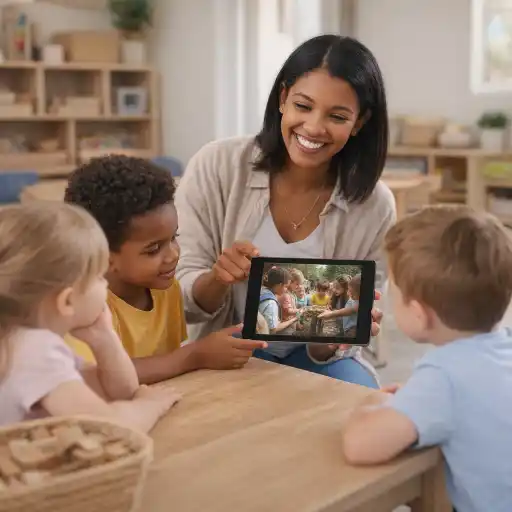
Keep the invitation low-pressure. A family can continue a conversation with one question at dinner or during a walk; no special supplies or extended activity are necessary. For example: “We looked closely at the shapes of leaves. If you notice a leaf outside, your child might enjoy showing you what they observed.” Families should be free to respond in the language and format that work for them—or not to respond at all.
Make space for family knowledge, too. Ask whether caregivers have noticed a related interest at home or know a story, word, or experience connected to the topic. Treat responses as expertise, not as material to extract. Head Start’s family engagement framework emphasizes culturally and linguistically responsive relationship-building, while NAEYC’s family-engagement resources foreground partnership. That means listening carefully and acting on what families share, when appropriate.
- Use clear language, explain why you are sharing the update, and avoid education jargon.
- Offer more than one communication channel when feasible.
- Invite a brief response or home connection, but keep it optional.
- Close the loop by telling children and families how their ideas informed what the class explored next.
State requirements vary - check your state licensing agency for rules related to family communication, documentation, consent, and confidentiality.
What common pitfalls should providers avoid?
One common pitfall is treating family attendance as the measure of engagement. Caregivers may be deeply interested in a child’s learning while being unable to attend an outing or respond to every update. Avoid language that implies blame, such as “Families who missed the trip,” when a neutral phrase like “For families who could not join us” better reflects respect and choice.
Another mistake is sending a long recap filled with adult-focused logistics but few details about children’s learning. A concise, specific story is often more useful than an exhaustive itinerary. Focus on the children’s questions, discoveries, and next steps. Avoid overstating what the group learned or presenting one child’s experience as representative of everyone.
Digital sharing also calls for care. Do not post identifiable photographs, names, or recordings without following program consent and privacy procedures. Never include confidential information or details about another child in a family’s update. If a caregiver raises a concern, move the conversation to an appropriate private channel rather than discussing it in a group message or public display.
Finally, avoid making home extensions feel like homework. A suggestion should be easy, free, and optional. A conversation starter or noticing prompt can be enough. Strong communication respects families’ time and circumstances while keeping the door open for connection.
How can directors and educators build a repeatable follow-up routine?
A dependable process makes it easier for staff to share meaningful learning consistently, even during busy weeks. Before a trip, decide who will collect notes or approved photographs and how children’s questions will be recorded. After returning, schedule a short reflection with children, then choose a manageable way to share the learning with families. A shared template can reduce staff workload without making messages feel impersonal.
For example, teams can use a simple sequence:
- Before the trip: identify the inquiry question and review consent and communication procedures.
- After the trip: invite children to recall observations, questions, and favorite moments.
- Document: select a few accurate artifacts, quotes, or images that show learning.
- Share: send or display a short, accessible recap with an optional conversation prompt.
- Reflect: notice what families or children add, and use that insight to plan follow-up experiences.
Directors can support this routine by clarifying approved communication channels, ensuring staff understand photo permissions, and providing examples of concise, strengths-based updates. Ask families whether the format is useful and accessible; adjust the approach when feedback or staff experience suggests a better option. Do not judge success by how many caregivers reply. A thoughtful, reliable update can build connection even when families are unable to respond.
To broaden your professional toolkit, explore these English-language ChildCareEd courses related to family partnership, communication, documentation, and field trip learning:
- Bridging Cultures: Family Communication & Collaboration Buy Now $55.00 — responsive communication and representing families who cannot be present.
- Family Voices Matter: Tools for Meaningful Collaboration Buy Now $55.00 — practical approaches to reciprocal family partnership.
- Open Ears: Listening in Child Care Buy Now $16.00 — active, empathetic listening across communication differences.
- Privacy Matters: Documentation and Observation in Early Learning Buy Now $55.00 — objective records and confidentiality practices.
- Enriching Education: Field Trips Buy Now $16.00 — planning outings that connect to curriculum and children’s development.
Conclusion: How can you keep the field trip learning going?
Families do not need to attend a field trip to be part of what children learned there. Share a short, specific account of children’s discoveries; include their voices, sketches, or other appropriate documentation; and offer an accessible, optional way to continue the conversation. These practices make learning visible, support children’s reflection, and create room for caregivers’ knowledge and perspectives.
Keep privacy, consent, language access, and family preferences at the center of your process. Above all, treat communication as an invitation rather than an obligation. When educators share the experience thoughtfully and listen to what families bring in return, the field trip can become a starting point for ongoing partnership and inquiry.
- Transportation and Field Trip Safety
- 45 Hour Preschool Methods and Materials
- CDA Bridge Bundle: Family Child Care without Portfolio Review
- Transportation and Field Trip Safety in the Early Childhood Environment
- CDA Bridge Bundle: Infant/Toddler without Portfolio Review
- CDA Bridge Bundle: Preschool without Portfolio Review
- Texas Director Credential
- Enriching Education: Field Trips
- CDA Certification en Español: Recursos y Consejos para Educadores Bilingües
- 🚌 What Do Illinois Transportation Regulations Mean for Childcare Field Trips? 🚦
- Texas Required Child Care Forms: Enrollment, Emergency Cards, and Permission Slips
- Fun Field Trip Ideas for Preschoolers, Elementary Kids, and Summer Camps
- Nevada Child Care Transportation Rules: Field Trip Forms, Car Seats, Supervision
- Proporciones de Cuidado Infantil y Tamaños de Grupo por Edad en Virginia (Guía Rápida para Centros y Hogares)
- Las Mejores Ideas de Excursiones para Guarderías en Dakota del Norte
- Best Daycare Field Trip Ideas in Georgia
- Las Mejores Ideas de Excursiones para Guarderías en Texas
- Las Mejores Ideas de Excursiones para Guarderías en Georgia
- Best Daycare Field Trip Ideas in Maryland
- How can childcare teams lead safe, fun nature walks in Georgia parks and gardens?
- Celebrando la amistad en el cuidado infantil durante el Día de los Mejores Amigos
- How to Create a Daycare Field Trip Permission Slip
- How can Michigan providers teach community and citizenship for the 250th anniversary?
- Field Trips for Elementary Students: 15 Adventures That Bring Learning to Life
- How Can You Choose a Field Trip That Extends What Children Are Already Investigating?
