When several children become ill at once, a clear response plan can protect everyone without turning the classroom into chaos. Strengthen your day-to-day infection-control practices with ChildCareEd’s Prevention and Control of Infectious Diseases  Buy Now $16.00, a focused two-hour online course that can build practical knowledge and may help you meet relevant training needs. Keep reading for a workable approach to supervising sick children while maintaining a safe, predictable classroom for the rest of the group.
Why does a coordinated response matter when several children are sick?
Multiple illnesses at once can stretch staffing, interrupt routines, and make even experienced educators feel pulled in every direction. A calm, consistent plan helps you respond to each child’s needs while preserving the supervision and care owed to the entire group. It also gives families timely, factual information and helps directors identify whether symptoms may be part of a larger cluster.
The goal is not to diagnose children or promise that no infection will spread. It is to make sound decisions based on observable symptoms, the child’s comfort and ability to participate, the level of care staff can safely provide, and current program policy.
Preparation matters because illness rarely arrives at a convenient time. When staff know who supervises a child waiting for pickup, who contacts families, and how the group stays covered, a challenging moment becomes more manageable. A predictable response supports children’s dignity, staff confidence, and classroom continuity.
How should staff assess and prioritize children’s needs?
Begin by quickly identifying whether any child needs emergency care. Follow your emergency procedures and call emergency services for severe breathing difficulty, unresponsiveness, seizure, or other urgent danger. For a child who appears ill but does not need immediate medical help, use the program’s illness policy and assess symptoms without attempting to diagnose.
Consider whether the child can participate comfortably, whether they need more individual care than staff can provide without compromising the group, and whether symptoms may pose a risk of spreading illness. A child meeting exclusion criteria should be moved away from close contact with peers, monitored, and continuously supervised by a familiar adult while an authorized adult is contacted. Do not leave an ill child alone or use separation as punishment.
When multiple children are affected, prioritize by urgency and follow a consistent sequence. One staff member can remain with the sick child or children, if staffing and ratios permit, while another notifies the director and contacts families. The director should arrange appropriate coverage before a staff member leaves the room. Maintain active supervision and required ratios throughout the response; state requirements vary - check your state licensing agency.
- Respond first to urgent symptoms and follow emergency protocols.
- Use the same written exclusion criteria for every child.
- Record observable symptoms and times, not assumptions about a diagnosis.
How can you supervise ill children without losing sight of the class?
Make a plan before illness occurs. Designate a comfortable area where a child can rest away from close group activity but remain within the sight and sound of an adult. The CDC recommends planning a supervised area for people who become ill in early care settings. Keep tissues, a lined waste container, gloves for situations involving body fluids, and a communication method nearby, while storing all supplies safely.
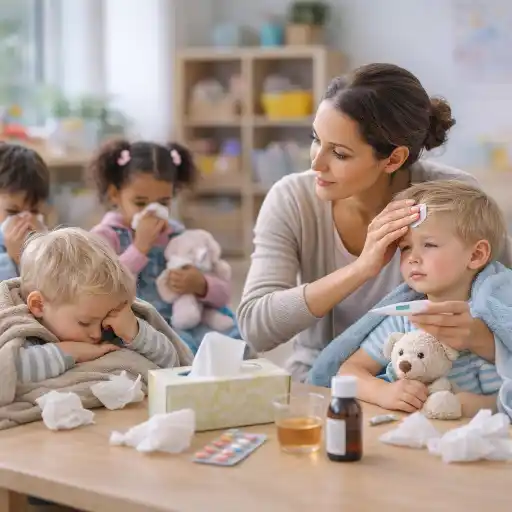
For more than one sick child, avoid placing children together simply because they are ill. Their symptoms or likely exposures may differ, and grouping them could create additional transmission risks. Follow public-health direction and program procedures for separation. If one adult cannot safely supervise the ill children and the classroom, call on a designated staff member, administrator, or approved backup rather than stretching supervision beyond safe limits.
For the rest of the class, use a familiar, low-transition activity that children can manage with the available staffing—such as a read-aloud, songs, drawing, or a well-known play invitation. Keep the activity engaging but simple, with clear boundaries and materials already prepared. Continue scanning and counting children, and ensure no classroom or outdoor area is left unsupervised during transitions.
- 🧸 Offer a quiet, familiar activity while keeping children within active supervision.
- Use a staff handoff so responsibility for the classroom and each ill child is explicit.
- Pause activities that require close individual assistance or extra movement if staffing is reduced.
What infection-control steps help limit further spread?
Use layered prevention rather than relying on one cleanup. Wash hands with soap and water for at least 20 seconds at relevant moments, including after helping a child with tissues or body fluids and before handling food. Help children wash hands as needed and teach cough and sneeze etiquette without shaming anyone. The CDC’s infection-prevention guidance for early care programs also emphasizes cleaning and disinfecting when someone is sick, separating personal belongings, and maintaining appropriate ventilation.
Clean visibly soiled surfaces first, then sanitize or disinfect as required for the surface and situation. Follow product labels for dilution, contact time, ventilation, and protective equipment; keep chemicals inaccessible to children. Remove mouthed toys and items contaminated by secretions from use until they can be cleaned appropriately. Use standard precautions when exposure to blood or body fluids is possible.
Avoid disrupting the whole classroom with unnecessary room changes or blanket restrictions. Maintain familiar routines where feasible, but temporarily adjust shared materials or activities that could increase exposure. If several people develop similar symptoms, document the pattern and consult the local health department or licensing agency when required or when guidance is needed.
How should you communicate with families and document the response?
Contact each child’s family promptly when symptoms meet the program’s exclusion criteria. Share what staff observed, when it began, what support was provided, and the pickup plan. Keep the conversation private and factual: “We observed two episodes of vomiting at about 10:15 a.m. and Sam is resting with a staff member. Please arrange pickup as soon as possible.” Avoid speculation, labels, or comparisons with other children.
When multiple children have similar symptoms, inform families about the general situation and the protective steps being taken, while protecting each child’s confidentiality. Explain what symptoms families should monitor and where they can direct health questions. Disease-specific instructions and return-to-care criteria can vary; use current health-department guidance and your written policy rather than improvising a single rule for every illness.
Document essential details soon after the event. Record the child’s symptoms and times, any temperature and measurement method if taken, care and supervision provided, family contacts and their outcomes, pickup time, and any follow-up or public-health notification. For a cluster, use records to help identify dates, classrooms, and symptom patterns. Accurate documentation supports continuity and helps leaders assess whether additional action is needed.
- Use a shared contact list with authorized pickup information and backup numbers.
- Give staff a brief, consistent script for explaining exclusion decisions.
- Keep illness records secure and share information only with people who need it.
What common mistakes can make a difficult day worse?
One common pitfall is allowing one adult to supervise several ill children and the full classroom without adequate support. Another is moving children repeatedly through shared spaces, which can increase exposure and make supervision harder. A third is making different exclusion decisions for similar symptoms because staff are relying on memory rather than a clear, written policy.
Directors can reduce these risks by practicing staff roles in advance. Identify who leads the classroom, who stays with an ill child, who contacts families, and who arranges coverage. Confirm that the designated rest area is usable and supervised, contact details are current, and cleaning supplies and protective equipment are accessible. Training such as ChildCareEd’s How To Keep A Healthy Class: Six Tips for Germ Control Buy Now $35.00 can further support staff in building consistent hygiene and illness-response routines.
Do not assume that a cluster automatically means the program should close, or that every mild symptom requires a child to go home. Follow the program’s policies, licensing rules, and public-health direction. After the immediate event, debrief briefly: What worked, where did staffing feel strained, and what one change would make the next response smoother?
Conclusion: How can you protect children and keep the classroom steady?
Handling multiple sick children without disrupting the entire classroom depends on preparation, clear roles, active supervision, and calm communication. Assess urgency first, apply consistent exclusion criteria, arrange prompt family pickup when needed, and keep each ill child supervised by a familiar adult. At the same time, maintain ratios, simplify activities for the rest of the group, and use appropriate hand hygiene, cleaning, and disinfection.
Keep policies and contact information current, document facts rather than diagnoses, and seek public-health guidance when similar illnesses cluster or requirements are unclear. A prepared team cannot prevent every illness, but it can respond with care and consistency. Strong #supervision, #communication, #hygiene, #documentation, and #prevention help protect children and preserve the steady, supportive environment they need.
Additional ChildCareEd learning options include Illness, Medication, and Allergies in Child Care Buy Now $32.00, Shoo, Germs! Don’t Bother Me! Buy Now $24.00, How To Keep A Healthy Class: Six Tips for Germ Control Buy Now $35.00, and Health and Safety Orientation Buy Now $55.00$45.00. Review each course’s details and confirm whether it meets your program’s or state’s specific training requirements.
- 45 Hour Child Growth and Development
- Pediatric Blended First Aid & CPR/AED Adult, Child, Infant
- CDA Bridge Bundle: Preschool
- Pediatric RSV First Aid & CPR/AED
- CDA Bridge Bundle: Family Child Care
- CDA Bridge Bundle: Family Child Care without Portfolio Review
- CDA Bridge Bundle: Infant/Toddler
- Texas Director Credential Renewal
- Texas Director Credential
- CDA Certification en Español: Recursos y Consejos para Educadores Bilingües
- 💛🧩 ¿Cómo puedo hacer que mi enseñanza sea inclusiva para los niños con autismo?
- 10 Ejemplos de Cómo la Cultura Influye en el Desarrollo Infantil
- Proporciones de Cuidado Infantil y Tamaños de Grupo por Edad en Maryland (Guía Rápida para Centros y Hogares)
- Proporciones de Cuidado Infantil y Tamaños de Grupo por Edad en Nueva Jersey (Guía Rápida para Centros y Hogares)
- Proporciones de Cuidado Infantil y Tamaños de Grupo por Edad en Virginia (Guía Rápida para Centros y Hogares)
- ¿Cuál es la Diferencia Entre la Crianza Respetuosa y la Crianza Permisiva?
- Retraso del Habla en la Guardería: Cómo Pueden Ayudar los Proveedores
- Cómo Trabajar en el Cuidado Infantil en Carolina del Norte: Requisitos y Pasos
- Celebrando la amistad en el cuidado infantil durante el Día de los Mejores Amigos
- Diversión fresca de verano: actividades del Día Nacional del Helado para niños
- Canciones, juegos y preguntas de círculo para niños
- Cómo simplificar la capacitación para sus empleados de daycare
- How can group child care programs effectively prevent the spread of illness?
- Time-In or Time-Out? 7 Real Classroom Scenarios and What to Try
- How Often Should Preschool Teachers Change Classroom Activities?
- When Does Classroom Clutter Become a Safety Issue?
- How Can You Plan a Food-Learning Activity for Children with Different Dietary Needs?
- How Can You Handle Multiple Sick Children Without Disrupting Your Entire Classroom?
