A block tower that topples or a puddle that changes after a cold night can launch powerful learning when children have time to wonder, test, and try again. Explore Creating Engaging and Meaningful Learning Experiences  Buy Now $55.00 for practical approaches to purposeful, child-centered activities, and Planning for Every Child: Responsive Strategies in Action Buy Now $55.00 for strategies that make investigations accessible to different learners. For ready-to-use conversation prompts and reflection tools, see the Pre-K Conversation & Thinking Toolkit Buy Now $0.00—then try these eight adaptable ideas in your Michigan classroom.
Why make room for curiosity and problem-solving?
Preschool critical thinking is not about expecting young children to master abstract concepts. It means helping them notice, ask questions, make a prediction, test an idea, and describe what they discovered. Hands-on inquiry gives children an authentic reason to use language, compare results, collaborate, and persist when a first attempt does not work. NAEYC describes inquiry-based STEAM as a way to support vocabulary, communication, reflection, problem-solving, and critical thinking (Breaking Down STEAM).
These experiences also give teachers useful insight into children’s interests and strategies. Rather than focusing only on a finished product or a correct guess, observe how a child approaches a challenge. Offer enough support for safety and participation, while preserving children’s agency and room to revise their thinking.
Which building challenges invite children to design and revise?
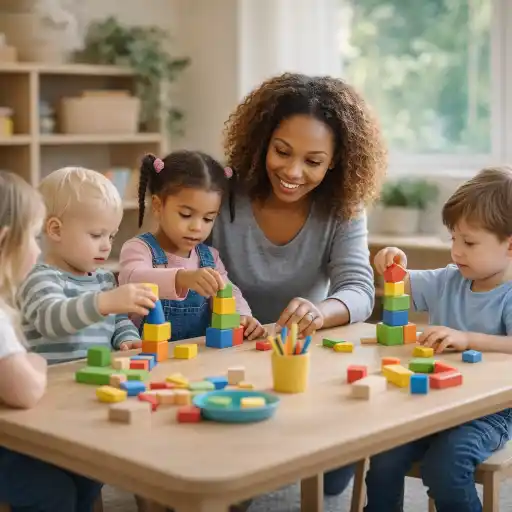
1. Build a tower that stands. Set out blocks, cups, or cardboard tubes and invite children to build the tallest tower they can. Ask, “What could help it stay up?” and “What changed when you moved that block?” Let children test different bases and notice balance.
2. Make a bridge for a toy. Provide blocks or sturdy recycled materials and two stable supports. Challenge children to connect them so a toy vehicle can cross. Add a gentle test—such as rolling a car across—and ask, “How could we make the bridge stronger?” Encourage redesign, not a single model to copy. Building and tinkering naturally involve planning, testing, and improving ideas (Small Hands, Big Ideas).
3. Create a shelter for an animal figure. Offer fabric, blocks, and large loose parts. Ask children what the animal might need and how they can keep the shelter standing. They may work alone or negotiate a shared plan. Choose age-appropriate materials and supervise closely.
How can simple science experiments turn questions into evidence?
4. Sink-or-float investigation. Fill a shallow container with water and offer a small selection of safe, appropriately sized objects. Before each test, invite a prediction: “What do you think will happen? What makes you think that?” Sort results together. Avoid the oversimplification that all heavy things sink; instead, help children compare material, shape, and size. Maintain active supervision throughout water play.
5. Color mixing with droppers. Provide clear cups of colored water and droppers. Ask children to predict what two colors might make, then mix and describe the result. Invite them to test a different combination or create a color for a pretend purpose, such as a lake for a class mural.
6. Ice-melting inquiry. Place ice cubes in trays in different classroom locations, such as a cool shaded spot and a warm area away from hazards. Ask, “Which ice might melt first? How could we check?” Revisit the cubes after a set time and describe the change. Children can draw what they notice. Keep materials clean, and do not allow ice or experiment supplies to become choking or ingestion hazards.
What other activities strengthen observation and flexible thinking?
7. Ramp and roll tests. Use a short, stable ramp and several large rolling objects. Invite children to compare what travels farther or faster, changing one feature at a time where practical. Ask, “What do you notice?” and “What might happen if we raise the ramp?” Children can mark stopping points with blocks and compare distances.
8. Michigan nature detectives. Take a supervised walk around the playground or observe nature from a safe classroom window. Look for leaves, seedpods, tracks, clouds, or seasonal changes. Children can sort observations by color, shape, or texture, draw a detail, and return later to see what has changed. Keep collections respectful of the site and avoid unknown plants, mushrooms, or small items that could be unsafe.
Across all eight activities, open-ended prompts invite children to explain and extend their thinking:
- “What do you notice?”
- “What do you think will happen next—and why?”
- “What else could you try?”
- “How could we find out?”
- “What changed after you tested it?”
- “Can you show or tell me how you decided?”
How can teachers make investigations inclusive and manageable?
Plan with children’s interests, communication styles, abilities, and experiences in mind. Make materials reachable, offer visual choices or adapted tools, and accept responses through speech, gestures, drawing, demonstration, or a home language. A child can participate by observing first, choosing an object, documenting results, or working with a peer. Responsive planning supports equitable access without requiring every child to participate in the same way.
Keep the setup focused: a clear question, a few materials, time to explore, and a brief way to revisit results. Use a photo, a child’s exact words, or a simple drawing to document thinking. If a child becomes stuck, pause before stepping in; then offer one useful prompt or hint rather than completing the challenge. State requirements vary - check your state licensing agency for applicable supervision, materials, and safety expectations.
🧰 Quick planning check: identify the question, inspect materials, consider access and supervision, and decide what observation will help you plan the next invitation.
How can directors and teams sustain inquiry over time?
Directors can make curiosity a shared teaching practice by inviting staff to plan one small investigation each week, share children’s observations, and reflect together. Ask: Which children engaged? What strategies did they use? What question could deepen the exploration? Brief reflection turns documentation into purposeful next steps rather than paperwork for its own sake.
Look for learning in the process: children making predictions, comparing outcomes, trying a new strategy, explaining an idea, or listening to a peer. Avoid rushing to answer every question, treating an unexpected result as failure, or insisting on one correct product. When plans change because children develop a new interest, that can be a productive sign of responsive teaching.
Conclusion: How can eight activities nurture young thinkers?
Building challenges, simple experiments, ramp tests, and nature observations give Michigan preschoolers repeated opportunities to question, test, communicate, and revise. The most important ingredients are accessible materials, thoughtful open-ended questions, adequate time, and an adult who listens without taking over. Start with one activity, notice children’s thinking, and use what you learn to shape the next investigation.
For further professional learning, explore Creating Engaging and Meaningful Learning Experiences Buy Now $55.00, Planning for Every Child: Responsive Strategies in Action Buy Now $55.00, Basic Science in Early Childhood Buy Now $25.00, Project-Based Learning for Children Buy Now $16.00, and Lesson Planning for Preschoolers Buy Now $24.00. Course details can help you decide which training best fits your professional learning goals.
- CDA Preschool Credential with Portfolio Review
- What Makes Me Special: An Overview of Autism and ADHD
- CDA Bridge Bundle: Preschool
- Art from the Heart for Preschoolers: Open Ended Art Projects that Build Self-Esteem
- Building Equity: Inclusionary Practices in Preschool
- Creating Environments that Nurture Growth and Community
- Environments That Inspire Independence and Exploration
- Project-Based Learning for Children
- Montessori Cultural Activities: Exploring the World Through Play and Learning
- From Marshmallows to Mastery: Hands-On Learning for Early Childhood
- CDA Certification en Español: Recursos y Consejos para Educadores Bilingües
- A Path to Engaged Learning: Play!
- 🎉STEM-sational Fun: How Can You Spark Preschoolers’ Curiosity with Engaging STEM Activities? 🔬🧪🔢
- 👶 ¿Cuáles son las proporciones y grupos requeridos en Dakota del Norte? 🏫
- 10 Ejemplos de Cómo la Cultura Influye en el Desarrollo Infantil
- ¿Qué preguntas aparecen en el examen CDA para preescolar?
- Por Qué la Supervisión Activa Es Clave para la Seguridad en el Cuidado Infantil
- Celebrando la amistad en el cuidado infantil durante el Día de los Mejores Amigos
- How can I use simple STEM activities to spark curiosity in preschoolers?
- How Can Educators Teach Problem-Solving Without Always Solving the Problem?
- How Can Early Educators Help Children Build a Lifelong Love of Learning?
- STEM for Preschoolers: Fun Activities That Encourage Curiosity
- How Can Child Care Providers Nurture Critical Thinking in Young Children?
- How Can Child Care Providers Support Preschool Development?
- How Can Child Care Providers Support Healthy Child Growth and Development?
- What Makes a Preschool Curriculum Meaningful, Inclusive, and Effective?
- How Can Michigan Child Care Providers Make Preschool More Accessible to Every Family?
- How Can Eight Activities Build Problem-Solving, Curiosity, and Critical Thinking in Michigan Preschool Classrooms?
