Preschoolers can learn practical pedestrian habits without being asked to carry the worry of adult-sized risks. A calm, repeatable “Stop, Look, Listen, Walk” routine helps children participate while adults remain responsible for supervision and crossing decisions. Reinforce these skills with ChildCareEd’s Street-Safety Lesson and Home-Practice Note: Stop, Look, Listen, Walk Buy Now $1.95, a printable resource featuring simple safety cues and a take-home activity that encourages families to practice safe walking habits together. For deeper professional learning, explore Appropriate Precautions in Transportation of Children  Buy Now $10.00 for guidance on supervision and transportation precautions, and Building a Community of Families Buy Now $16.00 for strategies to strengthen family partnerships and reinforce safety routines at home.
Why teach road safety in a calm, reassuring way?
Young children are still developing attention, impulse control, and the ability to judge traffic. A safety lesson should therefore offer simple actions to practise with a trusted adult—not frightening stories or a message that children alone must prevent danger. A predictable sequence can make everyday walks feel more understandable and give children a positive role: pausing, noticing, listening, and walking alongside an adult.
Educators can make the adult’s responsibility explicit from the start. Preschoolers should cross streets with a supervising adult; recognizing a signal or reciting a routine does not mean a child is ready to cross independently. The adult selects the crossing point, checks traffic, maintains close supervision, and decides when it is safe to move. This clear division of responsibility reassures children and supports realistic learning.
Playful, repeated instruction is more useful than a one-time warning. The National Highway Traffic Safety Administration’s child pedestrian curriculum organizes learning into practical topics such as walking near traffic, crossing streets, and parking-lot safety. For preschool, keep activities briefer and simpler, and focus on a small number of familiar cues.
- Use calm, concrete language: “We stop together. I check, and then we walk together.”
- Notice children’s questions and feelings without adding dramatic details.
- Celebrate participation, not independent decision-making.
How can educators teach “Stop, Look, Listen, Walk”?
Introduce each word with a demonstration. Use floor tape, a painted line, sidewalk chalk, or a pretend street in a protected play area. Keep practice away from active traffic unless it is a carefully planned, closely supervised real-world routine. The aim is to build familiarity through imitation, not to test children’s judgment.
- Stop: Pause with the adult at the curb or chosen crossing point.
- Look: Look together in every direction. The adult checks traffic and chooses when to cross.
- Listen: Notice traffic sounds while continuing to look. Listening supports attention; it does not replace looking.
- Walk: Hold the adult’s hand and walk together, continuing to pay attention.
Use a short chant, picture sequence, or puppet demonstration to make the steps memorable. A simple prompt from the educator—“What do we do first?”—can invite children to recall the routine, while the adult narrates the safety decision. Avoid suggesting that a green signal alone guarantees a safe crossing. Crosswalks, signs, and signals are useful cues, but children still need an adult to supervise and make decisions.
Adapt the routine to each child’s communication and access needs. Children can point to pictures, use signs or words, move a toy figure, or observe before joining in. Visual supports and extra time can help the routine feel predictable and inclusive.
What practice builds confidence without creating fear?
Play-based rehearsal gives children a chance to explore the sequence in a low-pressure environment. Set up a pretend crossing with tape and invite children to take turns being pedestrians or observers. Use large, age-appropriate props, and keep “traffic” slow and clearly pretend. A picture book or neighborhood photo can help children identify sidewalks, curbs, crosswalks, and traffic signals without turning the discussion into a frightening scenario.
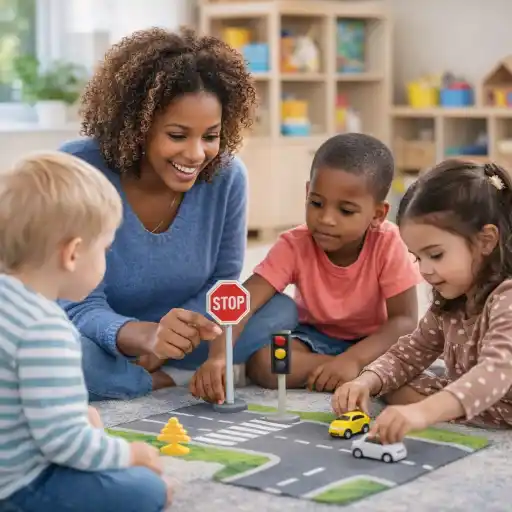
- Practise pausing at a pretend curb and waiting for the adult’s cue.
- Use puppets to model a safe choice, then invite children to suggest the next action.
- Draw a simple route map and let children point out places where a grown-up stops.
- On a supervised walk, narrate adult decisions: “We’re stopping here. I’m checking, and we’ll cross together when it’s safe.”
- Offer different ways to participate, including watching, pointing, speaking, signing, or demonstrating with a toy.
Follow children’s emotional cues. If a child seems worried, acknowledge the feeling and return to reassuring information: “You’re with me. I will stay close and decide when we cross.” Avoid crash stories, startling sounds, or dramatic role-play. Children learn more effectively when practice is calm and repeatable than when they feel alarmed.
Make the activity accessible by considering mobility, sensory preferences, language, and developmental differences. Previewing photos, choosing a quieter practice time, or using a visual sequence can support participation. A welcoming #classroom approach allows children to practise at their own pace while adults keep safety firmly in their hands.
How can families reinforce the same routine at home?
Children benefit when the same short words and expectations appear at home and in the program. Invite families to practise during ordinary, adult-supervised walks—such as approaching a driveway, sidewalk crossing, or parked car. No special outing is needed. Families can narrate each step while holding the child’s hand and making all route and crossing decisions.
A short home-practice note can keep the message clear and collaborative. Include the classroom phrase, a brief explanation of the adult’s role, and an invitation for caregivers to share the language or visual cues their child responds to. The ChildCareEd Street-Safety Lesson and Home-Practice Note: Stop, Look, Listen, Walk Buy Now $1.95 is a related resource educators can use as a starting point for connecting classroom instruction with family practice.
- Stop together at a safe crossing point and stay close.
- Look in every direction; the adult decides when it is safe.
- Listen for traffic while continuing to watch the surroundings.
- Hold hands and walk together across the crossing.
- Use specific, warm praise: “We waited together, and then we walked together.”
Keep communication respectful rather than prescriptive. Families know their routes, schedules, home languages, and children’s preferences. Ask what practice opportunities are realistic, and share accessible ideas rather than implying that families must complete a formal assignment. This consistent #family partnership supports familiarity while reinforcing that adults remain responsible for safety.
How can programs keep instruction consistent and age-appropriate?
Directors can support effective instruction by making the routine part of the program’s ongoing safety and curriculum planning. Agree on common language across classrooms, clarify staff responsibilities for transitions and any walks, and review supervision plans before children go near traffic. Staff should follow program policies, maintain required staffing and group procedures, and choose appropriate routes and practice settings. A lesson never replaces active adult supervision.
Use observation to decide what to revisit. Notice whether children pause when prompted, recognize a crosswalk in a picture, or join an adult in looking and listening. These observations guide teaching; they are not evidence that a preschooler can safely cross alone. Praise effort and participation, and adjust pacing or materials when a child needs more support.
Common pitfalls to avoid:
- Replacing frightening warnings with clear, reassuring actions children can practise with an adult.
- Treating a traffic signal as a substitute for an adult’s traffic check.
- Practising at a live curb without close supervision and a planned, safe procedure.
- Using different instructions across staff and family communications without explaining the shared routine.
- Overlooking children who need visual, communication, mobility, or sensory adaptations.
For deeper professional learning, explore ChildCareEd’s English-language Transportation and Field Trip Safety Buy Now $25.00, Effective Supervision in Child Care Buy Now $25.00, and Viewing Guidance in a Positive Light Buy Now $24.00. These courses address related areas including transportation precautions, active supervision, and positive guidance. State requirements vary - check your state licensing agency.
Conclusion: What should educators remember about teaching road safety?
How can educators teach preschoolers road safety without creating fear? Use a calm, repeatable routine—Stop, Look, Listen, Walk—and practise it through protected play, pictures, and adult-supervised everyday moments. Children need clear actions and reassuring adults; they do not need frightening scenarios or responsibility for managing traffic alone.
- Model the steps, and make clear that adults choose when and where to cross.
- Practise in a safe setting, adapting materials and pacing for each child.
- Share a brief home-practice note so families can use familiar language on ordinary walks.
- Keep active supervision, accessibility, and two-way family communication at the center of the plan.
When educators and families reinforce the same cues, children can build useful awareness in a supportive atmosphere. The goal is practical learning guided by trusted adults—not fear or independence before a child is ready.
- 18-Hour Train the Trainer
- CDA Home Visitor Subject Area 3 Part 3 Birth to 5
- Birth to Five CDA Credential with Portfolio Review
- CDA Bridge Bundle: Family Child Care without Portfolio Review
- CDA Bridge Bundle: Infant/Toddler without Portfolio Review
- CDA Bridge Bundle: Preschool without Portfolio Review
- Emergent Learning & Development
- Creating Environments that Nurture Growth and Community
- Texas Director Credential
- Health and Nutrition
- CDA Certification en Español: Recursos y Consejos para Educadores Bilingües
- ¿Qué Calificaciones Necesitas para Trabajar en Cuidado Infantil?
- Normas de Licenciamiento de Cuidado Infantil en Virginia para Centros Diurnos Infantiles y Hogares Diurnos Familiares
- Proporciones de Cuidado Infantil y Tamaños de Grupo por Edad en Maryland (Guía Rápida para Centros y Hogares)
- Proporciones de Cuidado Infantil y Tamaños de Grupo por Edad en Nueva Jersey (Guía Rápida para Centros y Hogares)
- Proporciones de Cuidado Infantil y Tamaños de Grupo por Edad en Virginia (Guía Rápida para Centros y Hogares)
- ¿Cuál es la Diferencia Entre la Crianza Respetuosa y la Crianza Permisiva?
- Actividades de Otoño Fáciles para Preescolares esta Temporada
- Cómo Trabajar en el Cuidado Infantil en Carolina del Norte: Requisitos y Pasos
- Cómo Ser Maestra de Preescolar en Illinois
- Cómo Ser Maestra de Preescolar en California
- Cómo Ser Maestra de Preescolar en Maryland
- Cómo Ser Maestra de Preescolar en Virginia
- Celebrando la amistad en el cuidado infantil durante el Día de los Mejores Amigos
- Canciones, juegos y preguntas de círculo para niños
- Cómo simplificar la capacitación para sus empleados de daycare
- How can we run fire and weather drills with young children safely and calmly?
- Why Are Coping Skills Important for Preschoolers?
- What Are the Best Ways to Support Children Who Struggle with Sharing?
- How Can Educators Teach Preschoolers Road Safety Without Creating Fear?
