Introduction
Trauma touches many young children. As a #caregivers team, you can make your #classroom a safe place where kids learn and grow. This article gives simple, practical steps you can use right away in your #earlychildhood program to build #resilience and calm.
Why it matters: Young brains change fast. Early support lowers later problems with learning, health, and behavior. See practical overviews and tools at ChildCareEd and guidance for early care providers from the CDC.
Note: state requirements vary - check your state licensing agency.
1) What is trauma-informed care and why does it matter in early childhood?
Trauma-informed care means noticing how hard events affect children and changing how we respond. It is not a diagnosis. It is a way of running your space so children feel safe, seen, and supported.
- Key ideas (short):
- Safety: predictable routines and calm spaces.
- Trust: steady adults who keep promises.
- Choice: give small choices so children feel control.
- Collaboration: work with families and specialists.
- Why it matters: Trauma affects attention, sleep, behavior, and health. Early support builds better outcomes for life. Read the research and resources in Georgetown’s module on trauma Module 1 and ChildCareEd’s posts on classroom practice here.
Using trauma-informed care helps all children, not only those with known trauma. A calm, predictable room supports learning, play, and friendship.
2) How can I change my classroom today to be trauma-informed?
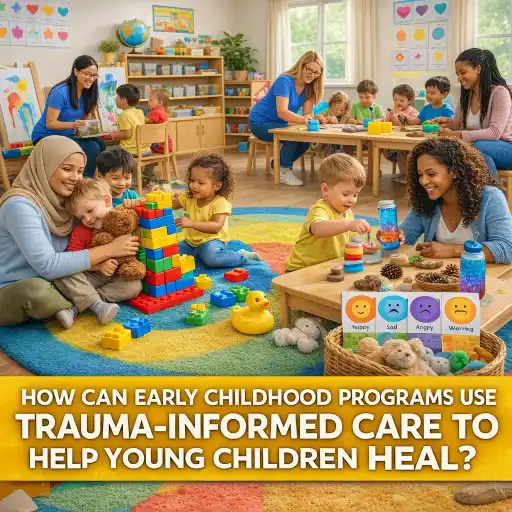
Small changes make a big difference. Use this easy 1-2-3 plan based on checklists and classroom resources from ChildCareEd’s checklist Buy Now $0.00 and free resources here.
- Create safety and routine:
- 🧭 Keep a visual schedule so kids know the day’s plan.
- 🔔 Give a 2-minute warning before transitions.
- 🛋️ Set a calm corner with soft items and quiet choices.
- Teach emotion skills:
- 🙂 Use simple feeling words and short role plays.
- 🫧 Practice 3 deep breaths together when upset (model it!).
- 🎨 Offer art or play to help kids tell their feelings.
- Set helpful responses to behavior:
- 📣 Describe what you see: “You look scared. I can sit with you.”
- ✅ Praise effort: “You kept trying — great choice!”
- 🚫 Avoid quick punishment; teach a better choice instead.
Want training? ChildCareEd’s course Trauma-Sensitive Care  Buy Now $16.00 gives practical activities and scripts you can use tomorrow.
3) How do we support staff and families so trauma-informed care lasts?
Programs change when staff and families share the work. Use a step-by-step team approach drawn from organizational resources like Georgetown’s Module 3 and local models such as CARE (Cornell CARE).
- Train and practice together:
- 🧑🏫 Give short, regular trainings (15–30 min) and practice calm responses.
- 📋 Use a checklist from ChildCareEd Buy Now $0.00 to track progress.
- Support staff wellness:
- 🌿 Build team time for reflection and quick calming breaks.
- 💬 Offer reflective consultation or peer support to reduce burn-out, as recommended by practice guides in NCTSN and local programs.
- Partner with families:
- 🤝 Listen to family stories before making plans.
- 📚 Share simple tools they can use at home (breathing games, routines).
- ⚠️ Remember: state requirements vary - check your state licensing agency when sharing records or screenings.
Organization-level change takes time. Use small wins: one routine, one calm corner, one family meeting. Repeat and build.
4) What common mistakes should we avoid and how will we know it’s working?
Common mistakes often come from good intentions. Here’s how to avoid them and measure progress.
- Common mistakes and fixes:
- ❌ Mistake: Punishing instead of teaching. ✅ Fix: Describe feelings and teach a replacement behavior.
- ❌ Mistake: One-time training with no follow-up. ✅ Fix: Short refreshers, coaching, and a checklist from ChildCareEd Buy Now $0.00.
- ❌ Mistake: Ignoring staff stress. ✅ Fix: Add scheduled reflection time and peer support (see Module 3).
- How to know it’s working (simple signs):
- 📈 Fewer big meltdowns and quicker recovery after upset.
- 🗣️ More children asking for help instead of acting out.
- 🤝 Stronger, calmer interactions between adults and children.
- 📅 Staff report greater confidence and less stress.
- Quick FAQ for common questions:
- Q: Do we need to diagnose children? A: No. Focus on supports, not labels.
- Q: When should we refer for help? A: If a child’s behavior or safety is a worry, consult your mental health partner or local child-serving agency. See resources at Module 5.
- Q: Is this just for special kids? A: No — these practices help every child.
Conclusion
Trauma-informed care is practical and kind. Start small: one visual schedule, one calming corner, one team check-in. Use the tools and trainings from ChildCareEd, review guidance from the Georgetown resources, and check public health tips at the CDC.
Remember: change grows slowly. Celebrate each step. Your steady care matters more than perfection.
- 45 Hour Child Growth and Development
- CDA Home Visitor Subject Area 3 Part 3 Birth to 5
- Pediatric RSV First Aid & CPR/AED
- CDA Bridge Bundle: Family Child Care without Portfolio Review
- CDA Bridge Bundle: Infant/Toddler without Portfolio Review
- CDA Bridge Bundle: Preschool without Portfolio Review
- Texas Director Credential
- 45 hour Growth and Development Birth-age 12 ONLINE
- Trauma-Sensitive Care: Supporting Young Children with Empathy
- Helping Your Child Navigate the Flashbacks and Triggers of PTSD
- Dance It Out: How Movement Therapy Helps Kids Heal Their Minds through Their Bodies
- Trauma-Sensitive Care: Supporting Young Children with Empathy
- Is Trauma the Same for All Children?
- Trauma-Informed Sleigh Rides: Supporting Children Through Play
- Why Trauma-Informed Care Should Be a Universal Approach in Early Childhood Settings
- Implementing Trauma-Informed Care in Early Childhood Education
- The Importance of Trauma-Informed Care in Early Childhood Classrooms
- Trauma-Informed Care: Because Every Tiny Human Deserves a Safe Place to Land
- CDA Certification en Español: Recursos y Consejos para Educadores Bilingües
- Abuse and Neglect Training: The Essential Guide for Childcare Providers
- Trauma-Informed Care in Childcare Settings
- How can early childhood programs use trauma-informed care to help young children heal?
- How can early childhood classrooms use trauma-informed care to help children heal?
- How Can New York Childcare Educators Support Children After Trauma?
- What Does Michigan's Overdose Decline Mean for Trauma-Informed Child Care?
- How Can Child Care Providers Put Trauma-Informed Practices Into Action?
