Every child communicates—even when spoken words are limited, developing, or expressed differently. With intentional routines, responsive interaction, visual supports, and strong partnerships, providers can help children participate and belong; Effective Approaches for Autism and Inclusion  Buy Now $55.00 offers practical professional learning on communication, sensory needs, and inclusive classroom adaptations. For a focused foundation in language growth and nonverbal communication, explore Language Development in Early Childhood Buy Now $16.00 to strengthen daily teaching practices and support professional development goals.
Why does including communication differences matter?
Communication differences may involve speech, language comprehension, gestures, eye gaze, sign language, behavior, or augmentative and alternative communication (AAC). A child may understand more than they can express, communicate inconsistently across settings, or use a combination of methods. Inclusion begins when adults recognize communication as a right and avoid equating spoken language with intelligence, readiness, or engagement.
Inclusive practice benefits the entire learning community. When children have reliable ways to request, refuse, comment, greet, and seek help, frustration can decrease and participation can increase. Peers also learn patience, reciprocity, and respect for different ways of expressing meaning. NAEYC describes inclusion through access, participation, and supports; these principles are especially useful when planning for children with communication differences.
- Presume competence and maintain meaningful expectations.
- Notice what the child communicates successfully, not only what is difficult.
- Design routines so communication opportunities occur throughout the day.
- Use the child’s interests as a bridge to interaction and learning.
How can educators understand a child’s communication profile?
Begin with observation rather than assumptions. Record how the child communicates across arrival, meals, play, transitions, outdoor activities, and rest. Note the child’s communication purpose, the method used, the communication partner, the context, and the response. A child who points to a cup, moves toward the door, vocalizes, or brings an adult an object is communicating intentionally, even without conventional speech.
Ask families what words, signs, gestures, pictures, devices, or routines are meaningful at home. Family knowledge can reveal pronunciation, cultural communication patterns, preferred interests, and successful calming strategies that may not appear during a brief classroom observation. Collaborate with speech-language pathologists and early intervention providers when families provide consent. NAEYC emphasizes that defining team roles, exchanging information with permission, using communication logs, and reviewing data can make support more consistent.
Providers should not diagnose. Instead, they can document functional observations and follow referral procedures when concerns persist, skills are lost, or communication substantially limits participation. State requirements vary - check your state licensing agency.
Which classroom strategies make communication more accessible?
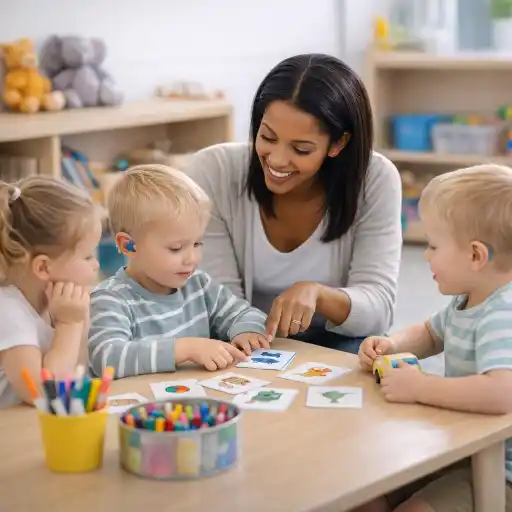
Communication supports should be available during ordinary routines, not reserved for therapy sessions. Pair spoken language with gestures, objects, photographs, symbols, or written words. Use short phrases, emphasize key words, and allow sufficient processing time before repeating or rephrasing. A pause communicates respect and gives the child space to respond.
- Post a visual schedule and refer to it before transitions.
- Offer two or three choices with objects, pictures, or a choice board.
- Use “first/then” language to clarify sequence and expectations.
- Model the child’s communication system while speaking naturally.
- Repeat and expand the child’s message without demanding imitation.
- Provide a quiet area when noise, movement, or crowding affects participation.
- Embed communication in songs, sensory play, books, meals, and outdoor routines.
Follow the child’s lead during play. Comment on what the child is doing, imitate actions, and create opportunities for turn-taking. The Hanen Centre recommends genuine back-and-forth interaction, small groups, expectant pauses, and language that builds on children’s interests (language-rich early childhood settings).
How should providers use AAC and other communication tools?
AAC includes no-tech methods such as gestures and signs, low-tech tools such as picture boards and communication books, and high-tech speech-generating devices or applications. AAC may supplement speech or serve as a primary communication method. It is not a reward, a last resort, or evidence that a child will never speak. ASHA states that there are no prerequisites for considering AAC in early intervention and that early AAC can support language development (AAC in early intervention).
Access is essential. Keep the child’s communication system available during play, meals, outdoor activities, and peer interactions. Adults should model its use without requiring the child to perform before receiving a desired item or response. Begin with functional vocabulary such as “more,” “help,” “stop,” “go,” “all done,” names, favorite activities, and emotional expressions. Coordinate vocabulary and positioning with the family and qualified professionals.
✅ Review whether every adult knows how to locate, protect, and model the child’s communication tools.
How can providers build partnerships and avoid common mistakes?
Families are partners, not merely recipients of progress reports. Ask what communication looks like at home, which messages are most important, and what the child enjoys. Share specific strengths and observations rather than labels. With consent, coordinate classroom strategies with therapists and early intervention teams so the child experiences consistent support across environments.
Common mistakes are usually understandable responses to busy classrooms, but they can be corrected:
- Waiting for speech before responding: respond to gestures, gaze, signs, pictures, devices, and behavior-based communication.
- Overprompting: use the least intrusive support first, then gradually increase assistance while preserving independence.
- Removing AAC during challenging moments: communication is most important when the child is distressed.
- Using vague documentation: record the exact message, context, support, and outcome.
- Isolating the child: embed supports into group routines and teach peers respectful interaction.
How can directors build a communication-inclusive program?
Program-wide inclusion requires more than one skilled teacher. Directors can establish an enrollment and accommodation process, provide staff training, schedule collaborative planning time, and ensure communication tools are funded, maintained, and accessible. A brief communication plan can identify the child’s methods, important vocabulary, preferred prompts, sensory considerations, safety needs, and team contacts.
Audit the environment from the child’s perspective. Are visual supports visible at the child’s eye level? Can the child reach the communication board? Are staff positioned to notice gestures and facial expressions? Do routines allow enough wait time? Are peers taught that communication can look and sound different?
Legal and ethical responsibilities also matter. The ADA protects equal participation and may require reasonable modifications or effective communication supports; the ChildCareEd ADA overview provides a starting point for reviewing program practices. Specific obligations and licensing procedures vary, so consult applicable guidance and state agencies.
- Train every staff member, including substitutes and floaters.
- Use strengths-based language in records and family conversations.
- Schedule periodic reviews of communication goals and accommodations.
- Measure participation, independence, and successful exchanges—not speech alone.
Conclusion: What does meaningful inclusion look like?
Including children with communication differences means recognizing and supporting many forms of communication. Effective programs observe carefully, presume competence, use visuals and AAC consistently, create responsive interactions, adapt routines, and partner with families and specialists. The goal is not to make every child communicate in the same way; it is to ensure every child can express needs, connect with others, participate in learning, and experience genuine belonging.
Start with one routine this week: add a visual choice board, extend wait time, model a child’s AAC system, or document one successful communication attempt. Small, consistent changes can transform access and relationships. Continue building your team’s knowledge through relevant training, and remember that inclusive communication is both a classroom practice and a program-wide commitment.
Which ChildCareEd courses can support this work?
- Effective Approaches for Autism and Inclusion Buy Now $55.00 — strategies for communication, sensory needs, adaptations, and family partnerships.
- Language Development in Early Childhood Buy Now $16.00 — practical approaches for verbal and nonverbal language growth.
- Recognize, Respond, Respect: Supporting Diverse Learners Buy Now $55.00 — observation, referral, communication, and individualized support.
- Special Needs: From Referral to Inclusion Buy Now $24.00 — referral, IEPs, ADA concepts, and classroom modifications.
- Coaching for Success: Inclusive Strategies to Support Children with Autism Buy Now
$55.00$45.00 — routines, scaffolding, coaching, and collaboration.
- Roots & Resilience: Understanding What Shapes a Child
- Reducing the Risk of Sudden Infant Death Syndrome
- CDA Infants/Toddlers: Importance of Consistent Care
- Family (or Parent) Conferencing: Developing Trust ONLINE
- Bridging Intent and Response: Communication
- Culture, Communication, and Collaboration in Assessment
- Texas Director Credential
- Every Moment Matters: Schedules and Transitions
- Families, Communities, and Classrooms: Working Together for Children
- Bridging Cultures: Family Communication & Collaboration
- CDA Certification en Español: Recursos y Consejos para Educadores Bilingües
- Curso de Comunicación de 9 Horas de Maryland
- 10 Ejemplos de Cómo la Cultura Influye en el Desarrollo Infantil
- Proporciones de Cuidado Infantil y Tamaños de Grupo por Edad en Maryland (Guía Rápida para Centros y Hogares)
- Proporciones de Cuidado Infantil y Tamaños de Grupo por Edad en Nueva Jersey (Guía Rápida para Centros y Hogares)
- Proporciones de Cuidado Infantil y Tamaños de Grupo por Edad en Virginia (Guía Rápida para Centros y Hogares)
- Lista para Guardería en Casa en Texas: Cómo Iniciar una Guardería en el Hogar
- What Massachusetts EEC Regulations Do Child Care Providers Need to Follow?
- What Cultural Differences Can Be Mistaken for Behavior Problems in Child Care?
- What Makes a Great Home Daycare? 10 Things Parents Notice First
- Can You Open a Daycare Just for Children With Special Needs? Licensing, Training, and Staffing Explained
- How Can Child Care Providers Support Individual Differences in Development?
- How Can Child Care Providers Create Sensory-Friendly Learning Spaces for All Children?
- How Can We Celebrate Every Family and Create a Classroom Where Everyone Is Represented?
- How Can Child Care Providers Include Children with Communication Differences?
- How Can Child Care Providers Support Children with Sensory Processing Differences?
- How Can Child Care Providers Calm an Overstimulated Child in a Busy Classroom?
- What Early Signs of Autism May Child Care Providers Notice?
- How Can “All About Me” Activities Build a Stronger Classroom Community?
- How Can Providers Explain Different Classroom Expectations to Families with Siblings?
