Play is one of the most meaningful ways young children explore, connect, and learn. Whether they are building a tower, inventing a story, or experimenting with paint, children use play to discover what they can do and make sense of the world around them. ChildCareEd’s Role of Play in Learning  Buy Now $16.00 course helps educators understand how play supports child development and the important place it holds in early childhood environments.
Through play, children practice skills across cognitive, language, social-emotional, physical, and creative development. Building with a friend can involve problem-solving, conversation, cooperation, and hand-eye coordination—all within the same experience.
Make play a foundation of your curriculum by providing time, space, and accessible materials that invite exploration. Offer age-appropriate blocks, clay, paints, books, puzzles, and other materials indoors and outdoors. Observe children’s interests, follow their ideas, and offer support that helps them explore further while keeping the play their own.
How does play support learning and development?
Play gives children opportunities to explore ideas, test predictions, make choices, and learn from the results. In block play, for example, children can compare height and balance, notice when a structure falls, and try a different design. Pretend play lets children represent familiar experiences, negotiate roles, and build stories. These experiences connect cognitive, language, social-emotional, and physical learning rather than isolating one skill at a time. The Connecticut Office of Early Childhood explains that adults can support play by creating engaging spaces, extending children’s ideas, asking questions, and offering new materials. Its guidance on play supports the value of responsive adult involvement.
Educators can observe what children are trying to do and respond without taking over. A brief question such as “What could make the bridge stronger?” encourages planning and reasoning while leaving the child in charge of the play. Adults can add a relevant material, model a safe way to use it, or introduce a new word when it fits the child’s activity. The goal is to extend exploration, not turn every play episode into a lesson with a predetermined answer. Learn more about how children learn through play and whole-child early childhood education.
How can educators support language, thinking, and social-emotional skills through play?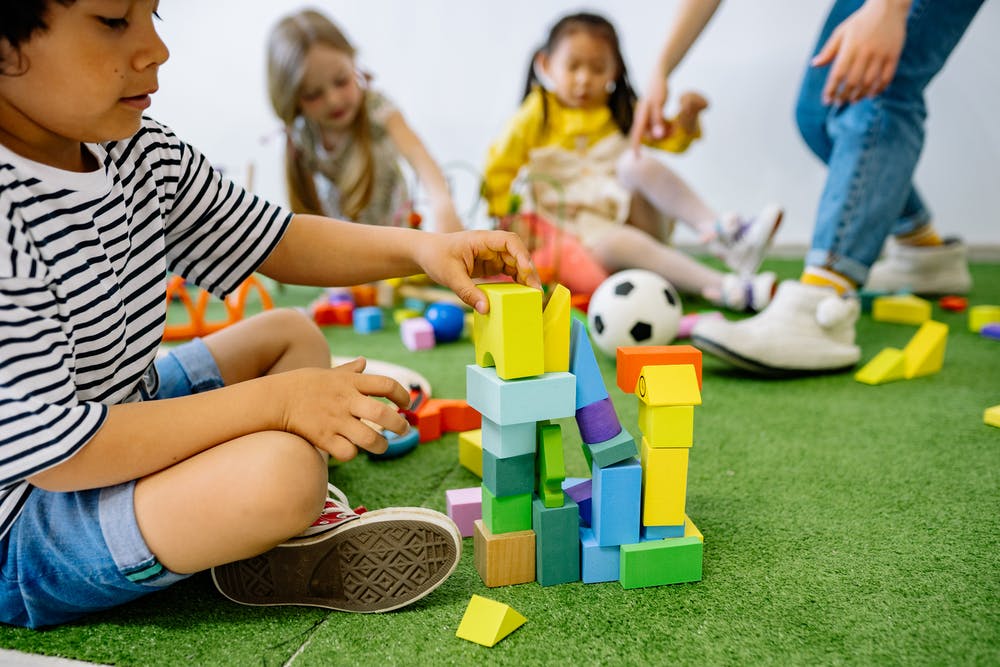
Play creates authentic reasons to communicate. During pretend play, children may assign roles, describe a plan, tell a story, and adapt their words when a peer does not understand. Symbolic play and storytelling can also strengthen representational skills; the University of Washington’s course text describes how play can provide a rich context for language growth. Read the University of Washington text on play and language development.
To support language, educators can follow children’s attention, describe what they notice, introduce precise vocabulary, and allow time for children to respond. For example, while children build with blocks, an educator might say, “You put the wide block underneath the narrow one,” then invite the children to explain their plan. In dramatic play, adding menus, notepads, or familiar household props can prompt conversation and early literacy without requiring a worksheet.
Play with peers also gives children practice expressing preferences, listening, sharing ideas, and working through disagreements. Educators can stay nearby, acknowledge feelings, and offer language children can use—such as “Can I have a turn when you’re finished?”—while allowing them to participate in resolving manageable conflicts. Social play develops over time and varies among children; provide options for solo, parallel, and cooperative engagement rather than expecting every child to play in the same way. For more ideas, see how parallel, associative, and cooperative play differ.
How can play build physical skills and invite outdoor exploration?
Active play can give children opportunities to develop balance, coordination, strength, and control through movements such as climbing, jumping, dancing, carrying, and manipulating materials. Fine-motor experiences—like molding clay, turning book pages, or fitting puzzle pieces—offer different challenges from large-body movement. Choose materials and spaces that are appropriate for children’s ages and abilities, supervise actively, and adapt activities so children with different mobility, sensory, or communication needs can participate.
Outdoor environments offer room to move and opportunities to notice natural features, but play does not need elaborate equipment. Children might follow a path, move objects between containers, observe leaves, or invent a movement game. Educators can plan for safe access, inspect play areas, and remain responsive to weather and children’s needs. Explore the role of outdoor play in healthy development and ways to foster motor skills through play.
How can child care programs plan inclusive, play-based experiences?
Start with observation: notice children’s interests, the materials they return to, and the skills they are practicing. Use those observations to offer a mix of open-ended materials—such as blocks, art supplies, books, puzzles, and loose parts—and enough time for children to develop an idea. Rotate materials thoughtfully rather than removing a popular activity before children have had time to explore it. Keep pathways accessible, offer materials at different levels of challenge, and consider whether children can communicate and participate in more than one way.
Play-based planning does not mean leaving children without support. Educators can prepare the environment, ensure safe supervision, join play when invited, and extend learning with a prompt or additional material. They can also document brief observations—what a child attempted, said, or changed—and use them to plan a next step. Share specific examples with families to make the learning visible, such as describing how a child tested balance while building or used new words during pretend play. For additional context, read how providers can show families the learning behind play.
What should educators remember about the benefits of play?
Play is a meaningful context for children to explore, communicate, move, imagine, and connect with others. Child care professionals can support it by offering accessible materials and time, observing children’s interests, and extending their ideas without controlling the experience. Balance opportunities for active, creative, solitary, and social play, and adapt the environment so each child can participate. Thoughtful play-based practice makes children’s learning visible while preserving the curiosity and agency that make play valuable.
Some of the benefits of play include:
- Builds executive function skills such as:
- Working memory
- Flexible thinking
- Self-control
- Allows children to practice the language skills they have learned and build on their expanding vocabulary.
- While engaged in play, children increase their ability to understand the thoughts and feelings of themselves and others, and to practice those skills through their interactions.
- During play, children are moving their bodies and working skills such as:
- muscle strength
- muscle control
- coordination
- reflexes
- balance
- dexterity
Want to learn more about the benefits of play and how to support children’s development through play? Visit ChildCareEd and register for one of our training courses.
- The Best Promotion is Play Buy Now $24.00
- Role of Play in Learning Buy Now $16.00
- Playing with a Purpose: Infant/Toddler Lesson Planning Buy Now $24.00
- Play, Learn, Grow Buy Now $16.00
"International Play Association (IPA World)". Ipaworld.Org, 2022, https://ipaworld.org/about-us/general-statement/. Accessed 11 Mar 2022.
- 45 Hour Child Growth and Development
- CDA Home Visitor Subject Area 3 Part 3 Birth to 5
- Bienvenido! Welcoming All Families
- The Best Promotion is Play
- Emergent Learning & Development
- Creating Engaging and Meaningful Learning Experiences
- Creating Environments that Nurture Growth and Community
- Texas Director Credential
- Montessori Cultural Activities: Exploring the World Through Play and Learning
- Frosty Fun: Trauma-Informed Play for Resilient Young Learners
- 10 Ejemplos de Cómo la Cultura Influye en el Desarrollo Infantil
- How can child care programs best support infant and toddler development?
- Celebrando la amistad en el cuidado infantil durante el Día de los Mejores Amigos
- Team-Building Games for Preschoolers That Teach Cooperation
- How Can Bingo Games Support Turn-Taking and Social Skills?
- How Can Child Care Providers Teach Empathy and Kindness in the Classroom?
- How Can Child Care Providers Support Healthy Child Growth and Development?
- Why Do Children Repeat the Same Play—and Why Should Educators Let Them?
- How Can Child Care Providers Teach Children to Join Play Without Grabbing or Interrupting?
- How Can Providers Respond When a Child Constantly Corrects Other Children’s Play?
- How Can You Welcome a New Child After the Class Has Already Bonded?
- How Can Providers Plan Meaningful After-School Choices for Seven- and Eight-Year-Olds?
- What Are the Best Ways to Support Cooperative Play in Preschool?
- How Can Screen-Free After-School Choices Engage Children Who Prefer Devices?
- How Can Pretend Voicemail Help Children Leave a Complete Message?
- Who Holds My Pretend Role While I Take a Bathroom Break?
- What Common Kindergarten Readiness Mistakes Should Preschool Teachers Avoid?
- How Can November Classroom Activities Help Preschoolers Build School Readiness Skills?
