Every child has ideas worth hearing, but some communicate through words while others rely on movement, drawings, play, gestures, home languages, or assistive tools. Child care providers can make those ideas visible by combining responsive listening, open-ended materials, thoughtful questions, and genuine opportunities for choice. For focused professional learning, explore Open Heart, Open Art  Buy Now $16.00 to strengthen process-based experiences that support self-expression and social-emotional development, and consider Language Development in Early Childhood Buy Now $16.00 for practical strategies that build verbal and nonverbal communication skills.
Why does children’s self-expression matter?
When educators invite children to share ideas and respond respectfully, they communicate a powerful message: “You are capable, your experiences matter, and your thinking can influence what happens here.” This message supports belonging, confidence, agency, and relationship-building. Head Start explains that back-and-forth conversations help children communicate feelings, explore concepts, learn vocabulary, and strengthen social-emotional development. Expression is therefore not an isolated language goal; it connects with #communication, cognition, creativity, and self-regulation.
Children also express themselves in multiple modes. An infant may turn toward a familiar voice, a toddler may point or repeat an action, and a preschooler may dictate a story, construct a structure, or act out a problem in dramatic play. The Virtual Lab School emphasizes that responsive adults observe how children communicate, collaborate with families, and adapt environments to children’s languages, interests, and developmental needs.
For directors, this perspective supports a classroom culture in which staff document children’s ideas and use them to shape curriculum. For teachers, it reduces the pressure to make every child answer verbally or produce a predetermined product. The goal is meaningful participation—not performance.
How can educators create environments that invite ideas?
The physical environment can either limit or expand children’s thinking. A room filled with single-purpose materials and adult-made samples may suggest that there is one correct response. By contrast, accessible, open-ended materials encourage children to combine, transform, test, and represent ideas in their own ways. NAEYC describes creativity as a combination of knowledge, skill, inspiration, and persistence; children need both rich experiences and time to develop those capacities.
Consider providing:
- Blocks, tubes, fabric, loose parts, recycled containers, and natural materials for construction.
- Blank paper, varied mark-making tools, paint, clay, collage materials, and safe scissors.
- Puppets, dramatic-play props, musical instruments, scarves, and space for movement.
- Books, photographs, family artifacts, labels, and writing tools throughout the room.
- Visual supports, picture choices, communication boards, and adaptive tools when needed.
🧩 Arrange materials where children can reach and choose them independently, while maintaining clear safety and cleanup routines. The UK early-years guidance on self-expression recommends observing before intervening and using descriptive language to enrich children’s exploration. A teacher might say, “You placed the smooth, shiny pieces next to the rough cardboard,” rather than taking over the design.
Use children’s work as documentation and conversation starters. Display drawings, dictated words, photographs of constructions, and short learning stories. Ask families what children are exploring at home so the classroom reflects children’s cultures, languages, and lived experiences.
Which questions help children explain and extend their thinking?
Questions are most effective when they emerge from children’s current interests and allow more than one reasonable answer. NAEYC’s discussion of adapted Bloom’s Taxonomy encourages educators to vary questions across remembering, understanding, applying, analyzing, evaluating, and creating. The purpose is not to make every interaction academically complicated; it is to match the question to the child and gradually extend thinking.
Useful prompts include:
- “What are you making?”
- “Tell me about your plan.”
- “What do you notice?”
- “What might happen if we change this?”
- “How are these two ideas alike or different?”
- “What could we try next?”
- “What else do you want me to know?”
After asking, pause. Children may need time to process language, retrieve vocabulary, organize an idea, and decide whether they feel safe sharing it. Follow their response rather than rapidly asking a new question. If a child says, “Tower fall,” an educator might respond, “Your tall tower fell. You were trying to make it stable. What could support the bottom?” This extends vocabulary and thinking without correcting or replacing the child’s idea.
Questions should not become an interrogation. Comment, listen, imitate, and share attention. Brightwheel and NAEYC both emphasize that open-ended questions work best when adults show genuine interest, observe nonverbal cues, and keep the conversation connected to children’s experiences.
How can providers include children who communicate in different ways?
Inclusive expression begins by rejecting the assumption that spoken English is the only evidence of thinking. Head Start notes that language develops in children’s home languages and that dual language learners benefit when educators welcome the languages they know. Encourage children to use home-language words, gestures, signs, drawings, objects, photographs, movement, or communication devices. Coordinate with families and specialists to understand each child’s preferred communication methods.
Practical supports include:
- Offer picture cards, visual schedules, choice boards, and first-then supports.
- Use gestures and simple signs alongside spoken language.
- Accept pointing, facial expressions, body movement, construction, and drawing as communication.
- Pair children with responsive peers during play and collaborative projects.
- Provide extra wait time and reduce pressure to speak in front of a group.
- Invite families to contribute songs, words, stories, and cultural materials.
For children with disabilities or suspected delays, individualized supports should align with the child’s IFSP or IEP when applicable. The educator’s role is to create access, notice strengths, document observations, and collaborate with families and qualified professionals—not to diagnose. A child who communicates through a device or gestures deserves the same authentic opportunities to initiate, choose, disagree, imagine, and influence the group.
Equity also means examining adult bias. Quiet children are not necessarily disengaged, and highly verbal children do not automatically have the most complex ideas. Use multiple ways to gather children’s perspectives: individual conversations, small groups, drawings, photographs, voting, learning stories, and observations.
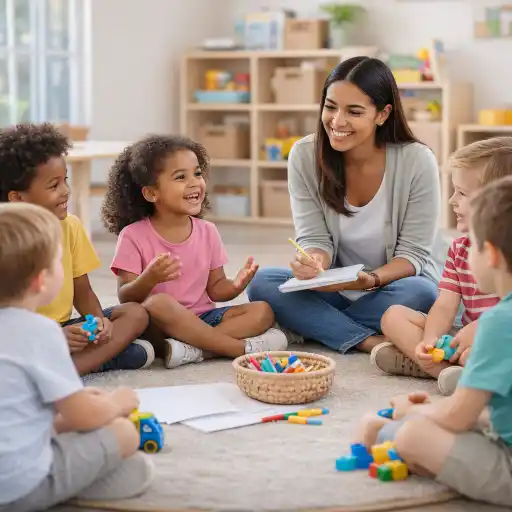
How can art, play, and writing make children’s ideas visible?
Art and play give children symbolic languages for experiences that may be difficult to explain directly. NAEYC distinguishes process-focused art from product-focused activities: process art offers choice, experimentation, and no predetermined final result. When educators avoid “fixing” children’s work or presenting a model to copy, children are more likely to persist, take risks, and describe their own intentions.
Try invitations such as:
- “Create something that can move in the wind.”
- “Make a place where a small animal could feel safe.”
- “Use lines, colors, or shapes to show a strong feeling.”
- “Build a bridge and decide who or what will cross it.”
- “Invent a character and tell us what the character needs.”
During play, observe first. A child’s block structure may be a home, a spaceship, or a hospital; ask before interpreting. In dramatic play, add props that invite narrative, such as clipboards, menus, maps, phones, fabric, and writing materials. In the writing area, value scribbles, letter-like forms, invented spelling, dictation, and drawings as meaningful attempts to communicate. NAEYC’s guidance on emergent writing explains that children can dictate stories, create lists, compose messages, and participate in group writing before conventional writing develops.
Document the child’s words beside the work: “I made a bridge because the animals needed to get across.” This preserves authorship and provides a foundation for later reflection. Display multiple versions of an idea, including revisions and unfinished work, so children see that thinking evolves.
How can directors and teachers turn listening into daily practice?
Intentional listening requires planning, not simply good intentions. Begin with an audit of routines: When do children make choices? Who speaks most during group time? Which forms of communication are recorded? Are children’s ideas actually used to shape the curriculum? Directors can support consistency by including these questions in coaching, observations, lesson planning, and team meetings.
A practical cycle is:
- Notice: Observe verbal and nonverbal communication without rushing to interpret.
- Record: Capture the child’s exact words, actions, drawing, construction, or choice.
- Reflect: Consider interests, skills, cultural context, language, and possible barriers.
- Respond: Add materials, vocabulary, questions, or adaptations that extend the idea.
- Revisit: Return to the idea with the child and invite revision, explanation, or continuation.
Avoid common mistakes such as asking questions only to elicit a predetermined answer, praising appearance instead of effort and meaning, interrupting wait time, correcting grammar in a way that ends conversation, or displaying identical crafts as evidence of learning. Also avoid treating children’s choices as unlimited; meaningful agency exists within clear boundaries for safety, respect, and shared responsibility.
Share documentation with families and invite their interpretations. Family perspectives can clarify a child’s home-language expression or explain why a topic matters. State requirements vary - check your state licensing agency when connecting professional learning, documentation, or curriculum practices to local expectations. Staff who want additional support may explore Open Ears: Listening in Child Care Buy Now $16.00, Building Bridges for Dual Language Learners Buy Now $25.00, and Creating Engaging and Meaningful Learning Experiences Buy Now $55.00.
Conclusion: What is the central goal of encouraging children’s ideas?
Encouraging children to express their ideas means creating conditions in which every child can initiate, choose, represent, explain, revise, and be taken seriously. The most effective practices are relational and intentional: listen before directing, offer open-ended materials, ask questions that invite genuine thought, provide multiple communication modes, honor home languages, and document children’s meaning rather than judging products.
When educators treat children as capable contributors, expression becomes part of the entire day—during arrival, meals, outdoor play, stories, art, problem-solving, and transitions. The result is more than increased talk. Children develop agency, vocabulary, creativity, confidence, collaboration, and a stronger sense of belonging. The question is not whether children have ideas; it is whether our environments and interactions make room for those ideas to be heard.
- From Play to Planning: Building Culturally Competent, Child-Centered Curriculum
- Open Ears: Listening in Child Care
- Creating Engaging and Meaningful Learning Experiences
- Risk Reduction: Infants and Toddlers in Family Child Care
- Texas Director Credential
- Wellness in Action: Teaching Healthy Habits to Children
- Bridging Cultures: Family Communication & Collaboration
- Bye Bye Winter: The Role of Outdoor Play in Early Childhood Development
- Tiny Tinkerers: How Messy Play Today Could Lead to Tomorrow’s Top Inventors
- Tiny Hands, Big Dreams: Fostering Creativity in Preschoolers
- National Grouch Day: Turning Grouches into Giggles, Teaching Kids about Handling Negative Emotions
- Nature’s Classroom: Why Fall Is the Best Season for Sensory Learning Outdoors
- Pumpkin Spice and Sensory Delight: Easy Autumn Sensory Bins for Early Learners
- Gift of Gratitude: Fostering Emotional Intelligence in Children through Acts of Kindness
- Counting Candy Canes: The STEM of Holiday Fun for Early Learners
- Frosty Fun: Trauma-Informed Play for Resilient Young Learners
- Party Hats and Emotional Regulation: Helping Little Ones Navigate Big New Year Feelings
- Mental Health for Tiny Elves: Supporting Kids Through Winter Blues
- CDA Certification en Español: Recursos y Consejos para Educadores Bilingües
- Celebrating Teachers
- Proporciones de Cuidado Infantil y Tamaños de Grupo por Edad en Nueva Jersey (Guía Rápida para Centros y Hogares)
- Proporciones de Cuidado Infantil y Tamaños de Grupo por Edad en Virginia (Guía Rápida para Centros y Hogares)
- Canciones, juegos y preguntas de círculo para niños
- How Can Child Care Providers Encourage Children to Express Their Ideas?
- How Can Child Care Providers Introduce Reptiles Through Art, Observation, and Conversation?
- How Can Educators Help Children Negotiate When Pretend-Play Rules Change Midgame?
