Children’s learning often unfolds in quick, layered moments that a paper checklist can miss. A thoughtful digital portfolio can help teachers capture that learning, reflect on what it means, and share it with families; Tracking Progress, Shaping Futures: Observation & Assessment Skills  Buy Now $55.00 offers practical support for objective observation and turning evidence into meaningful goals. For a focused next step on confidentiality, explore Privacy Matters: Documentation and Observation in Early Learning Buy Now $55.00, which addresses secure, ethical documentation practices.
Why are digital portfolios changing documentation practice?
Digital portfolios shift documentation from an occasional task of collecting work samples to a continuing process of noticing, interpreting, and responding to children’s learning. Teachers can bring together dated notes, children’s words, photographs, audio, video, and work samples in one organized record. This multimodal evidence may reveal learning that is difficult to represent in a brief written note: a child testing a theory through movement, negotiating roles in dramatic play, or revising a block structure after it falls.
The change is not simply a move from paper to a screen. In a thoughtful portfolio, documentation supports formative assessment: educators revisit evidence, notice patterns across time, and use those patterns to make decisions about materials, interactions, and next experiences. Research on digital documentation in early childhood settings points to opportunities for more accessible sharing and for recognizing varied ways children communicate and make meaning. At the same time, digital systems can privilege adult interpretations if children have little opportunity to see or contribute to their own records.
For providers and directors, the central question is therefore not how many entries the platform can store, but whether it helps make children’s thinking visible and informs responsive teaching. Strong portfolios honor each child’s #learning as a process, not just a sequence of milestones.
What makes portfolio evidence useful for teaching?
Useful documentation connects an observed moment with context, reflection, and a possible teaching response. A photograph alone may be appealing, but it rarely explains what a child was exploring or how their thinking changed. A concise caption can add the date, setting, child’s action or exact words, and a reflection about what the teacher may want to notice next.
For example, rather than recording “Sam is good at building,” a teacher might write: “During choice time on Tuesday, Sam placed three wide blocks across two towers, then added a smaller block when the bridge tipped. Sam said, ‘It needs a strong one here.’ I will offer varied materials and observe how Sam tests balance again.” The factual account is distinct from the teacher’s interpretation, and the next step remains open to revision.
- Collect varied evidence: brief observations, artwork, photographs, audio, and children’s explanations.
- Include both the product and the process, such as drafts, attempts, collaboration, and problem-solving.
- Use consistent dates and simple tags to make it easier to find patterns over time.
- Review entries together as a team and connect interpretations to curriculum and individual goals.
Digital tools make multimedia and search easier, but professional judgment remains essential. Avoid treating a tag or developmental label as proof by itself. The goal is to use evidence to plan an invitation, environment, or interaction that extends children’s #development.
How can digital portfolios strengthen family partnership and children’s voice?
Portfolios can make classroom experiences more accessible to families who cannot regularly visit the setting or review a physical binder. Families may respond to an entry, share a related experience from home, or help teachers understand a child’s interests, home language, and cultural context. A comparative study of paper portfolios and online ePortfolios reported that families found online portfolios more accessible for contributing to and sharing children’s assessment documentation. Access alone, however, does not guarantee meaningful partnership; the invitation to participate should be clear, respectful, and available in accessible language.
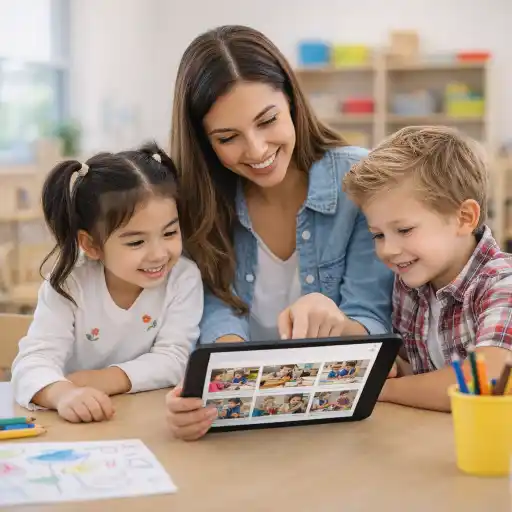
Children can also revisit their own learning. A teacher might ask, “What do you remember about this?” or invite a child to choose a photo, explain a drawing, or record a short reflection. These interactions position the child as a participant rather than merely the subject of adult documentation. This matters especially when children communicate through gesture, movement, play, home languages, or other forms that a conventional written record may overlook.
To make sharing purposeful, provide context rather than sending a stream of uncaptioned images. A brief story can help families see the questions, persistence, and collaboration behind an activity and encourage a conversation at home. Invite family perspectives without expecting every family to contribute in the same format or on the same schedule. Inclusive #families partnerships recognize that time, technology access, language, and comfort with digital platforms differ.
How should programs protect privacy and use technology responsibly?
Digital portfolios contain sensitive information about children and families. Photos, recordings, observations, and developmental notes should be collected and shared only for clear educational purposes and handled according to program policy and applicable law. The Council of Europe’s guidance on children’s data protection in educational settings emphasizes children’s rights, privacy, fairness, and the need to consider risks when digital tools are used.
Before adopting a platform, directors should review who can access records, how accounts are managed, what happens to data when a child leaves, and whether the provider can export or delete records. Staff need clear expectations for devices, consent, storage, and communication. A family’s permission for one use of a photo should not be assumed to cover every use or public sharing.
- Use individual accounts and role-based access; do not share passwords.
- Obtain and document family permissions in line with program policy before capturing or sharing identifiable media.
- Keep devices and records secure, and avoid storing children’s images in personal accounts or unapproved apps.
- Set a retention and deletion process, and explain it to families in plain language.
- Check that documentation does not distract from active supervision or responsive care.
Privacy is not an obstacle to meaningful documentation; it is part of the trust that makes family partnership possible. Requirements vary by setting and jurisdiction, so state requirements vary - check your state licensing agency.
What common pitfalls can teachers and directors avoid?
Digital systems can make it easy to capture more, but a larger archive is not automatically a better portfolio. When staff feel pressure to upload constantly, documentation may become a quantity target instead of a reflective practice. Teams can keep the workload sustainable by agreeing on a simple purpose, a concise entry format, and a reasonable review routine. Quality, balance, and usefulness matter more than a high volume of posts.
Another pitfall is documenting only polished products, compliance checkboxes, or concerns. This narrows the view of children and can obscure the persistence, curiosity, relationships, and everyday strategies that are central to learning. Include strengths and varied experiences, and check whether all children are represented across activities, routines, and forms of communication.
- Replace judgments such as “lazy” or “advanced” with observable actions and direct quotes.
- Do not infer a child’s feelings or intentions from a photo alone; add context and revisit interpretations.
- Do not let automated tags, templates, or summaries make assessment decisions without educator review.
- Do not treat one observation as a definitive measure; look for evidence across moments and settings.
- Do not assume every family has equal access, time, or confidence with digital tools; offer alternatives.
📝 A practical team habit: set aside a short weekly reflection to review a few entries, ask what they suggest about children’s interests, and choose one responsive next step. This keeps the portfolio connected to practice rather than turning it into a separate administrative project.
Conclusion: How can digital portfolios make learning more visible?
Digital portfolios are changing documentation by making it easier to combine different forms of evidence, revisit children’s learning over time, and share classroom experiences with families. Their value depends less on the platform than on the teaching practices around it: objective observation, thoughtful interpretation, child participation, family contribution, and careful attention to privacy.
Start with a manageable routine. Choose evidence that shows learning in progress, add brief context and reflection, and use what you notice to shape the next interaction or experience. Invite children and families to contribute in ways that suit them, and set clear safeguards for sensitive information. When technology serves these purposes, portfolios can help teachers recognize more of each child’s competence and build a fuller picture of how learning unfolds.
For further professional learning, ChildCareEd offers observation and assessment skills training Buy Now $55.00, privacy-focused documentation training Buy Now $55.00, culturally responsive assessment and family collaboration Buy Now $55.00, Observing & Assessing in Child Care Buy Now $16.00, and Preschool Assessments & Observations Buy Now $24.00.
- CDA Preschool Credential
- CDA Preschool Credential with Portfolio Review
- CDA Family Child Care Credential
- CDA Infant/Toddler Credential
- Birth to Five CDA Credential with Portfolio Review
- CDA Family Child Care Credential with Portfolio Review
- CDA Bridge Bundle: Preschool
- CDA Infant/Toddler Credential with Portfolio Review
- CDA Bridge Bundle: Family Child Care
- CDA Bridge Bundle: Infant/Toddler
- CDA Certification en Español: Recursos y Consejos para Educadores Bilingües
- 🩺 Cumplimiento de Salud e Inmunización en Cuidado Infantil de Nevada ✔️
- Proceso CDA: Entrenamiento, Portafolio, Examen y Visita de Verificació
- ¿Cómo empiezo mi certificación CDA en Florida en línea?
- Requisitos de Cuidado Infantil en Nueva Jersey para Centros y Proveedores de Cuidado Infantil Familiar
- Horas Anuales de Capacitación para Proveedores de Cuidado Infantil en Virginia
- Cómo Celebrar el Día Nacional del Kindergarten
- Lista para Guardería en Casa en Illinois: Cómo Iniciar una Guardería en el Hogar
- Consejos de Supervisión Activa para Salones de Preescolar y el Juego al Aire Libre
- 7 Estrategias de Supervisión Activa para un Cuidado Infantil Más Seguro
- Cómo Trabajar en el Cuidado Infantil en California: Requisitos y Pasos
- Capacitación Previa al Servicio para Proveedores de Cuidado Infantil en Georgia
- Celebrando la amistad en el cuidado infantil durante el Día de los Mejores Amigos
- Canciones, juegos y preguntas de círculo para niños
- From Classroom Notes to Useful Insights: How Can Technology Support Observation?
- How Are Digital Portfolios Changing the Way Teachers Document Children’s Learning?
- How Can Technology Help Teachers Track Children’s Progress Over Time?
- Personalized Learning in Preschool: Where Can Technology Help—and Where Should It Stop?
