Classroom notes become more powerful when they help you see a child’s learning over time—not merely add another task to a busy day. The Tracking Progress, Shaping Futures: Observation & Assessment Skills  Buy Now $55.00 course offers practical training in objective observation, assessment, and goal setting so you can turn evidence into responsive teaching. Read on for a manageable, child-centered way to use digital tools while keeping relationships, inclusion, and privacy at the heart of your practice.
For focused learning on ethical recordkeeping and confidentiality, explore Privacy Matters: Documentation and Observation in Early Learning Buy Now $55.00.
Why can technology make observation more useful?
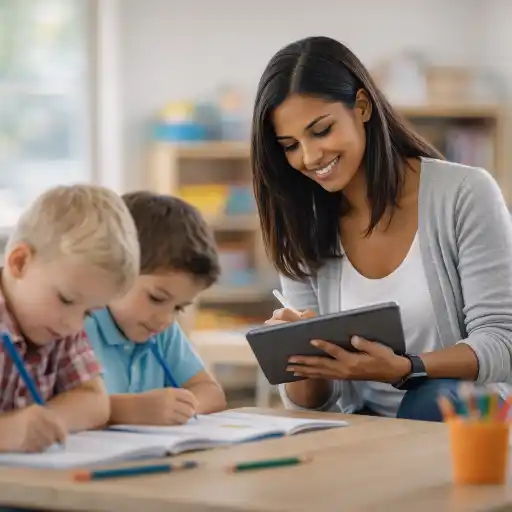
Children often show their thinking in quick, fleeting moments: a tower rebuilt after it falls, a new word used during pretend play, or a peer invited into a game. Technology can help educators capture those moments accurately through brief notes, photos, audio, or short video clips. Organized records make it easier to revisit evidence, notice patterns, and share concrete examples with families and colleagues.
The value is not the device itself. Observation remains a professional practice of watching and listening with intention, interpreting evidence carefully, and deciding what to do next. NAEYC describes observation as a way to inform teaching strategies and design learning experiences; digital tools can support that process when they help educators remain responsive rather than distracted.
Digital documentation may also widen whose learning is visible. A photograph of a model, a gesture, an audio sample in a home language, or a child’s own explanation can complement written notes. Research on digital documentation points to these multimodal possibilities while cautioning that systems designed mainly for adults may leave children’s voices out. Invite children to revisit, explain, or contribute to their own records when appropriate.
- Capture evidence close to the moment, reducing reliance on memory.
- Organize observations by date, setting, interest, or developmental domain.
- Use records to support reflection and communication—not to rank children or replace professional judgment.
Which digital tools fit classroom observation?
Choose tools according to your observation purpose and daily workflow, not according to the number of features advertised. A center may use a secure portfolio platform, a program-approved tablet or camera, voice notes, or a simple digital form. Paper notes can still be useful; a mixed system is often practical when technology is unavailable or a moment calls for a quick handwritten reminder.
Before adopting a platform, ask whether staff can use it without stepping away from supervision, whether it supports photos and written context, and whether records can be searched or exported. Consider access controls, data storage, cost, staff training, and family-sharing settings. Test a proposed tool during ordinary classroom routines, then invite honest feedback from educators who will use it.
Technology should serve the observation, not shape children’s activity around the need to capture content. A camera is not necessary for every learning moment, and teachers do not need to document every child every day. The ECCDC’s observation and documentation tools illustrate that digital cameras and related resources can support authentic documentation, while NAEYC’s guidance on portfolios and documentation emphasizes making learning visible through varied forms of evidence.
- Use program-approved devices and secure accounts.
- Choose an easy capture method: short note, image with context, or brief audio.
- Keep a non-digital backup process for outages or times when devices are inappropriate.
How do we turn a digital capture into meaningful insight?
A digital entry is not automatically an assessment. It becomes useful when it describes what happened, considers what the evidence may mean, and informs a next step. Start with a focused observation question: What strategies does this child use to solve a problem? How does the child communicate an idea during play? Which materials invite sustained engagement?
Record facts before interpretation. Include the date, setting, activity, observable actions, exact words when possible, and relevant adult support. For example: “During block play, Maya placed two wide blocks beneath a long plank. When the bridge tilted, she moved one block closer to the center and tried again.” This is more actionable than “Maya is good at building,” because it preserves the strategy and context.
Then review entries across time and contexts. One moment is a snapshot, not a complete account of a child’s ability. Discuss observations with colleagues, consider family perspectives, and look for strengths as well as areas where additional support may be helpful. Use this cycle to connect observation to teaching decisions and to plan experiences responsive to children’s interests.
- Observe: notice a meaningful action, interaction, or question.
- Document: capture concise, factual evidence in a secure system.
- Reflect: consider possible learning, context, and other perspectives.
- Respond: adapt materials, interactions, or the next learning invitation.
How can technology strengthen inclusion and family partnership?
Families know children in contexts educators may not see. Digital portfolios and secure updates can make classroom experiences easier to share and invite families to add their knowledge. A brief photo with a factual caption can prompt a useful conversation: “What do you notice about the way Kai persisted with this puzzle?” Families may connect the moment to interests, language, or experiences at home.
Make documentation accessible in more than one way. Children may communicate through speech, movement, drawing, construction, home languages, or quiet observation. Include varied evidence and avoid treating fluent English or verbal participation as the only sign of learning. Research on the move from paper to digital records notes that digital formats can increase access and capture dynamic learning, but adult-centered platforms may marginalize children’s perspectives. Ask children what they want to share and, when appropriate, let them help select or describe evidence.
Communicate with care: share strengths, specific examples, and next steps in language that families can understand. Invite correction or additional context rather than presenting an interpretation as the final word. This collaborative approach makes digital documentation a bridge between home and program, not simply a stream of updates. For further strategies on using narrative to include multiple perspectives, see NAEYC’s discussion of Learning Stories.
- Offer family communication in accessible formats and, where possible, home languages.
- Ask families for context and invite children to contribute to their documentation.
- Share selectively and purposefully; more images do not necessarily mean better partnership.
What safeguards and routines keep digital observation responsible?
Children’s records are sensitive. Before photographing, recording, or sharing, follow program policy and obtain the required family permissions. Use secure, program-approved platforms; limit access to staff who need it; and avoid storing children’s images or notes on personal devices or accounts unless an explicit program policy permits it. Review vendor privacy practices and understand how data is stored, shared, retained, and deleted.
Technology must never interfere with active supervision or a child’s dignity. Put the device away when a child needs immediate support, when recording would intrude on a private care routine, or when the moment is better met through direct interaction. Keep observations factual and strengths-based, and review entries for accuracy before sharing. State requirements vary - check your state licensing agency for applicable recordkeeping, consent, privacy, and retention rules.
Build a routine small enough to sustain. Rotate observation focus among children and settings; use a short template; and reserve a brief weekly review period to connect evidence with planning. Directors can support consistency by modeling objective notes, training staff on privacy settings, and giving educators time to reflect together. A digital system should reduce friction, not create pressure to collect data constantly.
- 🔒 Confirm permissions, secure storage, and appropriate access before sharing.
- Keep classroom interaction and supervision ahead of documentation.
- Set a regular review schedule and use records to guide concrete teaching decisions.
Conclusion: How can we move from notes to insight?
Technology can make observation easier to capture, organize, revisit, and share—but useful insight still depends on an educator’s thoughtful interpretation. Start with a clear question, record objective details, and use varied evidence to represent each child’s ways of communicating and learning. Review patterns over time, include family and child perspectives, and turn what you notice into responsive classroom experiences.
Keep the process practical: choose a secure tool that fits your team, establish a manageable observation rotation, and protect time for reflection. Treat digital records as evidence for professional dialogue rather than a substitute for relationships or a complete measure of a child. With these habits, classroom notes can become meaningful insights that strengthen teaching and help children’s learning be seen.
For a deeper learning experience, consider the linked ChildCareEd courses on observation and assessment and on privacy-conscious documentation. They can help you build practical skills for objective note-taking, planning, and safeguarding children’s records.
Five key ideas: #observation, #documentation, #technology, #privacy, and #families.
- 45 Hour Child Growth and Development
- Moving About the Classroom: Effective Transitions for Everyday
- Tracking Progress, Shaping Futures: Observation & Assessment Skills
- 45 Hour Infant and Toddler Methods and Materials
- 45 Hour School Age Methods and Materials
- CDA Bridge Bundle: Family Child Care without Portfolio Review
- CDA Bridge Bundle: Infant/Toddler without Portfolio Review
- Texas Director Credential
- Technology as a Classroom Tool
- CDA Certification en Español: Recursos y Consejos para Educadores Bilingües
- 🔍 ¿Qué ves cuando observas a un niño aprender?
- 💛🧩 ¿Cómo puedo hacer que mi enseñanza sea inclusiva para los niños con autismo?
- Apoyo en Español para Capacitaciones Grupales Presenciales y por Zoom en Cursos Selectos
- 10 Ejemplos de Cómo la Cultura Influye en el Desarrollo Infantil
- Can digital documentation make child care documentation faster, safer, and more useful?
- Examples of Anecdotal Notes for Preschoolers: 10 Real Classroom Moments, Written the Right Way
- How Can You Choose a Coaching Format That Fits a Teacher’s Communication Needs?
- How Can Family Knowledge Enrich a Montessori Toddler Classroom?
- How Can You Fact-Check an AI-Written Classroom Update?
- Is It Safe to Put Child Assessment Notes into an AI Tool?
- What Are 7 AI Prompts Every Busy Preschool Teacher Should Keep Handy?
- From Classroom Notes to Useful Insights: How Can Technology Support Observation?
- How Can Technology Track Children’s Development Without Creating More Paperwork?
- How Can Technology Help Teachers Track Children’s Progress Over Time?
- How Can AI Help Teachers Write Better Parent Updates?
- How Can Technology Make Daily Family Communication Faster Without Making It Impersonal?
- Can AI Help Teachers Recognize When an Activity Is Too Easy or Too Difficult?
- Personalized Learning in Preschool: Where Can Technology Help—and Where Should It Stop?
