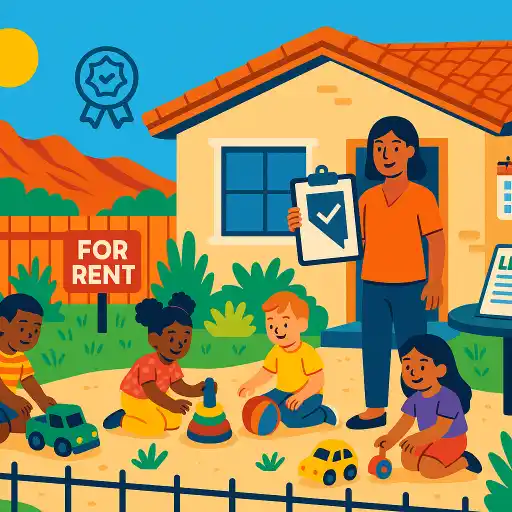
 Yes, sometimes. In #Nevada, you may be able to run licensed child care while renting a home, but there are important rules to follow. As a #tenant, you usually need your #landlord’s written permission, and you must meet state (and sometimes county) #licensing and #safety requirements. You may also need to follow local zoning rules and carry the right insurance.
This guide explains the steps, common risks, and what to check first so you can make a plan that keeps children safe and your program legal. For a starting point, you can use a general checklist from ChildCareEd.
Quick note: Nevada may treat some home programs as child care facilities that must be licensed by the state or county. Always review the Nevada licensing rules and statutes for child care.
Can a tenant run a licensed child care in a rented home?
Yes, but only if several things line up. In Nevada, state law explains when child care must be licensed, and cities/counties may have extra rules, too. For example, Nevada law defines when a place counts as a child care facility and some types of care must be licensed through the Bureau of Services for Child Care.
Key things that must be true
-
Landlord permission (#landlord #tenant):
Your lease must allow business use or you need written approval. Many landlords ask for added insurance and a signed lease addendum. -
Zoning and local rules:
Your city or county may limit businesses in homes or require permits. -
A state (or local) license when required (#licensing):
If your program meets Nevada’s definition of a child care facility, you must apply with the right licensing authority. Some counties may license smaller programs too (see NRS 432A.131). -
Safety and building rules (#safety):
You may need fire, health, and safety inspections. Nevada child care rules and standards are often listed in NAC 424.
For a simple “start here” guide, you can link ChildCareEd’s resource: Starting an In-Home Daycare.
What steps must a tenant take to get licensed and stay legal?
Follow these steps in order (so you can check them off). In Nevada, licensing rules come from state law and regulations, and local governments can add extra rules.
📞 Talk to your landlord first (#tenant #landlord)
Get written permission to operate child care in the rental. If needed, add a lease addendum that covers responsibilities and insurance.
🧭 Check local zoning and city/county rules
Some areas require a home business permit or have limits on home businesses. If you skip this step, you could be told to stop operating.
📝 Confirm what license you need and apply (#licensing)
Nevada law defines when a home is considered a “child care facility” (for example, care for five or more children can meet the definition).
Nevada also allows county/city licensing agencies in some cases (see NRS 432A.131), and AB 507 describes which facilities must be licensed by the state Bureau of Services for Child Care in certain situations.
👥 Complete background checks and clearances
Nevada’s child care statutes include investigation/background check provisions for applicants and certain staff/residents/participants.
🩺 Complete required training and health steps
Make sure you meet required trainings (often CPR/First Aid, health/safety topics, etc.) based on your provider type and licensing authority. Start with Nevada’s official licensing guidance for your program type.
🧯 Prepare for inspections and safety requirements (#safety)
Expect health/safety checks as part of licensing and ongoing compliance. Nevada’s licensing resources point you to the rules and inspection expectations that apply to child care.
If you’re doing major remodeling, you may need building plan review/approval through the state’s process (NAC 449.0115 describes building plan review requirements).
💼 Set up the business basics and keep records up to date
Keep a simple system for training records, child records, and required documentation so renewals and inspections are smoother. Use Nevada’s laws/regs page as your “source of truth” for what must be kept.
ChildCareEd provides a clear step-by-step checklist that matches these items for home daycares checklist.
What should I do with my landlord and the lease?
Do not assume your lease allows a business. Talk, negotiate, and get everything in writing. Here is a short plan you can follow:
-
📄 Review your lease right away
Look for rules about “business use,” home businesses, visitors, parking, noise, and landlord approval. -
✍️ Get written permission (signed)
A simple email is not enough. Ask for a signed lease addendum (or a new lease) that clearly says you may operate licensed child care at the home. -
🔒 Put insurance in the addendum
Many landlords require:-
proof of business liability insurance
-
a certificate of insurance
-
the landlord listed as additional insured (if your insurer allows)
-
-
💲 Agree on any extra costs
Landlords may request a rent increase, added deposit, or set rules for repairs. Write down payment terms, notice rules, and how problems will be handled. -
📜 Add safety and compliance promises (#safety #licensing)
Include simple clauses that say you will:-
follow licensing and safety rules
-
keep records if required
-
allow required inspections
-
report hazards and repairs quickly
-
-
⚖️ Think about your business structure
Some providers use an LLC. An attorney or insurance agent can explain what that does (and does not) protect.
Course to consider
ChildCareEd’s Business Planning: Family Child Care  Buy Now $16.00 helps you plan budgets, policies, and day-to-day operations for a home program so you can set up your child care business the right way.
- 30 hour Texas Director Annual ONLINE
- Nutrition Essentials for Child Care Providers
- Open Ears: Listening in Child Care
- Pediatric RSV First Aid & CPR/AED
- Texas Director Credential Renewal
- Texas Director Credential
- Building a Healthier Tomorrow: Preventing Childhood Obesity
- Balancing Active Play in Child Care
- CDA Certification en Español: Recursos y Consejos para Educadores Bilingües
- 🩺 Cumplimiento de Salud e Inmunización en Cuidado Infantil de Nevada ✔️
- 👧 ¿Cómo iniciar y abrir una guardería en Texas? Lo que necesitas saber
- 🚨 Reporte Obligatorio en Nevada
- Renting a Home in Nevada: Can You Operate Licensed Child Care as a Tenant?
- ¿Qué Se Necesita para Comenzar una Guardería en Casa en Texas?
- Cómo Empezar una Guardería en Casa: Requisitos y Pasos
- ¿Cómo solicito la licencia para una guardería en California?
- Regulaciones de Licenciamiento de Cuidado Infantil en California para Centros y Hogares de Cuidado Infantil Familiar
- Normas de Licenciamiento de Cuidado Infantil en Virginia para Centros Diurnos Infantiles y Hogares Diurnos Familiares
- Lista para Guardería en Casa en California: Cómo Iniciar una Guardería en el Hogar
- Lista para Guardería en Casa en Texas: Cómo Iniciar una Guardería en el Hogar
- Cómo Trabajar en el Cuidado Infantil en California: Requisitos y Pasos
- Cómo Trabajar en el Cuidado Infantil en Wisconsin: Requisitos y Pasos
- Capacitación Previa al Servicio para Proveedores de Cuidado Infantil en Dakota del Norte
- Capacitación Previa al Servicio para Proveedores de Cuidado Infantil en Nevada
- How to Open a Home Daycare in Nevada
- In-Home Daycare Requirements in Nevada
- How Many Kids Can You Babysit Without a License in Nevada?
