When a preschooler draws a curl, a row of dots, or a made-up sign and says, “This tells you where the blocks go,” they are exploring how messages work. Try the Classroom Tools for Emergent Literacy  Buy Now $16.00 course to strengthen your classroom strategies for connecting children’s marks, symbols, language, and print. For an additional perspective on the back-and-forth conversations that make invented messages meaningful, explore Reading Aloud and Storytelling Buy Now $16.00.
Why invite children to invent and interpret symbols?
Children do not need conventional letters to begin communicating through marks. A drawing or invented sign can stand for an object, an idea, a direction, or a story. When a friend is invited to interpret that mark, the child discovers that communication involves both a maker and an audience: someone creates a message, and someone else tries to make meaning from it.
This process supports symbolic thinking, oral language, listening, social interaction, and early writing concepts. It also gives educators a valuable view of children’s reasoning. Ask the child what the symbol means rather than deciding for them; a scribble that looks like a road to an adult might mean “the dinosaur is sleeping” to its creator. NAEYC describes early writing as including drawings and symbolic marks that express children’s ideas, and emphasizes the importance of helping children see that writing has a purpose.
Keep the experience playful, not a test of whether a peer guesses correctly. The important learning lies in explaining, listening, revising, and noticing that the same mark may not mean the same thing to everyone.
How can educators set up a meaningful symbol-message challenge?
Offer a small set of accessible materials: paper or cards, crayons, markers, and a few familiar classroom objects or photographs. Invite each child to create a simple message with their own marks, pictures, or invented signs. The message might tell a partner which toy to find, where to place a block, or what happens next in a pretend story.
Pair children and explain the roles: one child makes a message, while the partner studies it and shares an interpretation. Then the maker explains their intention. If the partner’s reading differs, treat that mismatch as information about how the message could be clarified—not as a mistake to shame.
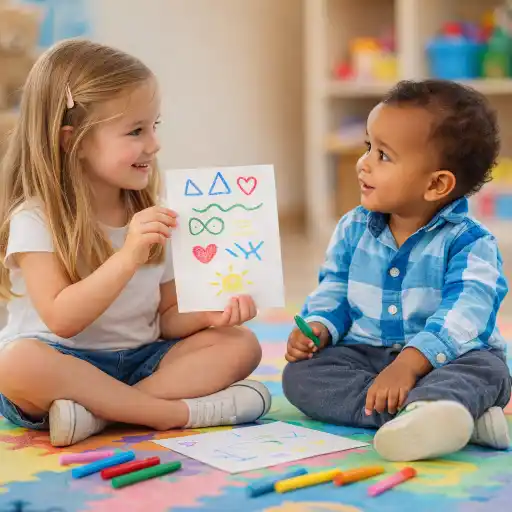
- Model a quick example: draw a simple shape and explain, “I made this to mean the basket is by the door.”
- Ask the maker to share the meaning orally, through gesture, or in a home language.
- Invite the partner to point, describe, or ask a question about the marks.
- Let the maker add a detail, change a mark, or dictate a caption after hearing the interpretation.
- 📨 Display messages with the children’s permission and their explanation, so the creator’s meaning stays visible.
For an engaging variation, use the Make a Message Symbol Cards and Partner Challenges resource as a prompt: children can create a message and invite a friend to interpret it. Keep the goal focused on making meaning together, not producing a polished picture.
What should teachers notice about children’s invented marks?
Observe what children say and do as they create and share. Do they name their marks before, during, or after drawing? Do they connect a symbol consistently to an idea, or change its meaning as the story develops? Can they describe the message, listen to a partner’s interpretation, or add a clue when the meaning is unclear?
These observations are more useful than judging the drawing by how much it resembles the intended object. Children’s graphic development varies, and drawing, mark-making, oral language, and early writing may overlap. A recent study examining young children’s transitions from drawing toward early writing describes this varied progression and the role of mark-making as a means of expression and communication.
Use curious, open prompts that keep ownership with the child:
- “Tell me about the marks you made.”
- “What might help your friend understand this message?”
- “What did you think your partner’s symbol meant?”
- “Would you like to add a picture, a mark, or some words?”
Record a short quote or save a sample when it helps you plan. A child’s explanation is essential context: without it, an adult may overlook the message and see only a set of marks.
How can symbol play include every child and language?
Offer multiple ways to make and interpret messages. Children may draw, arrange picture cards, use gestures, select objects, dictate a message, or communicate through an augmentative and alternative communication (AAC) system. A child can point to an image or use eye gaze rather than speak aloud. Provide adapted tools, larger surfaces, tactile materials, or extra time as needed.
For children learning more than one language, welcome the languages they use with family and peers. Invite families to share familiar words or symbols, and let children explain their messages in the language in which they feel most capable. Symbols can create a shared point of attention, but they do not replace meaningful conversation or the child’s home language.
Use images that reflect children’s real routines, interests, cultures, and community. Check that cards and symbols are clear and not overly crowded. If a child does not interpret a symbol as expected, consider whether the image is unfamiliar, ambiguous, or culturally specific before concluding that the child does not understand.
Accessibility is intentional: combine visual cues with objects, spoken language, gestures, and tactile experiences. A flexible approach communicates that every child has ideas worth sharing and can participate in the message-making process.
How can providers extend the learning—and avoid common pitfalls?
Connect invented messages to the everyday reasons people communicate. Add children’s signs to dramatic play, invite them to make a map for a block-built neighborhood, or create a class “message board” where children leave drawings and dictated notes. Pair a child-created symbol with the words the child chooses, reading the message aloud together. Environmental print—labels, signs, and familiar logos—can help children notice that marks and words carry meaning in daily life.
Revisit messages with the children: Can a friend interpret the revised sign? What clue helped? Did the message need a picture, a spoken explanation, or a label? These conversations build reflection and audience awareness without requiring children to master conventional spelling or handwriting.
- Avoid treating guessing as a score. Discuss different interpretations and how to make intentions clearer.
- Avoid taking over the child’s work. Ask before adding adult writing or correcting marks.
- Avoid assuming one symbol has a universal meaning. Ask the creator and consider children’s experiences and languages.
- Avoid making conventional letters the only valued response. Drawing, gesture, dictation, and invented marks are meaningful ways to communicate.
Directors can support this practice by keeping open-ended materials available, making room for children’s creations, and helping staff share observations. If you are planning professional development, consider the Science of Reading Foundations in the Pre-K Classroom Buy Now $16.00, the Building Vocabulary Buy Now $16.00 course, or Building Bridges for Dual Language Learners Buy Now $16.00 for related learning on early literacy, language, and inclusive practice.
Conclusion: What does a friend learn from reading an invented symbol?
A child’s invented mark can be a genuine message—and a friend’s attempt to interpret it turns writing into a social, purposeful experience. By making room for children to create symbols, explain their meanings, listen to others, and revise when they choose, providers support early communication and emergent writing without rushing children toward conventional forms.
Remember the central question: Can a friend read your invented symbols? Sometimes yes, sometimes not yet—and either outcome opens a worthwhile conversation. Follow the child’s meaning, offer accessible ways to participate, and celebrate the thinking behind each message. For more structured ideas to carry into daily practice, explore ChildCareEd’s Classroom Tools for Emergent Literacy Buy Now $16.00 and Reading Aloud and Storytelling Buy Now $16.00 courses. State requirements vary—check your state licensing agency.
- CDA Preschool Credential with Portfolio Review
- 45 Hour Preschool Methods and Materials
- Bienvenido! Welcoming All Families
- Play Safe, Think Big: Literacy Through Play
- 45 Hour Infant and Toddler Methods and Materials
- CDA Bridge Bundle: Preschool
- Texas Director Credential
- Classroom Tools for Emergent Literacy
- 💛🧩 ¿Cómo puedo hacer que mi enseñanza sea inclusiva para los niños con autismo?
- Celebra El Cumpleaños de Dr. Seuss En Tu Guardería Con Actividades Fáciles y Divertidas!
- 10 Ejemplos de Cómo la Cultura Influye en el Desarrollo Infantil
- Proporciones de Cuidado Infantil y Tamaños de Grupo por Edad en Maryland (Guía Rápida para Centros y Hogares)
- Proporciones de Cuidado Infantil y Tamaños de Grupo por Edad en Nueva Jersey (Guía Rápida para Centros y Hogares)
- Proporciones de Cuidado Infantil y Tamaños de Grupo por Edad en Virginia (Guía Rápida para Centros y Hogares)
- Cómo Celebrar el Día Nacional del Kindergarten
- Retraso del Habla en la Guardería: Cómo Pueden Ayudar los Proveedores
- Cómo Trabajar en el Cuidado Infantil en Carolina del Norte: Requisitos y Pasos
- Cómo Trabajar en el Cuidado Infantil en Wisconsin: Requisitos y Pasos
- Cómo Ser Maestra de Preescolar en Wisconsin
- Cómo Ser Maestra de Preescolar en Maryland
- Capacitación Previa al Servicio para Proveedores de Cuidado Infantil en Dakota del Norte
- Capacitación Previa al Servicio para Proveedores de Cuidado Infantil en Wisconsin
- Celebrando la amistad en el cuidado infantil durante el Día de los Mejores Amigos
- Canciones, juegos y preguntas de círculo para niños
- Cómo simplificar la capacitación para sus empleados de daycare
- How Can Child Care Providers Create Print-Rich Early Childhood Environments?
- How Can You Plan Patriotic Crafts Without Limiting Children’s Creativity?
- Can a Friend Read Your Invented Symbols? Exploring How Messages Work
