A bowl of water and a handful of cranberries can turn a Thanksgiving ingredient into a memorable lesson in observation, prediction, and evidence. Try the activity below, then explore Basic Science in Early Childhood Buy Now $25.00, a focused training that helps providers plan meaningful investigations and strengthen children’s scientific reasoning. Curious what tiny features inside a cranberry can reveal?
Why does a cranberry investigation matter beyond the holiday table?
A seasonal activity can do more than fill a November lesson plan. When children predict, test, notice, and talk about what happens, they practice the habits of scientific inquiry in a concrete, playful context. The question “Will a cranberry float?” gives children a reason to look closely and discover that an object’s appearance does not always tell us what it will do in water.
For providers, the value lies in the process as much as the result. Children share ideas, listen to peers, compare outcomes, and revise their thinking. A child who predicts that a cranberry will sink and then sees it float has not failed; they have gathered evidence that may lead to a new question. This respectful response helps make the classroom a place where #curiosity and changing one’s mind are welcome.
The investigation also connects science to familiar foods and seasonal experiences. Children may have seen cranberries in juice or sauce, but a whole fresh berry offers a new opportunity to inspect shape, texture, and structure. Start with a simple test, then follow the children’s observations rather than rushing to provide the explanation.
- Build vocabulary such as float, sink, surface, observe, and predict.
- Support early reasoning through comparison and evidence-based discussion.
- Offer a low-cost activity that can extend into sorting, drawing, or further testing.
How can you set up a safe, purposeful sink-or-float test?
Keep the setup straightforward so children can focus on the question. You will need fresh cranberries, a clear and stable container, water, a towel or tray to catch spills, and a few additional objects for comparison. Select materials suitable for the ages and abilities in your group, and prepare the space before inviting children to begin.
Ask children to make a prediction before each test. They can answer verbally, point to a picture, place an object beside a “sink” or “float” label, or draw what they expect. Then invite a child to gently place one item in the water while the group watches. Keep one object in the water at a time so the results are easy to see and describe.
- 🧪 Set a shallow container on a stable surface and keep towels nearby.
- Show the cranberry and ask, “What do you think will happen when it touches the water?”
- Test the berry, pause to observe, and describe where it is in the container.
- Try a few suitable comparison items, such as a leaf, twig, or large pebble.
- Sort or record the results with drawings, picture cards, or a simple chart.
Whole cranberries and small objects may pose choking risks. Closely supervise children, keep materials away from mouths, and adapt the experience for children’s developmental needs. An adult should handle any cutting. State requirements vary - check your state licensing agency.
What explains why fresh cranberries usually float?
Fresh cranberries usually float because their interior contains small air-filled spaces. These chambers affect the berry’s overall density: density describes how much matter is packed into a given amount of space. When an object’s average density is lower than the density of the surrounding water, it can float. Water also exerts an upward force, called buoyancy, on objects placed in it.
For young children, a plain-language explanation is enough: “There are tiny spaces inside the cranberry, and the air in those spaces helps it stay at the top.” The goal is not to require preschoolers to memorize a physics definition, but to connect an observation with a physical clue. If the group is ready, introduce the words density and buoyancy while pointing to the berry and the water.
With close adult supervision, cut a separate cranberry in half and invite children to look for the small chambers inside. Ask what they notice and how that evidence might relate to the berry floating. Let children draw the inside, dictate an observation, or describe it to a partner. A hands-on observation can make an abstract idea more understandable, while still leaving room for questions.
Be precise about what the test shows: fresh cranberries usually float, but fruit can vary. The result is not a rule that every berry or every object of a similar size will behave identically. Comparing items helps children see that size alone does not determine whether something floats; structure and density matter too.
How can you guide children through prediction, testing, and reflection?
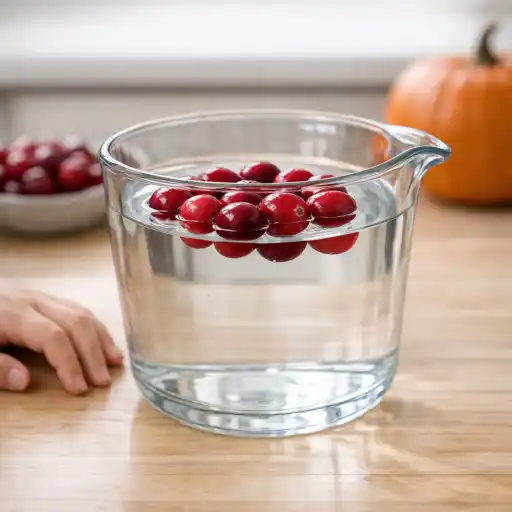
Use a flexible inquiry sequence rather than treating the activity as a performance with one “right” guess. Before testing, invite each child to share an idea and a reason: “What makes you think it will sink?” Accept explanations grounded in what children can see, such as “It feels heavy,” without confirming or dismissing them too early. The water test gives the group something observable to discuss.
During the test, use open prompts that direct attention to evidence. Ask, “Where did it go?”, “What do you notice about the other objects?” or “Did anything surprise you?” Give children time to respond through words, gestures, drawings, or their home language. Avoid turning questions into a quiz; the purpose is to help children notice and communicate, not to guess the adult’s answer.
Afterward, revisit the predictions. A simple record can include three columns: object, prediction, and result. Younger children can add a mark or picture; older children may dictate a sentence or help count how many objects floated. Documentation is most useful when you look at it with the children and ask what they would like to test next.
- Invite predictions, but present them as ideas to investigate—not answers to defend.
- Repeat a test if the result is unclear or children want another look.
- Notice thoughtful observations and revised explanations, not only correct guesses.
How can you extend the activity without making it too complicated?
Once children have tested a fresh cranberry, let their questions shape a small extension. Compare it with a leaf, twig, or pebble, or invite children to select a few safe classroom materials. Ask whether larger objects always sink or whether a small object can float. The contrast between a tiny pebble and a larger floating item can challenge assumptions and encourage children to use evidence rather than appearance alone.
You can also compare fresh and dried cranberries, but make the comparison a new investigation rather than assuming the outcome. Invite children to predict what each will do in water, test them separately, and record what they observe. Differences in the fruit’s condition and structure may affect behavior, so describe the results of your particular trial rather than promising a fixed result.
Keep the learning accessible by limiting the number of objects and changing one feature at a time when possible. Too many materials can make it difficult for children to focus on a single observation. If interest continues, return to the activity later, add a drawing or sorting task, or connect the question to how cranberries are harvested. A related buoyancy lesson about cranberries connects floating with cranberry production.
For more support in planning playful, purposeful science, explore Building Early Science Foundations  Buy Now $16.00, Tomorrow’s Einsteins: Infant and Toddler Science Buy Now $16.00, and Enhancing STEM Education for Infants and Toddlers Buy Now $16.00. These English-language courses offer additional professional learning related to inquiry and early science.
What common pitfalls can educators avoid?
A frequent pitfall is explaining the answer before children have time to notice what happens. Educators understandably want to keep a lesson moving, but a brief pause often produces richer language and questions. Let children watch the cranberry settle or float, and ask them to describe the evidence before introducing the explanation about air spaces.
Another mistake is treating a surprising result as a failed experiment. Fruit varies, and a single trial may not match an expectation. Instead of correcting children or changing materials without discussion, name what happened and consider a next step: “This berry stayed near the top. What could we compare it with?” Repeating a test can help children distinguish a pattern from a one-time observation.
Safety and inclusion deserve equal attention. Avoid small items for children who may mouth materials, actively supervise all water play, and have an adult use cutting tools. Offer different ways to participate: a child might make a prediction by pointing, watch from a comfortable distance, draw the result, or help record observations. These adaptations preserve the shared investigation while respecting individual needs.
- Do not suggest that size or weight alone determines floating; invite children to test and compare.
- Do not overcrowd the container; one item at a time makes observations clearer.
- Do not require spoken answers; gestures, pictures, and drawings can show thinking.
Conclusion: Will a cranberry float, and what can children learn?
Fresh cranberries usually float because small air-filled spaces inside the fruit contribute to its lower average density and help it remain at the water’s surface. But the central learning is larger than the answer: children can make a prediction, test it, observe carefully, and use evidence to explain or revise an idea. That is meaningful early science, even when the activity lasts only a few minutes.
For providers and directors, a cranberry investigation is a practical way to connect a familiar Thanksgiving ingredient with scientific reasoning, language, cooperation, and documentation. Prepare safe materials, ask open-ended questions, and treat unexpected results as useful information. To build a more complete foundation for bringing these experiences into classroom routines, consider the Basic Science in Early Childhood Buy Now $25.00 course. Let the children’s next question guide what you investigate after the cranberry reaches the water.
- CDA Subject Area 2
- What Makes Me Special: An Overview of Autism and ADHD
- The ABCs of Behavior: Turning Challenges into Learning Opportunities
- Children at the Wheel: Emergent Curriculum
- The Science of Growing Up: Typical and Atypical Development
- Building Early Science Foundations
- Mind's Medicine: Music in Early Childhood
- Montessori Cultural Activities: Exploring the World Through Play and Learning
- Enhancing STEM Education for Infants and Toddlers
- Environments That Inspire Independence and Exploration
- Cómo Abrir Una Quardería En Casa Sin Dinero?
- Requisitos Para Ser Maestra Principal En Un Daycare: Lo Que Necesitas Para Empezar
- ¿Qué Calificaciones Necesitas para Trabajar en Cuidado Infantil?
- 10 Ejemplos de Cómo la Cultura Influye en el Desarrollo Infantil
- Normas de Licenciamiento de Cuidado Infantil en Virginia para Centros Diurnos Infantiles y Hogares Diurnos Familiares
- Proporciones de Cuidado Infantil y Tamaños de Grupo por Edad en Nueva Jersey (Guía Rápida para Centros y Hogares)
- Proporciones de Cuidado Infantil y Tamaños de Grupo por Edad en Virginia (Guía Rápida para Centros y Hogares)
- Lista para Guardería en Casa en Texas: Cómo Iniciar una Guardería en el Hogar
- Por Qué la Supervisión Activa Es Clave para la Seguridad en el Cuidado Infantil
- Cómo Trabajar en el Cuidado Infantil en Carolina del Norte: Requisitos y Pasos
- Cómo Ser Maestra de Preescolar en Illinois
- Cómo Ser Maestra de Preescolar en California
- Cómo Ser Maestra de Preescolar en Maryland
- Cómo Ser Maestra de Preescolar en Virginia
- Celebrando la amistad en el cuidado infantil durante el Día de los Mejores Amigos
- Canciones, juegos y preguntas de círculo para niños
- Cómo simplificar la capacitación para sus empleados de daycare
- How Can November STEM Activities Encourage Curiosity and Discovery?
- How Can Thanksgiving Classroom Activities Teach Nutrition and Healthy Eating?
- Will a Cranberry Float? How Can Thanksgiving Ingredients Become a Science Investigation?
