When a child returns to the same Montessori work again and again, it can be tempting to offer something new—but that repetition may be where concentration and growing competence are taking shape. Mastering Observation Techniques in the Montessori Classroom  Buy Now $16.00 can help you strengthen objective observation and decide when support is useful, so your response fits the child rather than an adult timetable, while the Simple Daily Lesson Plan Template for Early Childhood Educators Buy Now $1.00 can help you organize observations, plan purposeful activities, and respond more intentionally to children’s individual learning needs.
Why can repeating the same work be meaningful?
From the doorway, repeated work can look like routine: the child pours water, rebuilds the same tower, or completes the same puzzle yet again. But the visible activity does not tell the whole story. A child may be refining movement, learning a sequence, noticing finer distinctions, or building confidence through a self-chosen challenge. The activity appears unchanged; the child’s coordination, understanding, or attention may be developing with each return.
Research on repetition in free-play settings found that children across the observed preschool ages engaged in repetitive motor behavior, with repetition occurring in different kinds of play. This does not establish that every repeated action has the same purpose, but it is a useful reminder that repetition is a common feature of young children’s activity, not automatically evidence of boredom or difficulty (A Natural History of Repetition).
In Montessori practice, the key question is not simply “How many times has the child done this?” Ask instead what the child seems to be working on. Is the activity purposeful? Is attention sustained? Does the child appear satisfied, or are there signs of frustration or disengagement? The Association Montessori Internationale’s discussion of repetition encourages close observation of what may be drawing the child back and whether mastery or boredom might be emerging.
What should a guide observe before deciding what to do?
Observation turns an impression into useful information. Rather than concluding that a child is “stuck” or “not ready,” record what happened in concrete terms: the material chosen, how the child began, what steps were repeated, how long engagement lasted, and what happened when the activity ended. Notice whether the child works independently, checks for errors, changes the sequence, or seeks help.
Look across more than one moment. A child may repeat a material with deep focus on one day and handle it casually on another. Consider the environment too: Was the room unusually busy? Was the work interrupted? Is the material complete, accessible, and presented in a way the child understands? These details help distinguish purposeful practice from a possible mismatch between child, task, and setting.
- Describe actions rather than assigning labels or motives.
- Notice concentration, emotional cues, movement, persistence, and self-correction.
- Compare observations across days and, when helpful, discuss them with colleagues.
- 📝 Keep brief notes during a focused observation period, then reflect later.
The AMI’s guidance on observation and intervention emphasizes observation that is consistent, objective, and non-judgmental. Even short periods of intentional observation can make patterns clearer and help educators decide what support, if any, is appropriate.
When is it best to step back and protect the child’s focus?
If the child is engaged purposefully, concentrating, and using the material safely, restraint is often a meaningful teaching decision. An adult’s well-meant suggestion—“Would you like something harder?”—can interrupt a process that is still unfolding. The AMI guidance on intervening in a child’s work advises against unnecessary interruption when engagement is positive, while recognizing the need to act if the activity is harmful to the child, others, or the material.
Stepping back does not mean withdrawing supervision or ignoring a child. Stay available, maintain a safe environment, and avoid taking over the work. If the child looks toward you, pauses, or asks for help, respond with the least intrusive support that meets the need. A brief invitation—“Would you like me to show you that step again?”—can preserve agency better than completing the task for them.
Protecting concentration also means considering the classroom rhythm. If possible, reduce avoidable interruptions, give the child enough time to complete the activity, and allow the full work cycle, including returning materials. In Montessori, purposeful independence develops within clear limits; the adult remains attentive while allowing the child’s effort to remain their own.
How can guides tell whether a child may be ready for a next step?
Repetition deserves respect, but it does not mean that every child should remain with the same material indefinitely. A guide can look for evidence that the work is no longer serving the child’s current learning: attention may become consistently shallow, the child may use the material carelessly, or the task may be completed easily without further exploration. Conversely, a child who is still concentrating, correcting errors, or experimenting with the work may be developing through repetition.
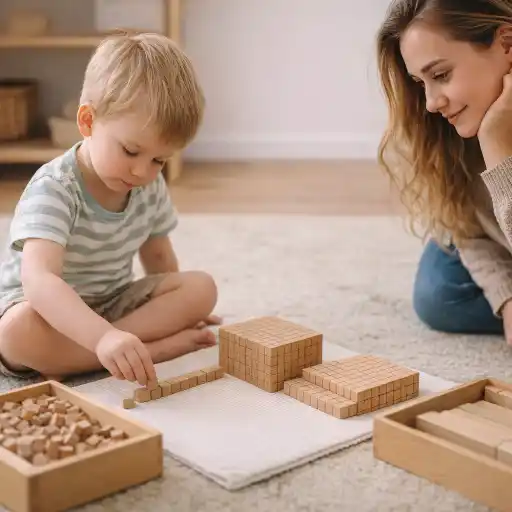
A next step need not be a direct replacement. You might offer a related presentation, make a material available after observing interest, or invite the child to explore a more complex variation when the timing seems right. Avoid treating a single successful performance as proof of mastery. Look for understanding over time, including whether the child can work independently, apply an idea in a new context, and return to the material with purpose.
To keep your decisions grounded, consider questions such as:
- What skill, concept, or interest might this repeated work be serving?
- Does the child appear absorbed, frustrated, or simply moving through the steps?
- What evidence suggests readiness for a new presentation or added challenge?
- Would a small change to the environment help more than redirecting the child?
When the pattern remains unclear, continue observing and consult your team. Responsive guidance is not a race through materials; it is a considered match between a child’s present engagement and a useful next opportunity.
What common mistakes can observation help prevent?
One common mistake is assuming that repetition always means boredom—or, at the other extreme, assuming it always signals productive learning. Neither conclusion can be made from repetition alone. Observe the quality of engagement, the child’s actions, and the pattern over time before deciding what it means.
Another pitfall is replacing objective notes with judgments. “She has no attention span” closes down inquiry; “She worked with the pouring activity for several minutes, paused when the room became noisy, and returned after the transition” gives the team something concrete to consider. Similarly, avoid interrupting simply because an adult expects visible novelty or wants to move through a planned sequence faster.
Observation should be respectful and purposeful, not surveillance or diagnosis. Keep records factual, protect children’s privacy, and share developmental concerns through appropriate program processes and family partnership. If a repeated behavior is persistent, causes distress, creates a safety issue, or interferes with participation or development, document what you see and consult the family and relevant professionals according to your program’s procedures. Repetition alone does not establish a developmental concern.
For practical professional development, Implementing the Montessori Curriculum Buy Now $32.00 explores child-directed and teacher-directed experiences alongside Montessori learning areas. The focused Sensitive Periods in Montessori: Guiding Natural Learning Buy Now $16.00 course can also support educators seeking to understand developmental interests and timing.
Conclusion: How can we respond thoughtfully when a child repeats work?
When a Montessori child repeats the same work, observe before intervening. Repetition may support practice, concentration, coordination, or emerging mastery, but its meaning becomes clearer through attentive, objective observation—not assumptions about what the child should choose next. Notice the child’s focus, actions, emotional cues, independence, and changes across time.
When work is purposeful and safe, protect the child’s opportunity to continue. When observation suggests frustration, disengagement, readiness for a new challenge, or a safety concern, respond proportionately: offer a small amount of help, adjust the environment, present a related lesson, or seek guidance from colleagues and families. The goal is neither to leave children unsupported nor to hurry them along, but to make the next decision with care. In the Montessori classroom, patient observation is an active form of teaching.
For further study, explore Mastering Observation Techniques in the Montessori Classroom Buy Now $16.00, Sensitive Periods in Montessori: Guiding Natural Learning Buy Now $16.00, Implementing the Montessori Curriculum Buy Now $32.00, The Montessori Classroom: Theory to Practice Buy Now $25.00, and The Montessori Assistant’s Toolkit Buy Now $40.00. Check course details and your professional development requirements before enrolling.
- 45 Hour Child Growth and Development
- Lesson Planning for Preschoolers
- 45 Hour Preschool Methods and Materials
- Birth to Five CDA Credential with Portfolio Review
- 45 Hour Infant and Toddler Methods and Materials
- Pediatric RSV First Aid & CPR/AED
- 45 Hour School Age Methods and Materials
- Texas Director Credential
- Every Moment Matters: Schedules and Transitions
- 😫🧸 ¿Qué hacer cuando un bebé no quiere dormir la siesta en el aula?
- Recursos en Español sobre el Sueño Seguro del Bebé
- ¿Cómo pueden los equipos de cuidado infantil practicar habilidades rápidas de primeros auxilios en situaciones reales?
- ¿Cómo empiezo mi certificación CDA en Florida en línea?
- Actividades de Fiesta para Niños de Preescolar y Primaria
- Lista para Abrir una Guardería en Casa en Dakota del Norte: Cómo Empezar
- Por Qué la Supervisión Activa Es Clave para la Seguridad en el Cuidado Infantil
- Retraso del Habla en la Guardería: Cómo Pueden Ayudar los Proveedores
- Cómo Trabajar en el Cuidado Infantil en Wisconsin: Requisitos y Pasos
- Cómo Ser Maestra de Preescolar en Maryland
- Capacitación Previa al Servicio para Proveedores de Cuidado Infantil en Nevada
- Why Do Children Repeat the Same Actions? Understanding Play Schemas and the 'Why' Behind Repetitive Play
- Why Should Montessori Guides Observe Before Intervening When a Child Repeats the Same Work?
- How Can Children Restore a Montessori Activity Before Choosing Another?
