When a new activity feels daunting, a child may need safety and support before they can explore—not a push to “just try.” ChildCareEd’s Anxiety: Signs & Strategies  Buy Now $16.00 course helps providers recognize how anxiety can appear and respond with inclusive classroom practices; it offers focused professional learning you can apply as you support children’s confidence. Read on for practical ways to make a first step feel manageable.
Why does anxiety about new experiences matter?
Young children meet unfamiliar experiences often: a new art material, a climbing structure, a group game, a substitute teacher, or a change in routine. What looks like refusal may be a child communicating uncertainty, fear of making a mistake, sensory discomfort, or a need for more time to observe. Children differ in temperament and in how quickly they warm up; hesitation alone does not mean a child is being defiant or lacks curiosity.
When worry becomes intense, a child may find it harder to play, learn, connect with peers, or show what they know. Anxiety can appear as withdrawal, clinginess, irritability, repeated questions, physical complaints, or avoidance—not only as visible fear. As the Child Mind Institute’s teacher’s guide to anxiety in the classroom notes, anxious behavior can be mistaken for other difficulties. Careful observation helps educators respond to the need rather than the surface behavior.
A supportive goal is not to make children fearless or require instant participation. It is to build a sense of security and offer an accessible path toward exploration.
How can teachers respond in the moment?
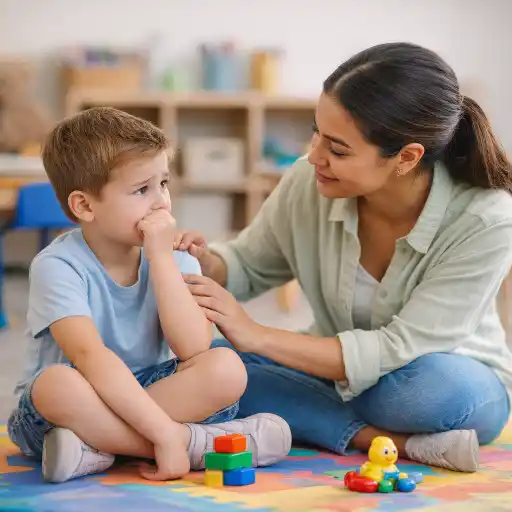
Begin by staying physically and emotionally available. Move to the child’s level, use a calm voice, and name what you notice without making assumptions: “You’re watching the new paint. It looks like you’re not sure yet.” Validate the feeling rather than dismissing it with “There’s nothing to be scared of.” A simple acknowledgment communicates that the child is understood and does not have to manage the feeling alone.
Offer a small, real choice that preserves connection and agency. The child might watch from beside you, touch a material with a tool, choose which color to try, or return to the activity later. Keep the invitation open without turning it into a public test.
- Use short language: “I’m here. You can watch first.”
- Offer two manageable options, not a long list.
- Allow nonverbal participation, such as pointing, holding a prop, or watching nearby.
- Stay close and supervise; do not use a calm space as punishment.
- Notice effort specifically: “You came over to see how the dough feels.”
If the child becomes overwhelmed, prioritize regulation and safety before encouraging participation. A quiet space, familiar sensory object, or slow breathing together may help. Practice calming tools during relaxed moments so they are familiar when needed.
How can educators make new activities feel more predictable?
Uncertainty can intensify worry, so prepare children for what is about to happen. Explain the activity in simple steps, show the materials, and demonstrate what they can do. Visual schedules, picture cues, a familiar song, or a brief story can make a new experience easier to understand. Before a change, offer a transition warning and enough time to finish what the child is doing. Predictable routines are especially helpful when children are adjusting to new people or events.
Adapt the entry point rather than removing the opportunity altogether. If a group activity feels too exposed, invite the child to explore with one trusted adult or a peer first. For a new sensory material, let the child look, use a spoon or brush, or watch someone else try it. If the setting is loud or crowded, choose a quieter spot or a smaller group.
- Preview what will happen, where it will happen, and who will be there.
- Break the experience into small steps and offer a clear stopping point.
- Make observation a valid first step, not a failure to participate.
- Offer a familiar person, buddy, or comfortable location when appropriate.
- 🧸 Provide a simple helper role, such as handing out materials or choosing a song.
These supports do not mean a child must avoid every challenge. Rather, they make the challenge accessible, so the child can approach it with support and at a developmentally appropriate pace.
How can teachers encourage brave steps without creating pressure?
Use gradual invitations that let the child move from watching to trying in manageable increments. For example, a child might first observe a water-play activity, then stand beside a familiar adult, touch the water with a scoop, and eventually pour or play. This is not a rigid ladder; the child may pause or choose a different route. The purpose is to keep the door open while respecting the child’s cues.
Focus praise on effort, curiosity, and self-advocacy rather than on being fearless or completing the entire task. “You asked to watch first, then you poured one cup” recognizes both communication and action. The experience itself—not a finished product or cheerful expression—is a meaningful success. The guidance in managing children’s fear of new activities similarly emphasizes that showing up and encountering an experience can be a valuable first step.
Avoid forcing, teasing, comparing, or publicly spotlighting a child. Pressure may increase distress and make future invitations harder. Instead, try language such as:
- “You can watch with me, or we can try it together.”
- “It’s okay to feel unsure. We can take one small step.”
- “Would you like to hold the brush or choose the color?”
Encouragement is not the same as insisting. When a child signals that they are overwhelmed, pause, reconnect, and consider a smaller step or a later opportunity. This approach nurtures #confidence and preserves trust.
How should teachers partner with families and the team?
Families can help educators understand what feels unfamiliar to the child, how the child communicates discomfort, and what has helped in similar situations. Share specific observations rather than labels: “Maya watched the new climbing activity for several minutes and joined after I demonstrated it.” Ask open questions such as, “How does Maya warm up to new experiences at home?” or “What helps when something feels uncertain?” This respectful exchange can reveal useful context without asking families to diagnose the child.
When a pattern appears, record brief, objective notes: what happened before the anxiety, where and with whom it occurred, how the child responded, and what support helped. Look for patterns across activities and days. Agree on one or two consistent strategies that staff and family can use, then review whether they are helping. Consistency among educators matters; a shared plan can prevent a child from receiving mixed messages.
If distress is persistent, intensifying, or interfering with play, relationships, routines, or participation, discuss concerns with the director and family and follow program procedures for consultation or referral. Educators should not diagnose. State requirements vary - check your state licensing agency. For ongoing professional learning, ChildCareEd’s Mental Health in Early Childhood Buy Now $24.00 course covers how stress may appear and how providers can understand children’s mental health. Brighter Futures: Social Emotional Development Buy Now $16.00, Early Emotional Wellness Buy Now $16.00, and Self-Regulation & Change: Helping Children Cope Buy Now $16.00 offer additional relevant learning opportunities.
What common mistakes should educators avoid?
Well-intended adults can accidentally make a new experience feel more threatening by focusing on compliance or speed. A child who is anxious does not necessarily need more persuasion; they may need clearer information, a smaller step, or a trusted adult nearby. Reflect on whether the environment and invitation can be adjusted before concluding the child is unwilling.
- Forcing participation: Physical pressure or repeated demands can escalate distress. Offer an invitation and a supported alternative.
- Dismissing the feeling: “You’re fine” may close communication. Validate what you observe and reassure without making promises you cannot control.
- Expecting instant success: Confidence often develops through repeated, low-pressure experiences. Recognize observation and small attempts as progress.
- Spotlighting or comparing: Avoid announcing the child’s hesitation or comparing them with peers. Keep encouragement private and specific.
- Removing every challenge: Automatically excluding the child may limit access to meaningful experiences. Adapt the activity and offer a supported way in, while respecting signs of overwhelm.
Afterward, reflect with colleagues: Was the activity predictable? Was there too much noise, waiting, or attention on one child? Did the child have a genuine choice? Small adjustments can change how safe and approachable an experience feels.
Conclusion: What is the most helpful response?
When a child becomes anxious about trying something new, teachers can connect first, validate the feeling, and offer a small, supported next step. Predictable preparation, meaningful choices, flexible participation, and calm adult presence help children approach unfamiliar experiences without being pushed beyond their capacity.
Look for progress in small signs: a child watches, moves closer, asks a question, touches a material, or tries one part of an activity. Partner with families and staff to notice patterns and provide consistent support. The aim is not to eliminate every worry or require every child to participate in the same way; it is to help each child feel safe enough to explore, learn, and build confidence at their own pace.
- 45 Hour Child Growth and Development
- Pediatric RSV First Aid & CPR/AED
- Health and Nutrition
- Working Together: Teachers & Preschoolers
- CDA Bridge Bundle: Family Child Care without Portfolio Review
- CDA Bridge Bundle: Infant/Toddler without Portfolio Review
- CDA Bridge Bundle: Preschool without Portfolio Review
- Texas Director Credential
- Anxiety: Signs & Strategies
- 👧 ¿Cómo iniciar y abrir una guardería en Texas? Lo que necesitas saber
- 🚨 Reporte Obligatorio en Nevada
- Requisitos Para Ser Maestra Principal En Un Daycare: Lo Que Necesitas Para Empezar
- Recursos en Español sobre el Sueño Seguro del Bebé
- Capacitación en Salud y Seguridad Preventiva en Línea para Proveedores de Cuidado Infantil
- Normas de Licenciamiento de Cuidado Infantil en Virginia para Centros Diurnos Infantiles y Hogares Diurnos Familiares
- Lista para Abrir una Guardería en Casa en Virginia: Cómo Empezar
- Lista para Guardería en Casa en California: Cómo Iniciar una Guardería en el Hogar
- Lista para Guardería en Casa en Texas: Cómo Iniciar una Guardería en el Hogar
- Retraso del Habla en la Guardería: Cómo Pueden Ayudar los Proveedores
- Capacitación Previa al Servicio para Proveedores de Cuidado Infantil en Dakota del Norte
- Celebrando la amistad en el cuidado infantil durante el Día de los Mejores Amigos
- Building a Better Head Start Lesson Plan: 7 Things Every Teacher Should Include
- How Can Teachers Ease Separation Anxiety at Drop-Off?
- How Can Teachers Share Meaningful Learning Updates with Families?
- When Families and Teachers Mean Different Things by “A Good Day,” How Can They Find Common Ground?
- How Do You Handle a Preschooler Who Refuses to Follow Directions?
- How Can You Choose a Field Trip That Extends What Children Are Already Investigating?
- What Should Teachers Do When a Child Refuses to Join Group Activities?
- What Should Teachers Do When a Child Becomes Anxious About Trying Something New?
