When children ask “What do I get?” before joining a routine, it may be time to shift from incentives toward skills, connection, and meaningful participation. The Viewing Guidance in a Positive Light  Buy Now $24.00 course offers practical strategies for positive discipline and social-emotional development; for a closer look at why challenging behaviors happen, explore The ABCs of Behavior: Turning Challenges into Learning Opportunities Buy Now
$55.00$45.00. These trainings can help you strengthen classroom practice while you consider what motivates children beyond the prize.
Why can dependence on rewards become a concern?
Rewards can be useful in limited, intentional ways. A brief incentive may help a child practice a new routine or make an unfamiliar task feel approachable. The concern is not a sticker or celebration by itself; it is when a reward becomes the main reason to share, help, participate, or manage frustration. A child who routinely asks “What will I get?” may be learning to connect cooperation with payment rather than with learning, belonging, or the needs of the group.
Motivation is not simply a matter of “more” or “less.” Children can act because they enjoy an activity, value its purpose, want adult approval, or expect a tangible reward. Self-determination theory highlights autonomy, competence, and relatedness as important psychological needs. When classroom guidance emphasizes control and prizes, children may have fewer opportunities to experience agency, mastery, and warm connection. NAEYC’s discussion of motivation and behavior management explains why choices and caring relationships are meaningful alternatives.
This is not a reason to blame yourself or a child. Reward systems often begin with caring intentions and can appear to work quickly. Treat the child’s request as information: the adult team can adjust how it supports the behavior and teach children what makes their actions valuable.
What should providers do first when children expect a prize?
Start by observing the pattern rather than removing every incentive abruptly. Note when the child asks for a reward, what happened just before, what the child did, and how adults responded afterward. Is the request most common during cleanup, transitions, group time, or a difficult task? Does the child understand the expectation, have the skills to meet it, and have enough time and support? This observation helps distinguish a motivation issue from confusion, fatigue, sensory overload, a mismatch in expectations, or an unmet need.
Then name the desired action clearly and connect it to its purpose. Instead of “Be good,” say, “Put the blocks in the basket so the walkway is clear.” Offer bounded choices that preserve adult-set limits: “Would you like to put away the blocks or the books first?” The child still contributes to the shared routine, while experiencing a measure of agency.
- Choose one routine to focus on first; changing everything at once can overwhelm adults and children.
- Teach and practice the expected behavior when the group is calm.
- Notice small attempts and progress, not only perfect completion.
- Keep adult responses warm and predictable, even when a child asks for a prize.
- Share observations with colleagues and families to understand what works across settings.
A steady transition is more supportive than a sudden withdrawal framed as punishment. Explain the change simply: “We’re learning to clean up because it helps our room stay safe and ready for everyone.”
How can feedback replace constant rewards?
Children still need responsive adult attention; reducing prizes does not mean ignoring positive behavior. Use feedback that is accurate, specific, and connected to an observable action. “You carried the dishes carefully and put them on the cart” gives useful information. “That helped us get ready for snack” links the action with a real classroom purpose. ChildCareEd’s discussion of praise and encouragement offers examples of language that emphasizes effort and process rather than evaluation.
Try a simple Notice, Name, Invite sequence. Notice what the child did, name the strategy or social skill, and invite reflection when the moment is right:
- Notice: “I saw you wait while Leo finished talking.”
- Name: “That gave him time to share his idea.”
- Invite: “What helped you remember to wait?”
Keep the exchange natural. A smile, nod, or short comment may be enough; feedback after every action can become another kind of constant evaluation. Avoid labels such as “You’re the best helper” and comparisons between children. Focus instead on the child’s strategy, persistence, communication, or contribution. Respect children’s preferences: some appreciate public acknowledgment, while others prefer a quiet comment or gesture. These choices protect #dignity and help make encouragement inclusive.
How can classroom design build motivation and independence?
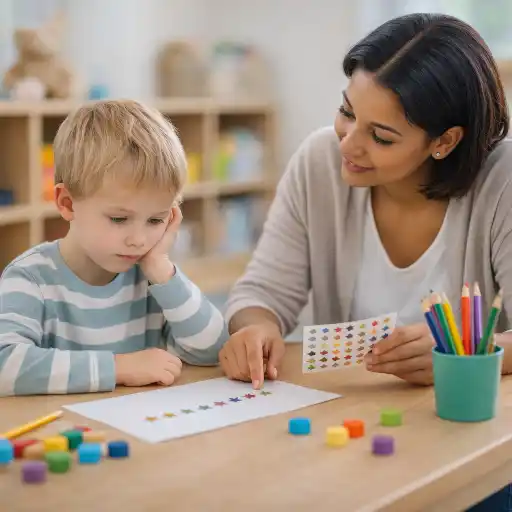
Motivation is shaped not only by adult words but by the conditions children encounter. A crowded center, long wait, unclear transition, or inaccessible materials can make cooperation unnecessarily difficult. Before adding a reward, ask whether the environment can be changed so the child can participate with greater success and independence.
- Use a visual schedule and give children a brief warning before transitions.
- Reduce bottlenecks and waiting; divide large groups when the routine allows.
- Keep materials organized and reachable so children can help themselves.
- Provide calm spaces and sensory supports as ordinary options, not as punishments.
- Offer meaningful choices within clear safety and classroom boundaries.
- Match the challenge to the child’s developmental skills and interests.
Play and purposeful work can also support internal engagement. When children choose materials, test ideas, repeat actions, and notice their own progress, the activity itself can become meaningful. The American Psychological Association’s early childhood motivation principles recommend supporting children’s interests, autonomy, and competence, and focusing feedback on strategies and progress. These approaches do not guarantee that every child will enjoy every routine, but they give children more ways to take part successfully.
Providers can review one daily routine together and ask: What makes this hard? What can children do independently? Which small change could reduce waiting or confusion? Practical adjustments often improve behavior more sustainably than adding another prize.
When are rewards appropriate, and how should they be faded?
There is no need to treat every reward as harmful or to ban all incentives. A short-term, individualized reward may sometimes support practice of a new skill, particularly when planned with a family or specialist. It should be one tool among several—not a substitute for teaching, relationship, environmental support, or safety limits. The Centers for Disease Control and Prevention’s guidance on praise and rewards notes the value of clear, specific expectations and tailoring strategies to the child; providers should also consider whether a reward system fits the classroom and each child’s needs.
Before using a reward, clarify the skill and why the child needs extra support. Select a goal that is observable and developmentally reasonable. Protect privacy and avoid public rankings, competition, food-based incentives, or taking away rewards a child has already earned. Pair any external incentive with teaching and descriptive feedback, then plan how to reduce it as the skill becomes more independent.
- Ask: “What skill are we teaching, and does the child understand what to do?”
- Consider whether a visual prompt, choice, practice, or routine adjustment could help instead.
- If using a temporary incentive, keep the plan simple, respectful, and individualized.
- Gradually shift toward natural outcomes and social connection—for example, the child’s request is understood and play continues.
When a child’s behavior creates immediate danger, intervene calmly and firmly. Stop harm, support regulation, teach a safer replacement, and help repair relationships as appropriate. A child’s access to care and belonging should never depend on earning a prize. State requirements vary - check your state licensing agency before changing formal behavior policies.
How can directors and teams make the change consistent?
Children benefit when the adults around them share a coherent approach. Directors can frame a move away from constant rewards as collective professional learning, not criticism of staff who used a system in good faith. Agree on the principles first: teach expectations, protect safety, preserve relationships, and use observations to guide adjustments.
A brief team plan can make the shift manageable:
- Choose one recurring routine and define the behavior children are learning.
- Agree on a few feedback phrases, such as “I noticed…,” “That helped…,” and “What could you try?”
- Role-play common situations, including a child asking for a prize or declining to participate.
- Record when the behavior occurs and what happens before and after it, without labeling the child.
- Invite families to share relevant context, preferences, and strategies that support the child.
- Review progress together and adjust the plan for culture, communication, disability, temperament, and sensory needs.
When behavior is persistent, unsafe, or significantly disrupts participation, collaborate with the family and qualified support professionals. A structured observation, including antecedent-behavior-consequence notes, can help the team identify patterns and teach a useful replacement skill. For professional development, providers may also explore Staying Positive: Guidance for Preschoolers Buy Now $24.00, Teach with Respect ONLINE Buy Now $24.00, and Social Foundations and Responsive Classrooms Buy Now $24.00. Each course focuses on practical aspects of respectful guidance and children’s social-emotional development.
Conclusion: How can children grow beyond reward dependence?
When children rely heavily on prizes, providers can respond with curiosity rather than blame. Observe the situation, make expectations clear, teach the needed skill, and strengthen children’s opportunities for choice, competence, and connection. Specific feedback and a supportive environment help children understand how their actions contribute to learning and community.
Rewards may have a limited, thoughtful role, but they should not be the engine of everyday cooperation. Start with one routine, replace a vague incentive with teaching and descriptive feedback, and work with families and colleagues to review what children need. The goal is not simply to stop children from asking “What do I get?”; it is to help them experience “I can do this, I belong here, and my actions matter.”
- 45 Hour Child Growth and Development
- 45 Hour Preschool Methods and Materials
- Bienvenido! Welcoming All Families
- Power of Art: Bldg Self-Esteem & Positive Behavior for ALL Abilities
- 45 Hour Infant and Toddler Methods and Materials
- Pediatric RSV First Aid & CPR/AED
- 45 Hour School Age Methods and Materials
- Texas Director Credential
- Recursos en Español sobre el Sueño Seguro del Bebé
- Capacitación en Salud y Seguridad Preventiva en Línea para Proveedores de Cuidado Infantil
- Regulaciones de Licenciamiento de Cuidado Infantil en California para Centros y Hogares de Cuidado Infantil Familiar
- Normas de Licenciamiento de Cuidado Infantil en Virginia para Centros Diurnos Infantiles y Hogares Diurnos Familiares
- Proporciones de Cuidado Infantil y Tamaños de Grupo por Edad en Maryland (Guía Rápida para Centros y Hogares)
- Proporciones de Cuidado Infantil y Tamaños de Grupo por Edad en Virginia (Guía Rápida para Centros y Hogares)
- Horas de Capacitación Anual para Proveedores de Cuidado Infantil en Maryland
- Lista para Abrir una Guardería en Casa en Virginia: Cómo Empezar
- Lista para Guardería en Casa en Illinois: Cómo Iniciar una Guardería en el Hogar
- Lista para Guardería en Casa en California: Cómo Iniciar una Guardería en el Hogar
- Lista para Guardería en Casa en Texas: Cómo Iniciar una Guardería en el Hogar
- Apoyo en Preescolar para Retrasos del Habla: Estrategias Simples que Ayudan
- Retraso del Habla en la Guardería: Cómo Pueden Ayudar los Proveedores
- Capacitación Previa al Servicio para Proveedores de Cuidado Infantil en Dakota del Norte
- How Can Smoother Classroom Transitions Reduce Challenging Behavior?
- How Can Child Care Providers Encourage Positive Behavior Without Relying on Rewards All the Time?
- What Are Developmentally Appropriate Ways to Introduce Goal Setting to Young Children?
- How Can Child Care Providers Use Classroom Jobs to Build Confidence and Independence?
- What Should Child Care Providers Do When Children Become Too Dependent on Rewards?
