Strong handwashing routines protect children, staff, and families while helping young learners build independence. For practical training on germs, hygiene policies, and infectious-disease prevention, explore Shoo, Germs! Don’t Bother Me!  Buy Now $24.00, a focused ChildCareEd course that can strengthen classroom practices and support professional development hours.
Handwashing is a small routine with significant public-health consequences. In group care, children share toys, tables, bathrooms, and learning materials, so germs can travel quickly from hands to surfaces and back again. The CDC identifies hand hygiene as one of the most effective ways to reduce respiratory and gastrointestinal illness in schools and early care settings.
For directors and providers, effective instruction requires more than posting a sign near the sink. Children need developmentally appropriate teaching, repeated practice, active supervision, accessible supplies, and consistent adult modeling. The following rules translate public-health guidance into routines that can work during busy arrivals, meals, diapering, outdoor play, and transitions.
Why does handwashing matter so much in child care?
Young children are still developing body awareness, impulse control, and self-care skills. They touch their faces, mouth toys, share materials, and may not recognize when their hands are contaminated. Consistent hand hygiene interrupts the pathway by which germs move from people to objects, food, and other people.
Handwashing also supports healthy development. When children repeatedly practice a predictable sequence, they gain independence and learn that caring for their bodies also protects their friends. A calm, respectful routine can become a meaningful part of the curriculum rather than an interruption to play.
The CDC and the Child Care Technical Assistance Network recommend building hand hygiene into daily routines and supervising or assisting children as needed. Federal Head Start guidance similarly describes routines such as handwashing and diapering as opportunities for learning and skill growth. Requirements vary by jurisdiction, so providers should confirm current rules with their licensing agency.
- Reduces opportunities for respiratory and gastrointestinal illness to spread.
- Protects children who are particularly vulnerable to infection.
- Builds independence and practical-life skills.
- Creates observable, consistent health-and-safety practices.
When should children and adults wash their hands?
“Wash hands often” is helpful but too vague for a child care program. Teach specific trigger moments and place them in the daily schedule. The Child Care Technical Assistance Network lists arrival, food preparation and meals, toileting, diapering, contact with body fluids, animals, outdoor play, garbage, sunscreen, and shared water play among situations requiring hand hygiene.
Children should wash their hands:
- When they arrive.
- Before and after eating or helping with food.
- After using the toilet or receiving a diaper change.
- After outdoor, sand, water, or sensory play.
- After coughing, sneezing, or wiping the nose.
- After touching animals or animal waste.
- After touching garbage or visibly dirty materials.
Adults should also wash before and after preparing food, feeding children, assisting with toileting, diapering, brushing teeth, administering medication when appropriate, treating wounds, cleaning, and handling body fluids. Staff should wash between assisting individual children when a task involves contact with saliva, mucus, blood, or broken skin.
Arrival, meals, toileting, and outdoor play are especially useful anchors because they already occur at predictable times. Add handwashing to the posted schedule and transition language: “First wash, then snack.”
What steps should children learn for effective handwashing?
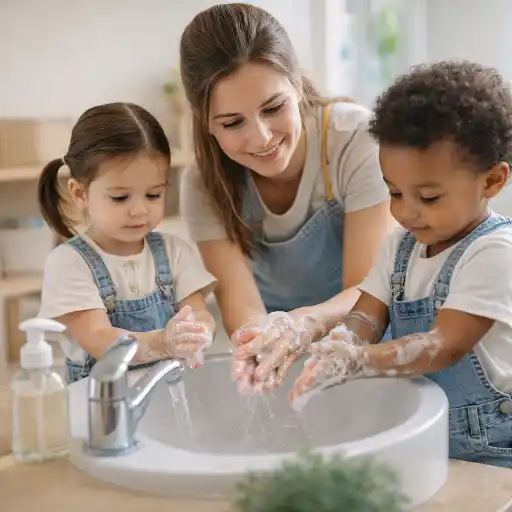
Use one consistent script: wet, soap, scrub, rinse, and dry. The CDC recommends clean running water, soap, scrubbing for at least 20 seconds, thorough rinsing, and complete drying. Children should learn to rub palms, the backs of hands, between fingers, thumbs, and under nails.
- Wet hands with clean, running water.
- Apply soap and create a lather.
- Scrub all hand surfaces for at least 20 seconds.
- Rinse thoroughly under running water.
- Dry with a clean towel or air dryer.
A song, rhyme, or short story can make 20 seconds concrete. Two rounds of “Happy Birthday” are a familiar cue, but programs may choose any age-appropriate song. The important factor is consistency.
Teach technique through demonstration, not correction from across the room. Say, “Let’s scrub between our fingers,” or “I see you washing your thumbs.” Children with motor, sensory, communication, or developmental differences may need visual cues, adapted equipment, hand-over-hand assistance, or additional time.
Make the routine positive rather than punitive. Praise effort and specific actions, and allow reasonable choices such as selecting between two accessible sinks. A visual handwashing poster Buy Now $0.99 can reinforce the sequence for children who benefit from picture-based support.
When is hand sanitizer appropriate, and how should it be used safely?
Soap and water are preferred because they remove dirt, grease, many germs, and some chemicals. When soap and water are not readily available, the CDC recommends an alcohol-based hand sanitizer containing at least 60% alcohol.
Sanitizer is a backup, not a replacement for handwashing. Do not rely on it when hands are visibly dirty or greasy, after toileting or diapering, after handling garbage, or after contact with certain body fluids. Sanitizer also does not eliminate every type of germ or remove all harmful chemicals.
Safety procedures are essential:
- Supervise children under six and children who may have difficulty following instructions.
- Store sanitizer up, away, and out of children’s sight when it is not being used.
- Use enough product to cover all hand surfaces and rub until hands are dry.
- Keep sanitizer away from eyes, mouths, heat sources, and flames.
- Follow the product label and your program’s written policy.
Accidental ingestion can cause alcohol poisoning. If a child may have swallowed sanitizer and is awake and alert, contact Poison Control at 1-800-222-1222 in the United States. Call emergency services if the child collapses or is not breathing. Directors should include storage, supervision, and emergency-response expectations in staff orientation.
How can directors make handwashing consistent and developmentally appropriate?
Consistency depends on systems, not reminders alone. Directors should ensure that sinks work, soap and towels are available, posters are visible, and children can reach the area safely. Stable step stools, child-height fixtures, easy-to-pump liquid soap, nearby trash cans, and accessible drying materials reduce unnecessary barriers.
Build a brief implementation plan:
- Post the five steps at every handwashing station.
- Identify required handwashing moments in the daily schedule.
- Teach the routine during orientation and practice it with staff.
- Observe classrooms periodically and coach respectfully.
- Send families the same language and key times used in the program.
- Document staff training and review policies regularly.
Pair handwashing with related infection-control practices. After diapering, staff must follow the full diapering procedure, clean and disinfect the changing surface as required, and wash hands. Mouthed toys should go into a designated container until they are cleaned and sanitized. Cleaning products must remain inaccessible to children and be used according to label directions.
Common mistakes include rushing the scrub step, treating gloves as a substitute for handwashing, using sanitizer after toileting, and expecting children to manage without supervision. Correct these through modeling, visual supports, practice, and calm feedback rather than shame.
For broader professional learning, providers may explore Prevention and Control of Infectious Diseases Buy Now $16.00, How To Keep A Healthy Class: Six Tips for Germ Control Buy Now $24.00, How To Keep A Healthy Class for Infants/Toddlers Buy Now $32.00, and Everyday Safety: Creating Healthy Environments Buy Now $55.00. Course acceptance and training-hour rules vary, so check your state licensing agency.
Conclusion: What handwashing rules should every provider teach?
Every child care provider should teach children to wash hands at predictable key times and to follow five consistent steps: wet, soap, scrub for at least 20 seconds, rinse, and dry. Adults must model the same behavior, supervise children who need support, and use sanitizer only as a supervised backup when soap and water are unavailable.
The strongest programs combine instruction with an environment designed for success. Accessible sinks, reliable supplies, visual cues, songs, respectful coaching, family communication, and documented staff training turn handwashing into a dependable daily habit. When providers connect hand hygiene with diapering, food safety, cleaning, and illness policies, they create a healthier and more secure environment for everyone.
- How To Keep A Healthy Class: Six Tips for Germ Control
- CDA Family Child Care Credential
- 24 Hour Texas Pre-Service
- Family Child Care Health Essentials
- Emergent Learning & Development
- 45-Hour Infant and Toddler Curriculum
- Texas Director Credential
- Building a Healthier Tomorrow: Preventing Childhood Obesity
- Everyday Safety: Creating Healthy Environments
- Shoo, Germs! Don't Bother Me!
- 😫🧸 ¿Qué hacer cuando un bebé no quiere dormir la siesta en el aula?
- ¿Cómo pueden los equipos de cuidado infantil practicar habilidades rápidas de primeros auxilios en situaciones reales?
- Regulaciones de Licenciamiento de Cuidado Infantil en California para Centros y Hogares de Cuidado Infantil Familiar
- Normas de Licenciamiento de Cuidado Infantil en Virginia para Centros Diurnos Infantiles y Hogares Diurnos Familiares
- Lista para Abrir una Guardería en Casa en Dakota del Norte: Cómo Empezar
- Lista para Guardería en Casa en California: Cómo Iniciar una Guardería en el Hogar
- Lista para Guardería en Casa en Texas: Cómo Iniciar una Guardería en el Hogar
- Cómo Trabajar en el Cuidado Infantil en California: Requisitos y Pasos
- DCF Child Care Exams: What to Expect and How to Prepare
- How can childcare programs prevent the spread of illness?
- How can child care programs meet licensing and compliance requirements?
- How can child care programs prevent the spread of illness?
- How can child care programs stop germs and keep children healthy?
- Health and Safety Training: 7 Everyday Habits That Protect Children in Care
- Child Care Facility Rules and Regulations DCF Practice Test: What Should You Study?
- What Handwashing Rules Should Every Child Care Provider Teach?
- What Should Every Child Care Allergy and Emergency Plan Include?
- How Can You Build a Family Child Care Day Around Shared and Individual Routines?
- What Health and Safety Training Is Required for Child Care Providers?
- What Should You Ask When a Family Reports a New Food Allergy?
