Supervision keeps children safe and helps staff do their job well. This short guide explains the basics of supervising children in Pennsylvania child care programs. It is written for directors and caregivers and uses easy steps you can share with your team. Remember: state requirements vary - check your state licensing agency.
Why it matters:
1. Supervision prevents accidents and keeps children healthy. Good supervision also builds trust with families. 2. Following state rules helps your program stay licensed and avoid penalties. For certification basics see Pennsylvania Child Care Certification.
What laws and staff numbers must we follow in Pennsylvania?
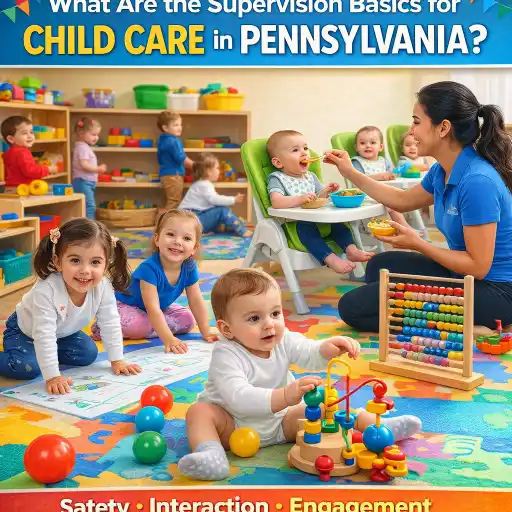
Pennsylvania sets rules that child care programs must follow. These rules explain how many staff must be on site and what counts as supervision. Read the full rules in the state code: 55 Pa. Code Chapter 3270. Two short, important points:
- 🔍 At least two facility persons must be present whenever two or more children are in care. One must be a staff person (see 55 Pa. Code §3270.54).
- 👥 Staff:child ratios depend on age and group size. For detailed ratios (infant, toddler, preschool), see 55 Pa. Code §3280.52.
Follow these rules every day. Post your certificate of compliance and have ratios visible for inspectors and families; more on certification is at PA certification info.
How do we practice active supervision every day?
- 👀 Positioning: place staff so they can see and quickly reach all children.
- 🔁 Scanning & Counting: scan the space and count children often, especially during transitions.
- 🎧 Listening: pay attention to sounds and calls for help.
- 🧭 Anticipating: know which children may wander or take risks and stay close.
- 🙂 Engaging: join play and redirect when needed to prevent problems.
Use zones or buddy systems for mixed-age groups and outdoor play. ChildCareEd has tools for mixed ages and bus supervision too (six strategies Buy Now $0.00).
What training and records do staff need?
- 📚 Annual training: plan for ongoing professional development and log hours in your PD system.
- 🩺 Health & Safety: make sure staff have training in child abuse reporting, first aid/CPR, safe sleep, medication, and supervision strategies. ChildCareEd offers courses like Safe Supervision
 Buy Now $24.00 and Active Supervision Buy Now $35.00.
 - 🗂️ Documentation: keep training certificates, staff background checks, staff schedules, sleep logs, and incident reports. These records help during licensing reviews.
Train substitutes the same way and run short drills so every staff member knows routines. ChildCareEd also provides staff supervision and mentoring courses (Staff Supervision, Observation & Feedback Buy Now $20.00).
How should we supervise sleep, transport, and trips?
Special times need extra planning. Naps, rides, and field trips require clear rules and hands-on supervision.
- 🛏️ Naps: follow safe sleep rules for infants—back to sleep, firm crib, no loose bedding. See ChildCareEd's safe sleep guides (safe sleep basics) and keep nap logs. For practical strategies to establish consistent sleep routines and to support families' and staff well-being, see Cracking the Code of Children's Sleep (And Your Sanity).
- 🚌 Transport & Excursions: have at least two adults on outings and follow transport ratios in state code. The rule about two adults on excursions is in 55 Pa. Code §3270.54 and detailed transport ratios appear in 55 Pa. Code §3280.52.
- 🔐 Safety steps: plan routes, share emergency contacts, review medical needs, and do headcounts at every step.
Common mistakes — and how to avoid them
- ❌ Mistake: Relying on one staff when more are needed. ✅ Fix: follow the two-person rule and ratios in state code (§3270.54).
- ❌ Mistake: Inconsistent nap checks. ✅ Fix: set a visual-check schedule and keep sleep logs.
- ❌ Mistake: Skipping training for substitutes. ✅ Fix: require core training before they work alone.
FAQ
- Q: How often should we count children? — A: Count at transitions: before leaving a room, getting on a bus, and after a break. Use a headcount every time.
- Q: Can one staff supervise outside with 10 preschoolers? — A: No. Use the state ratios in §3280.52 to decide.
- Q: Who files complaints about licensed programs? — A: Families can contact regional child care licensing; see PA certification info at ELRC certification.
Conclusion
Good supervision depends on clear rules, steady practice, and trained staff. Use state code for legal requirements (Chapter 3270), teach active supervision with tools from ChildCareEd, and keep records ready for licensing. Your #supervision, #safety, #ratio, #infants, and #training choices help every child thrive.
Active supervision means more than being in the room. It means watching, listening, positioning, and counting children on purpose. Use simple routines so all staff do the same things. ChildCareEd explains the main ideas in Active Supervision and offers a free poster you can hang up (Active Supervision Poster Buy Now $0.00).Training keeps staff ready. Pennsylvania expects regular training and health & safety topics. For an overview of state-approved training and why it matters, see ChildCareEd's training guide for PA.- CDA Certification en Español: Recursos y Consejos para Educadores Bilingües
- Qué capacitación se requiere para ser director de cuidado infantil en Texas?
- Niveles de credencial de Maryland: qué significan
- Que es Título 22 en California?
- ¿Cómo puedo usar escenarios de juego de roles de primeros auxilios en mi aula?
- Capacitación en Salud y Seguridad Preventiva en Línea para Proveedores de Cuidado Infantil
- ¿Cómo solicito la licencia para una guardería en California?
- Regulaciones de Licenciamiento de Cuidado Infantil en California para Centros y Hogares de Cuidado Infantil Familiar
- Proporciones de Cuidado Infantil y Tamaños de Grupo por Edad en Maryland (Guía Rápida para Centros y Hogares)
- Lista para Abrir una Guardería en Casa en Dakota del Norte: Cómo Empezar
- Lista para Guardería en Casa en Texas: Cómo Iniciar una Guardería en el Hogar
- Cómo Trabajar en el Cuidado Infantil en California: Requisitos y Pasos
- Capacitación Previa al Servicio para Proveedores de Cuidado Infantil en Dakota del Norte
- How can Pennsylvania child care providers prepare for licensing visits?
- What are the supervision basics for child care in Pennsylvania?
- How do I run a simple first-week staff onboarding plan for Pennsylvania child care?
- How can Pennsylvania child care programs celebrate National Ice Cream Day safely and with learning?
- How can the CDA help Pennsylvania child care providers — and is it on sale now?
- What are Pennsylvania's child care ratios and group size rules for centers and homes?
- How can Pennsylvania child care programs cover staff breaks and always stay in ratio?
