When a child grabs a toy, spills paint, or refuses to clean up, your response can turn a tense moment into a useful lesson in responsibility and problem-solving. Developmentally appropriate consequences help children connect actions with outcomes without shame or fear. To build practical, classroom-ready positive-guidance strategies, explore ChildCareEd’s Solutions NOT Punishments  Buy Now $16.00 and Viewing Guidance in a Positive Light Buy Now $24.00; these courses offer focused learning to strengthen your knowledge and practice.
Teaching about consequences is not about securing instant compliance. It is about helping young children understand what happened, learn what they can do next time, and remain connected to the classroom community. Because children’s language, impulse control, emotional regulation, and perspective-taking are still developing, the adult’s response needs to be safe, brief, respectful, and matched to the child’s abilities.
Why does a developmentally appropriate approach matter?
A consequence can teach a child that actions have results, but the experience is only useful when the child can understand the connection. A toddler may need an adult to model a very simple cause-and-effect link: “The water spilled. Let’s wipe it up.” A preschooler may be ready to help plan a solution after a toy conflict. These moments are opportunities to teach—not proof that a child is bad or deliberately difficult.
Developmentally appropriate practice accounts for children’s age, individual abilities, experiences, culture, and context. NAEYC’s Developmentally Appropriate Practice framework emphasizes decisions grounded in child development and knowledge of each child. A behavior that looks like refusal may reflect fatigue, a confusing direction, sensory overload, limited communication skills, or a transition that came too quickly.
Guidance protects both boundaries and belonging. NAEYC explains in Instead of Discipline, Use Guidance that children are learning the social skills adults may expect them to use; they need help practicing those skills. A calm, connected response can:
- Support children’s understanding of cause and effect.
- Preserve dignity and trust while setting firm limits.
- Build #selfregulation, communication, and problem-solving over time.
What is the difference between a natural consequence, a logical consequence, and punishment?
A natural consequence occurs without an adult arranging it. For example, if a child leaves a washable drawing outdoors and it gets wet, the result follows from the situation. A logical consequence is intentionally chosen by an adult and directly connected to the behavior: if a child spills water, they can help wipe it up with support. Both can help children learn when the connection is clear and the response is safe, reasonable, and respectful.
Punishment is different: it focuses on discomfort, shame, fear, or control rather than helping the child learn a useful next step. Taking away an unrelated activity because a child spilled paint does not teach how to use or clean art materials. Guidance asks, “What skill or repair is needed?” rather than, “How can I make this child pay?”
Use these questions before choosing a consequence:
- Is the outcome safe for this child and the other children?
- Can the child understand how the result connects to the action?
- Is the response proportionate and appropriate to the child’s developmental abilities?
- Does it help repair harm, restore safety, or practice a replacement skill?
Safety takes priority over allowing a natural outcome. Stop a child running toward a street or handling a dangerous object; then teach and practice a safe alternative. Never withhold food, rest, comfort, supervision, or other basic needs as a consequence. State requirements vary - check your state licensing agency.
How can providers choose consequences that teach?
Logical consequences work best when they are related, reasonable, and respectful. They should be brief, predictable, and shaped to the child’s age and abilities. The goal is not to make a child suffer; it is to help them participate in restoring a safe, workable environment and learn what to do next time.
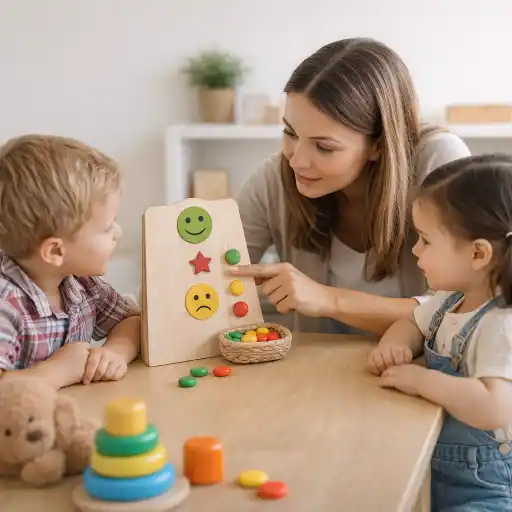
Examples can be adapted to each child and classroom:
- 🧽 If a child spills water, invite them to help wipe it up, offering assistance as needed.
- If a child throws blocks, pause access to the blocks while you support safe use and restore the play area.
- If a child grabs a toy, help return it and practice asking for a turn or waiting with adult support.
- If scissors are being used unsafely, put them aside briefly, restate the safety limit, and model how to use them appropriately.
- If a child hurts a peer, attend to the peer first, then guide a meaningful repair when the children are ready—such as checking in or helping rebuild.
Keep language concise: “I won’t let you throw blocks. Blocks are for building. Let’s put them away and practice gentle hands.” Offer choices when possible: “You can help wipe the spill, or I can help you start.” Avoid sarcasm, public lectures, labels, forced apologies, or consequences that last longer than needed to teach the lesson.
How can adults teach children to connect actions and outcomes?
Young children benefit from repeated, concrete experiences—not long explanations delivered during an emotional moment. Narrate simple sequences in everyday routines: “First we put the lids on the markers; then the markers stay ready for next time.” The ability to understand before and after, possibility, and why-because grows gradually, so revisit these ideas through play, stories, and conversation.
Edutopia’s Explaining Consequential Thinking to Young Children describes ways to build these early thinking skills. During a calm moment, adults can ask open, non-judgmental questions such as “What happened after the water spilled?” or “What might we try next time?” With younger children, model the answer first. A storybook offers a low-pressure way to wonder together: “What might happen if the character leaves the blocks on the floor?”
When behavior escalates, prioritize safety and regulation. Use a calm voice, state the limit briefly, and help the child settle before discussing or practicing. Afterward, connect the action to a next step without blame: “You wanted the truck. You grabbed it, and Maya got upset. Next time, you can ask for a turn or get my help.” Children learn through repetition, supportive relationships, and chances to try again. Consistent #guidance is a teaching process, not a one-time speech.
How can teams make consequence-based guidance consistent?
Consistency does not mean treating every child or incident identically. It means staff share the same principles: protect safety, speak respectfully, understand context, choose a related response, and teach an alternative. A simple team plan can reduce improvised reactions when the room is busy.
- Prevent avoidable problems with clear routines, adequate materials, transition warnings, and active supervision.
- Connect with the child: move close, use a calm voice, and acknowledge the feeling or goal.
- Set a clear limit: “I won’t let you hit. Hitting hurts.”
- Teach a replacement: model asking for a turn, getting help, or using a calming strategy.
- Use a related, brief consequence if needed, then support repair and a return to play.
Directors can help staff practice common scenarios in meetings and agree on shared language. For recurring behavior, record objective observations: what happened before, what the child did, and what followed. An ABC observation—antecedent, behavior, consequence—can reveal environmental patterns or unmet needs. Partner with families using strengths-based, factual communication, and consider adaptations for disability, communication differences, sensory needs, or trauma. If behavior is persistent or presents a safety concern, collaborate with appropriate specialists and follow program procedures.
Conclusion: What are the key takeaways for teaching consequences?
Developmentally appropriate consequences help children understand cause and effect, take part in repair, and learn useful skills—without shame or fear. Natural consequences may be allowed only when safe and understandable; logical consequences should be related, reasonable, respectful, and brief. Adults should intervene immediately when safety is at risk.
Most of all, a consequence is not a substitute for connection, prevention, or teaching. Set clear limits, consider what the child may be communicating, model the behavior you want to see, and offer a chance to practice again. By choosing guidance over punishment, providers help children grow in responsibility while keeping the classroom a place where every child belongs.
For further professional learning, consider these English-language ChildCareEd courses:
- Solutions NOT Punishments Buy Now $16.00 — practical positive-discipline strategies.
- Viewing Guidance in a Positive Light Buy Now $24.00 — developmentally appropriate guidance and classroom planning.
- The ABCs of Behavior: Turning Challenges into Learning Opportunities Buy Now
$55.00$45.00 — understand behavior through antecedents, behavior, and consequences. - From Tantrums to Triumphs: Equipping Preschoolers with Self-Regulation Skills Buy Now $25.00 — strategies for supporting preschoolers’ self-regulation.
- You're Not My Friend Anymore: Learning Conflict Resolution Buy Now $16.00 — support children’s peer problem-solving and conflict resolution.
- You're Not My Friend Anymore: Learning Conflict Resolution
- Lesson Planning for Preschoolers
- CDA Home Visitor Subject Area 3 Part 3 Birth to 5
- CDA Home Visitor Subject Area 2 Part 3 Birth to 5
- The ABCs of Behavior: Turning Challenges into Learning Opportunities
- Birth to Five CDA Credential with Portfolio Review
- Pediatric RSV First Aid & CPR/AED
- CDA Bridge Bundle: Family Child Care without Portfolio Review
- Play, Learn, Grow
- CDA Certification en Español: Recursos y Consejos para Educadores Bilingües
- 😅❌ ¿Cómo Puedo Manejar a un Niño que Dice “¡NO!” a Todo en el Aula?
- 😤💬 ¿Qué Le Digo a un Niño que Acaba de Morder a Otro?
- ❄️ ¿Qué actividades al aire libre funcionan bien para los niños de Illinois en cada estación? 🌷🍂
- Requisitos Para Ser Maestra Principal En Un Daycare: Lo Que Necesitas Para Empezar
- Regulaciones de Licenciamiento de Cuidado Infantil en California para Centros y Hogares de Cuidado Infantil Familiar
- Normas de Licenciamiento de Cuidado Infantil en Virginia para Centros Diurnos Infantiles y Hogares Diurnos Familiares
- Consejos de Supervisión Activa para Salones de Preescolar y el Juego al Aire Libre
- Retraso del Habla en la Guardería: Cómo Pueden Ayudar los Proveedores
- Cómo Trabajar en el Cuidado Infantil en California: Requisitos y Pasos
- Cómo Ser Maestra de Preescolar en Wisconsin
- Las Mejores Ideas de Excursiones para Guarderías en Texas
- Celebrando la amistad en el cuidado infantil durante el Día de los Mejores Amigos
- Why Do Classroom Management Strategies Fail With 3-Year-Olds—and What Works Instead?
- When Learning Feels Hard: Positive Discipline Strategies for Children Who Struggle
- How Can Child Care Providers Use Positive Discipline to Teach, Connect, and Guide Young Children?
- How Can Child Care Providers Use Natural and Logical Consequences with Young Children?
- What Is the Difference Between Positive Discipline and Punishment in Early Childhood Education?
- How Can Child Care Providers Help Young Children Follow Directions?
- What Are Developmentally Appropriate Ways to Teach Children About Consequences?
