Montessori education is based on scientific observations of human development. Dr. Maria Montessori, a scientist, and a medical doctor, based her approach on thousands of hours of observation of children and a lifetime of experimentation and refinement, developing a scientific model of human development and an educational approach that supports fully realized human potential.
Explore practical professional development for classroom implementation such as Montessori Made Simple Buy Now $35.00 and The Montessori Classroom: Theory to Practice Buy Now $25.00.
What is Montessori education?
Montessori is a child-centered educational approach grounded in systematic observation and the developmental work of Maria Montessori. It emphasizes a prepared environment, self-directed activity, hands-on materials, and mixed-age groupings so children can practice autonomy while teachers observe and guide. Montessori assessment focuses on developmental progress rather than standardized testing and uses observation to individualize learning. For a concise practitioner-oriented overview of Montessori principles, see What Is Montessori Learning?.
What are the essential elements of Montessori practice?
- Children choose their own work- Children choose their own activities from a range of carefully prepared lessons and materials designed to support children’s natural development and drive to learn.
- Trained teachers support children’s development- Teachers trained in Montessori principles and practice present a comprehensive curriculum individualized for each child.
- Mixed-age groupings- Classrooms serve children in three-year age groupings according to developmental stages. Children can progress naturally as they are ready for more challenging material, build authentic community and learn from both teachers and peers.
- Uninterrupted independent work periods- Classrooms offer long uninterrupted periods for independent work, where children build attention, focus, and concentration while learning at their own pace.
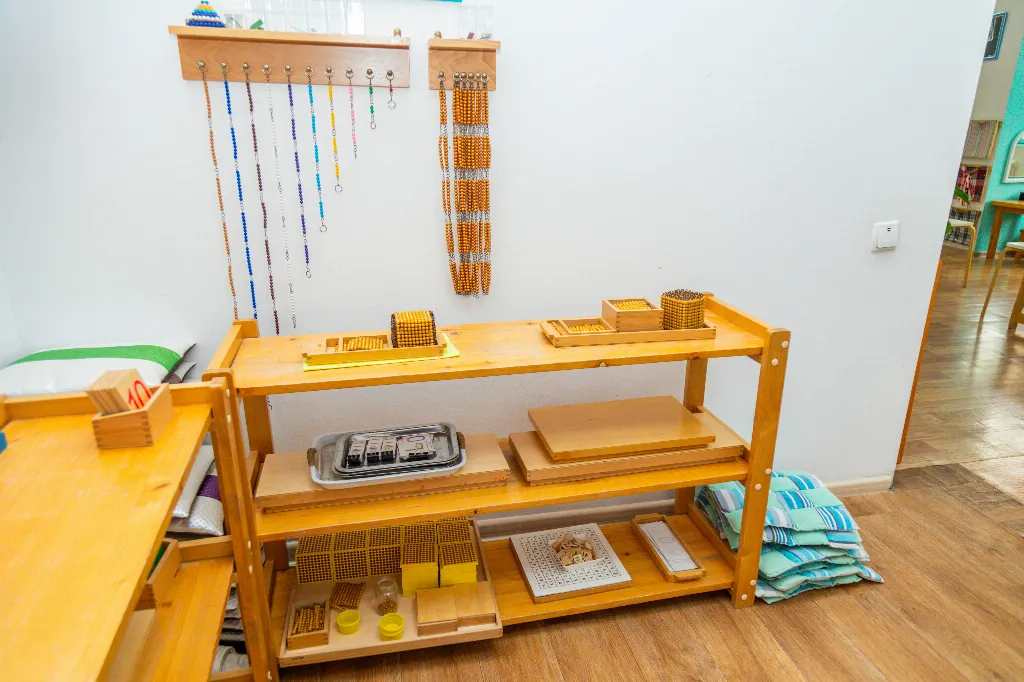
- Montessori materials- Hands-on, concrete, self-correcting materials support engagement, curiosity, independence, and self-guided learning.
Evidence shows that Montessori students often outperform their peers in both verbal and mathematical measures, and that children who attend Montessori programs frequently show stronger executive function and social understanding. Randomized evaluations of public Montessori preschools report improved kindergarten outcomes in reading, memory, executive function and social understanding, and have highlighted cost-effectiveness in some implementations. A national study summarizes these effects for early learners.
These gains are attributed to multiple features of Montessori practice: extended, uninterrupted work periods that promote sustained attention; hands-on, self-correcting materials that let children learn by doing; and mixed-age classrooms that support peer teaching and leadership. Observational assessment—the core teacher skill in Montessori practice—lets teachers tailor presentations to each child's sensitive periods and developmental needs. For practical classroom ideas that translate these outcomes into daily practice, see our articles on Grace and Courtesy Activities for Montessori Classrooms and Montessori Social Skills: Grace and Courtesy Lessons.
While evidence is encouraging, program design and fidelity to Montessori principles matter: quality prepared environments, teacher training in observation, and appropriate grouping by developmental stages influence outcomes. To improve observation-based assessment in your classroom, consider our course Mastering Observation Techniques in the Montessori Classroom  Buy Now $16.00, which supports reliable data collection and individualized planning.
 How can teachers implement Montessori practices in their programs?
Knowing each child and responding to developmental needs is central, but teachers also need actionable systems. Below are practical, sequential steps you can apply in child care or preschool settings to bring Montessori elements into daily practice.
- Design a prepared environment: Arrange accessible shelves, defined work areas, and clearly labeled materials so children can make independent choices. For design specifics and layout strategies see our article How can I organize an effective preschool classroom? and the course The Prepared Environment: Montessori Class Design Buy Now $16.00.
- Create longer uninterrupted work periods: Schedule blocks of time that allow deep engagement and reduce task-switching to build concentration.
- Use hands-on, self-correcting materials: Introduce concrete materials that isolate concepts and permit self-correction to support mastery and independent learning.
- Implement mixed-age grouping strategies: Organize groups so older children can model and mentor younger peers; for evidence-based approaches to mixed-age practice see How do we apply Developmentally Appropriate Practice in mixed-age groups? and our course Montessori Essentials: Mixed-Age Mastery.
- Train teachers in observation and individualized presentation: Teachers should record systematic observations, identify sensitive periods, and present lessons at the child's readiness level. Our course Mastering Observation Techniques in the Montessori Classroom Buy Now $16.00 and the article How to Become a Montessori Assistant Teacher support these professional skills.
- Practice Grace and Courtesy and conflict resolution: Build social curricula that teach children communication and problem-solving skills. See our practical activities in Grace and Courtesy Activities for Montessori Classrooms.
- Reflect, adapt, and document progress: Use observation notes to adapt materials, groupings, and lesson presentations. For structuring reflective practice, read How do you build a classroom that encourages independent thinking?.
We also offer targeted staff training and leadership courses to support implementation and fidelity to Montessori principles.
What are practical next steps I can take this week?
1) Walk the classroom with an observation sheet and note one child's choice patterns; 2) rearrange one shelf to improve accessibility; 3) plan a single 45–60 minute uninterrupted work block tomorrow; 4) schedule a short staff meeting to review observation notes and align on one change. For more on celebrating identity and inclusive practice while you implement Montessori, see our article How Can You Celebrate Black Culture and Music Effectively in Your Program?.
By combining observation-based planning, modest environmental changes, and targeted staff training, centers can begin to realize Montessori benefits without an overnight overhaul.
What is the bottom line for busy programs?
Montessori implementation improves attention, independence, and social development when programs commit to a prepared environment, staff observation training, and consistent uninterrupted work periods. Begin with one small change, document outcomes, and iterate weekly.
How can I summarize key Montessori actions to transform my classroom?
Start with systematic observation: record what children choose, how long they sustain attention, and moments of readiness. Prioritize a prepared environment that places concrete materials on low, labeled shelves and provides consistent, predictable work areas. Schedule at least one uninterrupted 45–60 minute work period daily to support sustained attention and executive function, and organize children in mixed-age groupings so mentorship and leadership naturally emerge. Invest in at least one targeted staff training module on observation and individualized presentation, and use brief weekly reflection meetings to adapt materials and groupings based on documented observations. Taken together, these small, iterative changes preserve program continuity while improving developmental outcomes and classroom climate. Key themes: #Montessori #observation #independence #environment #mixedage.
For deeper reading on Montessori foundations and classroom design see What can the National Mall teach us about building a classroom where every child has a voice? and our practitioner piece Is the Lost Art of Letting Children Figure It Out Worth Rediscovering?.
- CDA Home Visitor Subject Area 3 Part 3 Birth to 5
- Authentic Montessori in Action
- Emergent Learning & Development
- 45 Hour Preschool Methods and Materials
- Montessori Foundations
- Understanding Montessori's Approach to Child Development
- CDA Bridge Bundle: Preschool
- Mastering Observation Techniques in the Montessori Classroom
- Intro to Montessori: Philosophy, Principles, and Practices
- Texas Director Credential
