A tray of autumn treasures can become a lively science investigation when children discover that a magnet does not attract every metal object. To strengthen your planning and classroom practice, explore ChildCareEd’s Basic Science in Early Childhood Buy Now $25.00 training, which helps educators create meaningful opportunities for children to investigate, question, and experiment. Read on for a practical, safe way to turn that big question into a discovery-center experience.
Why is this a worthwhile fall discovery-center question?
Fall offers a natural invitation to collect, compare, and sort: a sturdy jar lid, a clean metal ring, a leaf, a pinecone, or a smooth stone can all prompt children to wonder what materials are made of. Asking “Is every metal magnetic?” takes that familiar curiosity a step further. Children may expect every shiny or metal-looking object to stick, then discover that the magnet’s response depends on the material—not simply its color or appearance.
This is a useful early-science experience because the question is concrete, testable, and open to repeated exploration. Children make predictions, observe what happens, compare results, and revise their ideas. Those actions support inquiry habits alongside language, early classification, and collaborative problem-solving. As Karen Worth’s discussion of science in early childhood classrooms emphasizes, children’s curiosity can provide a meaningful starting point for inquiry and learning across domains.
The goal is not to teach a complete physics lesson or demand a technically sophisticated explanation. Instead, invite children to notice a pattern: magnets attract certain materials, including iron and many kinds of steel, but not all metals. The surprise is part of the learning. When children see that a familiar rule needs refining, they get to experience how investigation helps us build better explanations.
What does the magnet actually tell children?
A magnet attracts some materials; it does not identify every object that is metal. Iron is magnetic, and many steel objects respond because steel contains iron. Aluminum and copper are common examples of metals that are not attracted to an ordinary classroom magnet. Stainless steel can vary by composition, so it is better to test a specific object than to promise that every stainless-steel item will behave the same way. The American Chemical Society’s activity on metals and magnetism offers examples of familiar objects with different results.
Use clear, accessible language: “The magnet attracted this object,” or “This object was not attracted.” This describes what children observed without suggesting that all metal is magnetic. If children say, “The magnet likes the shiny things,” acknowledge the idea and invite another test: “Let’s check a dull-looking object. What do you think will happen?”
- Magnetic: attracted to the magnet in this test.
- Not attracted: the magnet did not pull the object in this test.
- Metal: one kind of material; a metal object is not automatically magnetic.
Keep the explanation at the level children can use. They can recognize patterns in results long before they need an account of microscopic particles or magnetic domains. That distinction helps providers support accurate science while staying developmentally responsive.
How can you set up a hands-on investigation?
Make the discovery center inviting but uncluttered. Place a child-safe wand or large bar magnet on a tray, add a few clearly different objects, and provide two labeled spaces: “attracted” and “not attracted.” Include a mix of materials and appearances—for example, a large steel washer, a steel can lid with no sharp edges, a wooden block, a plastic lid, a fabric swatch, and a large aluminum item. Add a few safe fall finds such as a pinecone or smooth stone for comparison.
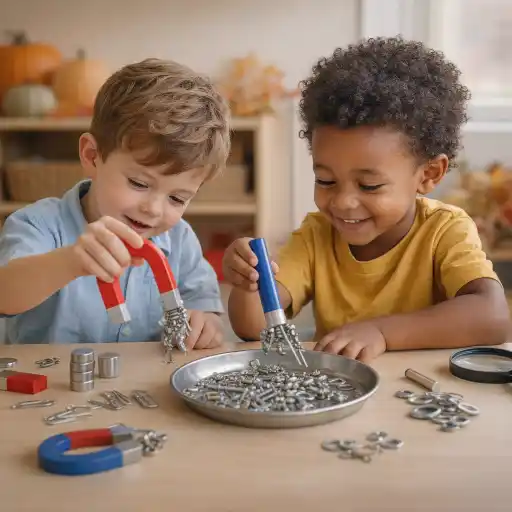
Before children test, encourage them to choose an object and make a prediction. They can point, say “yes” or “no,” place a picture card, or mark a simple chart. Then let them touch the magnet to the object and sort it according to what they observe. The sequence—predict, test, observe, sort, and talk—supports thoughtful investigation without making the activity feel like a quiz.
- Start with a small selection, then add more items as interest grows.
- Use a tray to contain materials and make cleanup easier.
- Invite children to compare objects that look alike but respond differently.
- Record results with drawings, tally marks, photos, or children’s words.
- 🧲 Ask, “What do you notice about the things the magnet attracted?” and give children time to think.
For ideas on supporting prediction and open exploration, see Be a Magnet Detective. Keep your own prompts open-ended; the children’s observations should drive the next question.
How can you make the center safe and accessible?
Magnets and loose objects require active adult planning, especially with infants and toddlers or children who mouth materials. Use age-appropriate, intact magnets designed for children; do not offer small, loose magnets or small test objects to children who may put them in their mouths. High-powered magnets and small magnetic parts can pose serious hazards if swallowed. Follow product guidance, program policies, and applicable safety requirements, and keep materials within continuous adult supervision.
Choose large, smooth items without sharp edges, rust, loose parts, or choking hazards. Inspect the collection before each use and remove anything damaged or unsuitable. Keep magnets away from devices or equipment that may be affected, in accordance with manufacturer guidance. State requirements vary - check your state licensing agency.
Accessibility is part of good planning, too. Offer objects that are easy to grasp, stabilize the tray, and allow children to participate by pointing, using a communication device, choosing a picture, or dictating a prediction. A peer can help hold the tray or record a result without taking over the investigation. If a child prefers to watch first, that is a valid way to engage; invite participation without pressure.
- Model safe handling and clear expectations before opening the center.
- Keep magnets and objects accounted for; count them in and out if appropriate.
- Use close supervision and put materials away when an adult cannot attend the area.
How can you extend learning without giving away the answer?
Children often begin with a broad theory: “Magnets pull metal.” Rather than correcting them immediately, invite them to test more examples. Present a metal object that is not attracted, then ask, “What happened to our idea? What could we check next?” This helps children use evidence to refine a claim. The National Science Teaching Association’s early-years exploration of magnetism recommends discussion and documentation as ways to help children articulate observations and build on their thinking.
Extend the investigation gradually. Children might compare how a magnet moves an object through paper or fabric, test whether distance changes what they observe, or look for places magnets are used in the classroom. Keep one variable in focus at a time and describe the result carefully. A classroom magnet test does not establish that an item contains no metal; it only shows that the magnet did not attract it under the conditions tested.
Common pitfalls are easy to avoid:
- Calling every metal object magnetic: say “some metals” and test examples.
- Relying on appearance: compare shiny and dull items, and avoid guessing from color.
- Turning the activity into a right-answer exercise: celebrate predictions and changing ideas.
- Using too many objects at once: offer a manageable set, then rotate new materials in.
For further professional learning on intentional early-science experiences, consider ChildCareEd’s Building Early Science Foundations  Buy Now $16.00 or Enhancing STEM Education for Infants and Toddlers Buy Now $16.00. These courses address broader strategies for fostering inquiry and exploration with young children.
Conclusion: What should children take away?
“Is every metal magnetic?” is a question worth adding to a fall discovery center because it turns an everyday assumption into an observable investigation. The central takeaway is simple and accurate: a magnet attracts some materials, including iron and many steels, but not every metal. Children can explore that pattern through safe materials, predictions, repeated tests, sorting, and conversation.
For providers, a strong activity does not depend on elaborate equipment or a long explanation. Prepare an accessible selection of objects, supervise closely, use precise language, and leave room for children to revise their thinking. Notice what they say and do; their questions can guide the next round of exploration. A well-planned magnet center supports science reasoning while inviting children to approach the changing fall world with curiosity and confidence.
For a deeper foundation in planning early-science learning experiences, explore ChildCareEd’s Basic Science in Early Childhood Buy Now $25.00. It offers additional professional learning to help you shape purposeful investigations in your classroom.
- CDA Certification en Español: Recursos y Consejos para Educadores Bilingües
- Requisitos Para Ser Maestra Principal En Un Daycare: Lo Que Necesitas Para Empezar
- Que es Título 22 en California?
- ¿Cuáles son las mejores actividades del Día de la Tierra para niños en casa o en el aula?
- Capacitación en Salud y Seguridad Preventiva en Línea para Proveedores de Cuidado Infantil
- Regulaciones de Cuidado Infantil en Maryland para Centros y Hogares de Cuidado Infantil Familiar
- Regulaciones de Licenciamiento de Cuidado Infantil en California para Centros y Hogares de Cuidado Infantil Familiar
- Normas de Licenciamiento de Cuidado Infantil en Virginia para Centros Diurnos Infantiles y Hogares Diurnos Familiares
- Proporciones de Cuidado Infantil y Tamaños de Grupo por Edad en Wisconsin (Guía Rápida para Centros y Hogares)
- Consejos de Supervisión Activa para Salones de Preescolar y el Juego al Aire Libre
- Cómo Trabajar en el Cuidado Infantil en California: Requisitos y Pasos
- Cómo Ser Maestra de Preescolar en Wisconsin
- Capacitación Previa al Servicio para Proveedores de Cuidado Infantil en Illinois
- Las Mejores Ideas de Excursiones para Guarderías en Texas
- Las Mejores Ideas de Excursiones para Guarderías en Georgia
- Capacitación CDA gratuita en Illinois
- Calabazas, hojas y manzanas: actividades de otoño para preescolares
- Celebrando la amistad en el cuidado infantil durante el Día de los Mejores Amigos
- La mejor manera de hacer seguimiento a la capacitación de su equipo de daycare How to Organize Staff Training for Your Child Care Center Cómo organizar la capacitación del personal para su centro de cuidado infantil
- Is Every Metal Magnetic? A Question Worth Adding to Your Fall Discovery Center
