A safe playground is built through consistent inspections, timely maintenance, and supervision—not a once-a-year scramble before licensing visits. Strengthen your team’s ability to identify outdoor hazards and respond proactively with Active Supervision: A Strategy That Works Buy Now $35.00, a three-hour training focused on watching, listening, interacting, and preventing problems during children’s play.
For broader premises and outdoor-safety knowledge, directors may also explore Building and Physical Premises Safety  Buy Now $10.00. The course addresses hazard identification and prevention and may support professional-development goals; state requirements vary, so verify applicability with your licensing agency.
Why Does a Formal Playground Safety System Matter?
Outdoor play supports physical coordination, confidence, social negotiation, creativity, and healthy risk-taking. Children need meaningful challenges, but those challenges should not include preventable hazards such as exposed hardware, inadequate surfacing, or an unsecured gate. A formal inspection system helps providers preserve the developmental value of play while reducing avoidable danger.
Inspections also create operational consistency. When the same categories are checked, documented, and reviewed, a director can identify recurring problems rather than relying on memory or informal conversations. Written records demonstrate that the program has a process for identifying hazards, removing unsafe equipment, assigning repairs, and verifying completion.
ASTM F1487 identifies requirements related to equipment, layout, installation, structural integrity, maintenance, and hazard assessment for many public-use playgrounds. The standard is not a substitute for local law, and its scope does not include every type of play equipment or every age group. Use it together with CPSC guidance, manufacturer instructions, accessibility requirements, and state licensing rules.
- Protect children through prevention rather than reaction.
- Give staff a shared language for reporting hazards.
- Make repairs and follow-up visible to the entire team.
- Build a reliable record for licensing and internal quality improvement.
What Should a Daily or Pre-Use Playground Inspection Include?
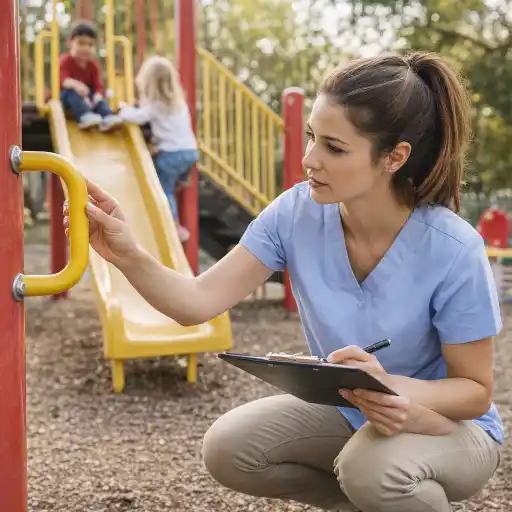
A daily inspection should be brief enough to complete consistently and specific enough to catch changing conditions. Assign a trained staff member to inspect before children enter the yard and, when required by your rules, before each separate outdoor session. Document the date, time, inspector, findings, and action taken.
- 🔍 Equipment condition: Check swings, slides, climbers, platforms, rails, chains, ropes, connectors, fasteners, caps, and anchors for looseness, cracks, rust, sharp edges, splinters, or missing components.
- Fall protection: Look for displaced, compacted, wet, eroded, or contaminated surfacing, especially under swings and at slide exits.
- Entrapment and entanglement: Identify dangerous openings, damaged barriers, protrusions, loose ropes, and clothing-catching hardware.
- Ground and pathways: Remove glass, litter, animal waste, broken toys, roots, holes, standing water, and other trip hazards.
- Boundaries: Test gates, latches, fencing, borders, and access points near roads, parking areas, water, or maintenance zones.
- Visibility: Confirm that shrubs, storage, equipment placement, and temporary items do not create supervision blind spots.
- Weather: Check for hot surfaces, ice, rain, storm damage, smoke, poor air quality, and unsafe wind conditions.
A checkmark without details is weak documentation. If something fails, describe the exact location and condition—for example, “right swing chain shows corrosion near upper connector,” rather than “swings need attention.”
How Should Monthly and Annual Inspections Differ?
Daily checks identify obvious and immediate hazards. Monthly or quarterly operational inspections should examine how equipment performs over time. The person completing this review may need a tape measure, flashlight, hand tools, surfacing probe, photographs, and access to manufacturer documentation.
Review structural stability, anchors, fasteners, moving parts, swing hangers, protective barriers, drainage, surfacing distribution, use-zone clearances, age-designated areas, signage, accessibility routes, and recurring repair trends. Compare observations with the equipment manufacturer’s instructions and applicable CPSC and ASTM guidance. Do not assume that a structure is compliant merely because it was safe when installed.
An annual comprehensive review should evaluate the entire site, including layout, installation, structural integrity, maintenance history, surfacing, accessibility, and changes made since the prior review. For complex or heavily used sites, consider a qualified or Certified Playground Safety Inspector. The National Recreation and Park Association describes CPSI training as covering hazard identification, equipment specifications, surfacing, and risk management.
Increase inspection frequency after:
- Severe weather, flooding, freeze-thaw cycles, or extreme heat.
- Vandalism, construction, landscaping, or equipment relocation.
- Reports from staff, families, children, or maintenance personnel.
- Periods of unusually heavy use, such as summer programming.
- A near-miss, injury, or repeated defect.
How Can Programs Maintain Safe Surfacing, Use Zones, and Age Separation?
Impact-attenuating surfacing must be evaluated across the full use zone—not only where the surface looks attractive. Loose-fill materials can migrate, compact, decompose, and become shallow beneath high-use equipment. Unitary surfaces can crack, buckle, separate, or deteriorate with age. Measure, rake, replenish, repair, and document according to current guidance, manufacturer specifications, and local requirements.
Fall zones and use zones depend on equipment type and height. Stationary equipment commonly requires a clear area around the structure, while swings and slides have additional movement and exit considerations. Because dimensions vary by equipment and standard, directors should avoid copying a single number onto every checklist. Confirm the applicable requirements for each structure.
Age separation is equally important. ASTM F1487 covers much public-use equipment for children from approximately age two through twelve, but infant and toddler equipment may fall under different guidance. Use clear signage, physical separation when feasible, and developmentally appropriate equipment. A preschool child should not routinely access equipment designed for older children simply because the areas are nearby.
- Record the material type, depth, condition, and high-use areas.
- Check drainage and erosion after rain.
- Keep hard surfaces, exposed footings, and debris out of fall zones.
- Maintain accessible routes and inclusive entry points.
- Review equipment modifications before allowing use.
State requirements vary - check your state licensing agency. The federal National Database of Child Care Licensing Regulations can help directors locate state regulations, agency contacts, and searchable licensing documents.
What Is the Correct Response When a Hazard Is Found?
The first priority is control, not paperwork. Move children away from the hazard, stop access, and place a visible “Do Not Use” tag or barrier on the affected equipment. Notify the director or designated maintenance lead immediately. A verbal warning alone is not enough if children can still reach the unsafe area.
Record the hazard with a date, time, location, description, photograph when appropriate, person notified, and corrective action. Assign an owner and due date. For structural failures, damaged anchors, unsafe surfacing, or uncertain repairs, consult the manufacturer or a qualified professional rather than improvising.
Do not return equipment to service merely because a repair appears complete. A responsible person should verify the repair, inspect the surrounding area, remove temporary barriers only when appropriate, and document the return-to-service date. Retain inspection and maintenance records according to state, organizational, insurance, and legal guidance.
Near-misses deserve careful review. A child nearly leaving through an unlatched gate, slipping on a wet surface, or catching clothing on a protrusion may reveal a system weakness even when no injury occurs. Discuss patterns without blame and update the checklist, supervision plan, equipment arrangement, or staff training.
- Secure the hazard immediately.
- Communicate clearly with all staff.
- Document the finding and resolution.
- Notify families and authorities when required after an incident.
- Analyze recurring concerns during staff meetings and monthly audits.
How Can Directors Build a Sustainable Inspection Culture?
Inspection systems succeed when they are visible, assigned, practiced, and reviewed. Keep the daily form near the playground exit, use one consistent format, and train new employees with a completed example. Assign responsibility for daily checks, repairs, documentation review, and annual evaluations so accountability does not depend on one person’s memory.
Create a compliance calendar that includes daily checks, monthly operational reviews, annual audits, surfacing replenishment, equipment servicing, training renewals, and follow-up deadlines. Review the calendar during staff meetings. A short pre-play huddle can connect inspection findings with active supervision: identify closed equipment, clarify zones, assign first-aid responsibilities, and confirm child counts.
Common mistakes are usually process problems rather than carelessness:
- ❌ Signing without inspecting: Require specific observations and corrective-action notes.
- ❌ Checking only once: Inspect before each required use and after environmental events.
- ❌ Leaving hazards accessible: Tag, block, and communicate closures.
- ❌ Ignoring documentation gaps: Audit logs weekly or monthly and correct missing information promptly.
- ❌ Forgetting staff practice: Use brief scenarios to rehearse weather closures, injuries, missing children, and equipment failures.
Five additional ChildCareEd courses can support related professional learning: Preventative Health and Safety Buy Now $24.00, 1,2,3, Eyes on Me: Classroom Safety Buy Now $32.00, Effective Supervision in Child Care Buy Now $25.00, Injury Prevention: Their Safety Is In Your Hands Buy Now $24.00, and Responding to Emergencies Buy Now $16.00. Select training based on your program’s needs and confirm any state-specific acceptance before counting hours toward a requirement.
Conclusion: How Can a Program Keep Playground Safety Standards Current?
A dependable playground safety program combines pre-use checks, scheduled operational inspections, comprehensive reviews, active supervision, prompt hazard control, and complete documentation. Directors should evaluate equipment condition, fall protection, use zones, age appropriateness, boundaries, visibility, weather, accessibility, and repair follow-through—not simply whether the playground looks clean.
The central question is not whether a playground was once safe; it is whether the program has a repeatable system that keeps it safe as children play, weather changes, materials wear, and staff teams evolve. Keep the checklist practical, train staff to act on findings, review patterns, and check current state requirements regularly.
- Basic Health & Safety and Breastfeeding Awareness
- Adult Only CPR AED and Adult First Aid Blended
- Adult/Child CPR AED and Adult First Aid Blended
- Preventative Health and Safety
- Family Child Care Health Essentials
- Positive Attention: Interactions & Supervision for Infants & Toddlers
- Texas Director Credential Renewal
- Texas Director Credential
- Family Child Care: Building, Premises, and Outdoor Safety
- Mindful Supervision: Balancing Safety & Independence in Montessori
- CDA Certification en Español: Recursos y Consejos para Educadores Bilingües
- Daycare Training 101: Building a Safe, Fun, and Educational Environment
- Staying Compliant in the Lone Star State: Avoiding Common Licensing Pitfalls
- Cómo Solicitar una Licencia de Guardería en Texas
- Missouri Child Care Licensing Rules: A Guide for Family Child Care Homes, Group Child Care Homes, and Child Care Centers
- Maryland Home Daycare Checklist: How to Start a Daycare at Home
- How to Get a Daycare License in Virginia
- How can I open or expand a child care program in Michigan with Caring for MI Future funding?
- How can child care programs keep playgrounds safe every day?
- How can child care programs keep playgrounds safe for infants through school-age children?
- How can childcare providers and families keep children safe around water?
- How Can Child Care Programs Keep Outdoor Play Safe?
- Playground Safety Checklist Template for Child Care Programs
- How Can Your Program Best Prepare for Accreditation?
- MN Daycare Rules and Regulations 2026: Current Requirements and Upcoming Changes
- What Massachusetts EEC Regulations Do Child Care Providers Need to Follow?
- What Certifications Do I Need to Open a Daycare? License, Training, and Credentials Explained
- Childcare License Texas: Which Permit Do You Need for the Program You Want to Open?
- Texas Home Daycare Minimum Standards: Which Rules Apply to Your Type of Home?
- How Can Child Care Programs Maintain Playground Safety Inspections and Standards?
