Fall celebrations create memorable moments, but a camera should never pull children away from the play, discovery, and relationships that make the event meaningful. Learn how to capture authentic evidence of learning while keeping supervision, participation, and children’s dignity at the center—and explore Preschool Assessments & Observations  Buy Now $24.00 to build practical skills in objective observation, assessment, and planning individualized experiences.
Why should photos document learning instead of staging it?
Seasonal gatherings offer children natural opportunities to investigate, create, communicate, and collaborate. A child comparing pumpkin sizes, explaining a leaf collage, or negotiating roles at a pretend harvest stand is demonstrating learning in context. A posed portrait may be a lovely keepsake, but it rarely tells the whole story of what the child was thinking or practicing.
Purposeful images can help make learning visible to families and support educators’ reflection. NAEYC’s guidance on using observation to guide teaching emphasizes watching and listening intentionally, then using what educators notice to adjust strategies and plan responsive learning experiences. A photo is one piece of evidence—not an assessment by itself—and it is most useful when paired with context, observation notes, or a child’s own words.
Keep the goal simple: capture a small number of moments that reveal children’s ideas and involvement. A thoughtful photograph can show how a child approaches materials, persists with a challenge, or connects with peers. This kind of documentation respects the child as an active participant rather than turning the event into a photo session.
- Prioritize children’s engagement and relationships over perfect poses.
- Look for process: choices, strategies, experimentation, and collaboration.
- Connect the image to a learning question or observation focus.
How can you plan photographs around children’s participation?
Before the event, choose one or two learning priorities and think through when a photo might add useful information. For example, you may want to notice how children sort natural materials, describe seasonal changes, or work together on a shared display. Planning a focus prevents the familiar “camera everywhere” pattern and makes it easier to stay present with the group.
Set up the space so children can join in without waiting for an adult to arrange them. Use a simple background for optional portraits, but keep the main activity open-ended. Assign a staff member to photograph only if staffing and supervision allow; otherwise, take a few brief images when the group is safely engaged and return attention to children immediately. Active supervision and responsive interaction remain the priority.
Participation should have multiple entry points. Some children may want to speak to the camera, others may prefer to show their work, and some may not want to be photographed at all. Respect those choices without pressure. A photo of materials in use, a child’s hands at work, or the finished group creation can document an experience without requiring a face in the frame.
- Choose a clear photo purpose and a few likely moments in advance.
- Keep the activity child-led; avoid stopping play to recreate a moment.
- Offer alternatives such as pointing, drawing, dictating a comment, or opting out.
- 📷 Take a quick image only when it does not compromise supervision or engagement.
What makes a fall event photo useful documentation?
A useful image gives enough context to understand what is happening. A close-up of a finished craft may show a product, while a wider image of children selecting leaves, comparing colors, and discussing their choices can reveal more about the learning process. A sequence of two or three photographs can show a beginning, a strategy, and a result without requiring a long photo session.
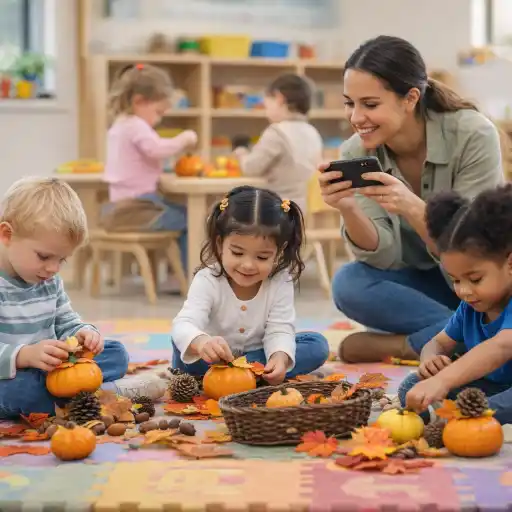
Pair selected images with concise, factual captions. Include the date or activity context when appropriate, describe observable actions, and preserve the child’s words accurately. For example: “During the leaf collage, Elena placed three red leaves together and said, ‘These are the same color.’” This is more informative than “Elena had fun making art,” because it records evidence that can inform reflection and follow-up planning.
Use a strengths-based lens and avoid drawing broad conclusions from one snapshot. Children communicate in many ways, including gestures, home languages, movement, and collaboration. A brief note can clarify what the image cannot show, such as what happened before or after the shutter clicked. For ideas on seasonal images and captions, see fall classroom photo ideas.
- Capture process as well as the finished creation.
- Use short captions with specific actions or direct quotes.
- Separate what you observed from what you interpret or plan next.
How do you protect privacy, safety, and dignity?
Photo planning begins with consent and clear program procedures. Check each child’s current permissions before capturing or sharing images, and verify that consent covers the specific audience and purpose—such as an internal display, private family communication, or public posting. Do not assume that permission for one use covers another. Follow program rules for approved devices, secure storage, access, retention, and deletion.
Children’s dignity matters in the moment as well as after the event. Avoid images that embarrass, expose, or reduce a child to a difficult moment. Do not pressure children to pose, repeat an action, or smile on demand. If a child declines, accept the choice and document the activity in another way. Keep identifying details out of captions and public displays unless specifically authorized and permitted by program policy.
Plan for physical safety, too. Seasonal décor and natural materials should be age-appropriate and checked for hazards, including choking risks and allergies. Keep equipment and props out of pathways, maintain clear sightlines, and do not let taking photos distract from supervision. State requirements vary - check your state licensing agency, along with your program’s privacy and documentation policies.
- Confirm permissions for the intended use before photographing or sharing.
- Use approved devices and secure program storage; avoid personal-account posting.
- Respect a child’s refusal and choose a non-identifying alternative when appropriate.
- Keep supervision and safe access to materials ahead of getting the shot.
How can you turn event photos into reflection and family connection?
After the celebration, select a few images that answer a useful question: What did children explore? What strategies did they try? How did they communicate or work with others? If a photograph does not help answer a question, support a family conversation, or guide planning, it may not need to be kept. A small, purposeful collection is easier to review and more meaningful than hundreds of disconnected images.
Use the evidence to plan a next step. If children compared leaves, you might add magnifiers, books, drawing materials, or a simple sorting invitation. If a group worked together to build a pretend market, revisit their ideas with signs, baskets, or dramatic-play materials. NAEYC’s Learning Stories guidance describes how observations, images, reflection, and family perspectives can come together to recognize children’s strengths and extend learning.
Share captions that explain the learning rather than simply announcing that an event occurred. Invite families to respond with what they notice or what the child discussed at home. A reusable Learning-Focused Event Photo Planner and Caption Templates can help teams decide what to capture, document context, and prepare clear family-facing captions. For deeper professional learning in objective observation and assessment, consider Tracking Progress, Shaping Futures: Observation & Assessment Skills Buy Now $55.00.
- Choose a few images that show meaningful participation and learning.
- Use captions to connect visible actions with children’s ideas and words.
- Invite families’ perspectives and use observations to shape future activities.
Conclusion: How can you capture fall celebration photos without disrupting participation?
Capture fall celebration photos by planning with a learning purpose, staying responsive to children, and choosing brief, unobtrusive moments. Focus on authentic participation and process; add factual captions or child quotes; protect consent, privacy, and dignity; and let photographs inform reflection and family partnership. A camera should support educators’ understanding—not compete with children’s experience.
Start with one activity and a small set of intentional images. Ask what each photo helps you notice, what it leaves out, and how that evidence might inform your next interaction or plan. These thoughtful choices can turn seasonal snapshots into meaningful documentation while keeping the joy and discovery of the celebration where they belong: with the children.
Additional ChildCareEd courses for continued learning:
- Preschool Assessments & Observations Buy Now $24.00 — objective observation and assessment for preschool practice.
- Observing & Assessing in Child Care Buy Now $16.00 — methods for documenting children’s growth and planning responsive experiences.
- Privacy Matters: Documentation and Observation in Early Learning Buy Now $55.00 — privacy-conscious documentation and observation practices.
- Tracking Progress, Shaping Futures: Observation & Assessment Skills Buy Now $55.00 — objective documentation and using multiple measures to guide goals.
- CDA: A Closer Look at Assessments Buy Now $24.00 — observation techniques, bias awareness, and goal development.
- 45 Hour Child Growth and Development
- What Makes Me Special: An Overview of Autism and ADHD
- CDA Bridge Bundle: Family Child Care without Portfolio Review
- CDA Bridge Bundle: Infant/Toddler without Portfolio Review
- CDA Bridge Bundle: Preschool without Portfolio Review
- Creating Engaging and Meaningful Learning Experiences
- Building Bridges for Dual Language Learners
- Bienvenido! Welcoming All Families
- Montessori Cultural Activities: Exploring the World Through Play and Learning
- CDA Certification en Español: Recursos y Consejos para Educadores Bilingües
- 🔍 ¿Qué ves cuando observas a un niño aprender?
- 💛🧩 ¿Cómo puedo hacer que mi enseñanza sea inclusiva para los niños con autismo?
- ¿Cuáles son los pasos, los requisitos y las opciones en línea para la certificación de 90 horas para cuidado escolar en Maryland?
- 10 Ejemplos de Cómo la Cultura Influye en el Desarrollo Infantil
- Proporciones de Cuidado Infantil y Tamaños de Grupo por Edad en Maryland (Guía Rápida para Centros y Hogares)
- Proporciones de Cuidado Infantil y Tamaños de Grupo por Edad en Nueva Jersey (Guía Rápida para Centros y Hogares)
- Proporciones de Cuidado Infantil y Tamaños de Grupo por Edad en Virginia (Guía Rápida para Centros y Hogares)
- ¿Cuál es la Diferencia Entre la Crianza Respetuosa y la Crianza Permisiva?
- Actividades de Otoño Fáciles para Preescolares esta Temporada
- Cómo Trabajar en el Cuidado Infantil en Carolina del Norte: Requisitos y Pasos
- Cómo Trabajar en el Cuidado Infantil en California: Requisitos y Pasos
- Celebrando la amistad en el cuidado infantil durante el Día de los Mejores Amigos
- Canciones, juegos y preguntas de círculo para niños
- Cómo simplificar la capacitación para sus empleados de daycare
- How Can You Capture Fall Celebration Photos Without Interrupting Children’s Participation?
- How Can Child Care Programs Set Clear Expectations for Fall Party Donations Without Creating Extra Work?
- How Can You Plan Fall Celebrations Every Child Can Follow, Including Children With Different Hearing Needs?
- How Can Child Care Programs Create Belonging When a Child Misses the Fall Celebration?
- How Can Child Care Programs Build a Clear Photo-Review Routine Before Posting Fall Party Photos?
