A familiar fall song can become more than a seasonal sing-along: it can help children hear their home languages welcomed in the classroom. Invite families to contribute words, pronunciation, or a short recording, and explore Family Voices Matter: Tools for Meaningful Collaboration  Buy Now $55.00 for practical ways to build respectful, culturally and linguistically responsive partnerships. The ideas below offer a simple starting point; the course can help you strengthen the family collaboration behind it.
Why does a shared autumn song matter?
Young children often meet language most naturally through relationships, rhythm, repetition, and play. A seasonal song gives a group a common melody while making room for each family’s familiar words. When children hear a greeting, nature word, or refrain from home represented in the program, they may recognize that their language and experiences belong in the learning community.
This is not about asking children to perform their identity or making a single child the representative of a language or culture. It is about inviting families to contribute what feels meaningful and comfortable. NAEYC’s guidance on supporting families’ home language practices emphasizes the value of maintaining home languages as children encounter English. Head Start likewise describes families and program staff as partners in supporting children’s languages and traditions.
Music can support connection as well as communication. Head Start’s resource on using music with infants, toddlers, and families describes how singing and predictable musical patterns can support bonding, attention, language learning, and routines. Keep the purpose simple: make a welcoming shared experience, notice children’s responses, and let family knowledge guide the choices.
- Support a sense of #belonging through everyday representation.
- Invite children to listen, move, sing, gesture, or simply observe.
- Build a bridge between classroom routines and family life.
How can educators invite family contributions respectfully?
Begin with a warm, low-pressure invitation. Explain that the class is learning one autumn song in several languages and that families may share a word, a phrase, a pronunciation, or a recording if they wish. Make it clear that participation is optional and that families do not need to attend an event or prepare a polished performance. A small contribution—a word for leaf, wind, rain, or a favorite fall sound—can be enough.
Ask open questions rather than making assumptions: “Is there a song, rhyme, or word your family enjoys this time of year?” “How would you like us to pronounce it?” “Would you prefer to share it in writing, by voice recording, or in conversation?” Families may use multiple languages, regional expressions, or different terms for the same thing. Welcome those differences instead of treating one translation as the only correct version.
Use trusted family input to verify pronunciation and spelling. If families provide recordings, ask permission before playing them for the group or sharing them beyond the classroom. The Head Start resource on partnering with families of dual language learners underscores the importance of close partnership in supporting home languages and family traditions.
- Offer choices for how to contribute, including no contribution.
- Ask whether a word or song is appropriate to share in a group setting.
- Thank families without comparing participation or asking a child to translate.
- Use qualified interpretation for important or sensitive communication, as needed.
How can you create a family-contributed autumn songbook page?
A simple, consistent page makes contributions useful for children and staff. One page can feature a family-approved word or short phrase, its language, a phonetic pronunciation guide if the family offers one, and a picture chosen or approved by the family. You might also include a brief note about when the word or song is used, but only if the family wishes to share that context.
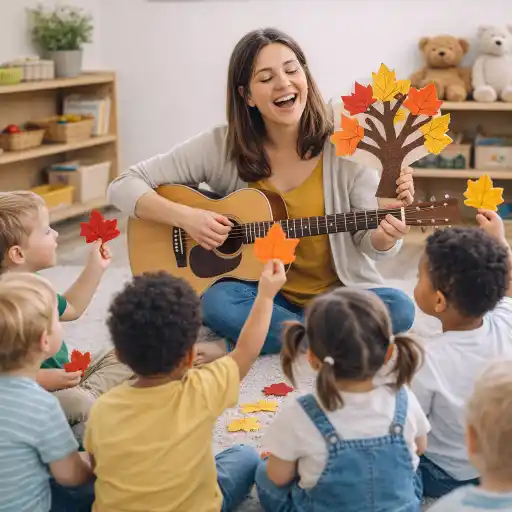
Use a repeatable template so educators can assemble pages without putting pressure on families to create materials. Keep the design accessible: large print, clear images, and limited text help children follow along. Include the English version as a bridge when appropriate, while preserving the original language rather than replacing it. Before displaying or distributing a page, confirm family preferences about names, photographs, recordings, and classroom use.
Make the songbook a living classroom resource. Place a few pages near the music area, use the words during circle time, or revisit them during outdoor walks as children notice changing leaves and weather. ZERO TO THREE’s songs, rhymes, and fingerplays in English and Spanish resource offers an example of songs used with young children and families in bilingual settings.
- 🎵 Add a family-contributed refrain or autumn word to a familiar melody.
- Pair words with pictures, gestures, or real objects such as leaves and pinecones.
- Mark the source respectfully, using the family’s preferred wording for attribution.
- Review pages periodically with families and update them when they request changes.
How can the song include children with different languages and abilities?
Participation is broader than singing aloud. Children can listen, sway, tap a rhythm, point to a picture, use a communication device, sign, or join only for a familiar sound. Offer these options without ranking them. Some children may need more time to observe before participating; others may prefer a quieter version or a predictable visual cue before the song begins.
Keep the musical structure manageable. Sing one version in its contributed language, then repeat or alternate with another version, using clear visual cues to mark the change. Avoid rapid switching that makes words hard to hear. The goal is not perfect fluency from educators or children; the goal is shared attention and respectful exposure. NAEYC’s discussion of embracing linguistic diversity recommends language-rich environments where children can draw on the languages they know.
Plan for sensory and physical access: moderate volume, leave space for movement, and offer seated participation. Watch children’s cues and adjust the pace or stop if a child appears uncomfortable. State requirements vary - check your state licensing agency for applicable supervision and activity requirements.
- Use pictures, gestures, objects, and repetition alongside words.
- Offer stillness, movement, instruments, or listening as valid ways to join.
- Notice and affirm children’s responses across languages and communication modes.
- Avoid pressuring children to translate, sing solo, or explain family culture.
How can providers keep the activity meaningful beyond one day?
Build the song into ordinary classroom routines rather than limiting it to a special autumn event. Sing a short refrain at circle time, revisit a family’s word during an outdoor observation, or invite children to choose which songbook page to use before cleanup. Repetition gives children opportunities to notice familiar patterns and participate at their own pace.
Document small observations without turning the activity into a test. Note whether a child anticipates a word, recognizes a picture, joins a gesture, chooses a page, or shares a related word at another time. Invite families to tell you whether the activity resonates at home and whether they would like to add, revise, or remove a contribution. This reciprocal process communicates that family expertise continues to shape classroom practice.
Common pitfalls are easy to avoid with intentional planning. Do not assume all families celebrate autumn in the same way, or that a particular song is familiar across communities. Do not display contributions without permission, rely on children as interpreters, or treat a family’s absence from an event as lack of interest. Offer flexible ways to participate, and use the songbook as one small, ongoing expression of partnership. For deeper professional learning, Building Bridges for Dual Language Learners Buy Now $25.00 offers strategies for language support and family collaboration.
Conclusion: What makes one fall song welcome several languages?
A shared fall song becomes welcoming when families choose what to contribute, educators represent those contributions accurately, and every child has multiple ways to participate. A family-contributed autumn songbook page can turn a seasonal routine into a practical expression of respect, language inclusion, and partnership.
Start with one song, a few voluntary family contributions, and a simple page template. Ask permission, confirm pronunciation, use visuals and movement, and make room for children to listen as well as sing. These manageable steps help answer the central question: one familiar song can make space for several languages when the classroom treats family voices as valuable knowledge and builds them into everyday learning.
For further professional development, explore Family Voices Matter: Tools for Meaningful Collaboration Buy Now $55.00, Building Bridges for Dual Language Learners Buy Now $25.00, Mind’s Medicine: Music in Early Childhood Buy Now $16.00, Language Development in Early Childhood Buy Now $16.00, and Supporting Families and Caregivers in Language and Literacy Buy Now $16.00.
- 45 Hour Child Growth and Development
- What Makes Me Special: An Overview of Autism and ADHD
- Pediatric RSV First Aid & CPR/AED
- 45 Hour School Age Methods and Materials
- Building Equity: Inclusionary Practices in Preschool
- Bienvenido! Welcoming All Families
- IEPs and IFSPs in Family Child Care
- Supporting Families and Caregivers in Language and Literacy
- CDA Certification en Español: Recursos y Consejos para Educadores Bilingües
- 10 Ejemplos de Cómo la Cultura Influye en el Desarrollo Infantil
- Proporciones de Cuidado Infantil y Tamaños de Grupo por Edad en Maryland (Guía Rápida para Centros y Hogares)
- Proporciones de Cuidado Infantil y Tamaños de Grupo por Edad en Nueva Jersey (Guía Rápida para Centros y Hogares)
- Proporciones de Cuidado Infantil y Tamaños de Grupo por Edad en Virginia (Guía Rápida para Centros y Hogares)
- Apoyo en Preescolar para Retrasos del Habla: Estrategias Simples que Ayudan
- Retraso del Habla en la Guardería: Cómo Pueden Ayudar los Proveedores
- Canciones, juegos y preguntas de círculo para niños
- La mejor manera de hacer seguimiento a la capacitación de su equipo de daycare How to Organize Staff Training for Your Child Care Center Cómo organizar la capacitación del personal para su centro de cuidado infantil
- Cómo simplificar la capacitación para sus empleados de daycare
- How Can Family Knowledge Enrich a Montessori Toddler Classroom?
- How Can Preschool Teachers Use Fall Activities to Strengthen Family Engagement?
- How Can Fall Classroom Projects Build Stronger Family Partnerships?
- How Can You Invite Families to Share Fall Traditions Without Making Anyone a Spokesperson?
- How Can You Plan a Fall Family Night That Works for Different Schedules and Budgets?
- How Can Families Share Fall Discoveries at Home Without Homework?
- How Can Fall Wordplay Invite Families Into Early Sound Exploration in Every Home Language?
- How Can Child Care Providers Better Support Dual Language Learners?
- How Can “Leaf” and “Leaves” Grow Preschool Grammar Through Fall Conversations?
- How Can One Fall Song Welcome Several Languages Into Your Child Care Program?
