This quick guide helps Minnesota child care directors and #providers get ready for MN DHS Rule 2 (family & group family child care) and Rule 3 (center-based) in 2026. It gives clear steps, links to helpful training 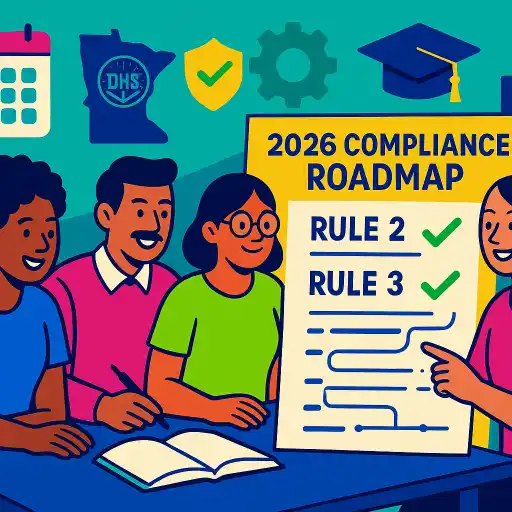 and resources, and simple lists you can use with your team. Remember: state requirements vary - check your state licensing agency.
What do Rules 2 and 3 actually require in 2026?
Here are the main things licensors and MN DHS expect under Rule 2 and Rule 3 as you plan for 2026. Use these as a checklist for your program.
- Licensing basics: maintain current license, post your certificate, and keep staff files updated. For state overviews and licensing modernizations, see Child Care in Minnesota: What’s Coming in 2026 and state reports on licensing change work posted by DHS.
- Health & safety records: have immunization records on file and follow Minnesota’s immunization rules (Rule 3 programs file an annual immunization report by Dec. 1). See MN Dept. of Health guidance at Childcare Provider Information for Minnesota's Immunization Law. Use MIIC to check records when available.
- Staffing & ratios: meet the staff-to-child ratios in your license type and have qualified substitutes on call. Expect licensors to use standardized timelines for inspections as part of licensing modernization (see DHS reports above).
- Training: new annual training rules for some family child care, substitutes, and volunteers started Oct 1, 2025, and continue into 2026—plan for at least two hours for some roles and more for certificate pathways. ChildCareEd lists Minnesota-approved courses and bundles at What’s new for child care providers in Minnesota in 2026?.
Hashtags: keep these keywords handy—#Minnesota #licensing #training #attendance #providers
How do I meet training and staff competency requirements?
Good training plans keep your program compliant and help staff feel supported. Follow these practical steps.
- Identify required hours by role: directors, teachers, family child care providers, and substitutes all have different hour needs. Start by checking your role-specific expectations on state pages and in ChildCareEd bundles (see Minnesota bundle guide).
- 📘 Register staff in the Develop Registry or add their IDs to your training accounts so hours report correctly to the state. ChildCareEd explains how to add Develop IDs in A Complete Guide to ChildCareEd Courses.
- 🧾 Keep certificates filed: save PDFs in personnel files and a backup folder for easy licensor review. Plan renewals early, so staff don’t rush at the end of the year.
- 🧑🏫 Use role-based bundles to save time and match state topics. Examples: Family 16-hour bundle for homes, Teacher 24-hour bundle for classrooms, Director 40-hour bundle for administrators—see recommended bundles at ChildCareEd Minnesota bundles.
- ✅ Include health-and-safety topics: CPR/First Aid, medication administration, SIDS/SUID prevention. Instructor-led and blended classes are listed at ChildCareEd's upcoming classes. For an overview of the federal baseline expectations that underpin many of these topics, review the federal health and safety requirements to align your training and policies with national guidance.
- ✅ Health & safety training for Rule 2 and Rule 3 compliance: A reliable starting point is ChildCareEd's Health and Safety Orientation
 Buy Now
 $55.00$45.00 — a 6-hour online course covering the core health and safety topics both rules require. Complete it on your own schedule, link your Develop Registry ID beforehand, and hours post automatically to your state record. - 🏠 Minnesota-specific course for family child care providers: Rule 2 providers should also consider ChildCareEd's Family Child Care Health Essentials Buy Now $16.00 — a 2-hour online course built specifically for Minnesota family and group child care settings. It covers health, safety, and compliance requirements tied directly to state licensing standards, making it an efficient way to address Rule 2 topics and add a clean certificate to your audit-ready file.
Tip: Schedule trainings across the year and pair learning with small staff incentives to boost retention. State requirements vary - check your state licensing agency for specific topic and hour requirements.
How should I manage attendance, billing, and audit-ready records?
Strong records protect your program if state or federal staff review claims. Start with these steps and links.
- 📌 Daily attendance: keep a signed daily sign-in/out for every child and note who dropped off and picked up. If your program accepts subsidies (CCAP), attendance documentation is often required.
- 📂 Save subsidy paperwork: keep CCAP authorizations, invoices, and copies of payments in one folder. Some federal guidance now supports attendance-based payment controls—see the recent federal rule discussion in the Department of Labor and related federal notices (policy updates affect billing practice) at Federal Register and news summaries.
- 🛡️ Audit-ready files checklist:
- Child enrollment forms and immunizations (use MIIC where available: MDH immunization page).
- Daily attendance logs with parent signatures.
- Staff training certificates, background study clearances, and personnel records.
- Invoices, subsidy authorizations, and bank deposits are tied to billing dates.
- 📆 Retention: keep records of the number of years your licensor requires—scan and back up records to avoid loss from fire or theft.
Why this matters: Federal agencies have increased verification and oversight in recent months. Keeping clean attendance and billing records reduces risk and keeps your program stable. For practical steps and sample checklists, see ChildCareEd’s Minnesota resources at What new changes are coming to childcare in Minnesota.
How can I avoid common mistakes, prepare for inspections, and answer FAQs?
Below are common pitfalls and clear fixes. Use the FAQ to answer staff and family questions quickly.
Common mistakes and how to avoid them:
- ❌ Not linking training to staff Develop IDs — Fix: collect IDs before training and upload them so hours post to the registry (see ChildCareEd guidance).
- ❌ Weak attendance logs — Fix: require daily parent/guardian signatures and keep digital backups.
- ❌ Missing immunization reports (Rule 3) — Fix: run MIIC reports or collect signed exemption forms; file your annual report by Dec. 1 (MDH immunization guide).
- ❌ Poor cleaning records — Fix: follow CDC cleaning, sanitizing, and disinfecting steps (see CDC ECE cleaning guidance).
Quick FAQ for directors:
- Q: Will attendance verification be required for subsidy payments? A: Many federal and state actions move toward attendance-based verification—keep clear logs. See federal notices and news summaries at the Federal Register.
- Q: Where do I find approved Minnesota trainings? A: Use ChildCareEd Minnesota course pages and bundles: MN training guide.
- Q: What if we are inspected? A: Provide requested records promptly, be honest, and ask for written guidance if a correction is needed (DHS has new transparency measures on corrections—see DHS mandated reports at DHS reports).
- Q: Who can help locally? A: Contact your local Child Care Resource & Referral (CCR&R) and use state one‑stop assistance plans described in DHS reports; ChildCareEd also lists supports and free resources at ChildCareEd Minnesota resources.
Final quick action plan (3 steps):
- 📌 This week: update daily attendance logs and scan older records into a secure folder.
- 📚 This month: add Develop Registry IDs for staff and enroll them in an approved Minnesota bundle at ChildCareEd.
- 💬 Ongoing: review immunization files, follow MDH guidance, and keep communication open with families and your licensor. Remember: state requirements vary - check your state licensing agency.
You’re doing important work. If you want help choosing a ChildCareEd bundle or making a 30‑day plan to meet Rule 2 or Rule 3 requirements, reach out to your local CCR&R and use the ChildCareEd Minnesota guides linked above. Keep records tidy, train steadily, and protect your program and children.
- CDA Certification en Español: Recursos y Consejos para Educadores Bilingües
- 👶 ¿Cuáles son las proporciones y grupos requeridos en Dakota del Norte? 🏫
- Cómo Abrir Una Quardería En Casa Sin Dinero?
- Cómo Empezar una Guardería en Casa: Requisitos y Pasos
- Regulaciones de Licenciamiento de Cuidado Infantil en California para Centros y Hogares de Cuidado Infantil Familiar
- Proporciones de Cuidado Infantil y Tamaños de Grupo por Edad en Wisconsin (Guía Rápida para Centros y Hogares)
- Proporciones de Cuidado Infantil y Tamaños de Grupo por Edad en Nueva Jersey (Guía Rápida para Centros y Hogares)
- Proporciones de Cuidado Infantil y Tamaños de Grupo por Edad en Virginia (Guía Rápida para Centros y Hogares)
- Lista para Abrir una Guardería en Casa en Carolina del Norte: Cómo Empezar
- Lista para Abrir una Guardería en Casa en Dakota del Norte: Cómo Empezar
- Lista para Abrir una Guardería en Casa en Georgia: Cómo Empezar
- Lista para Guardería en Casa en Texas: Cómo Iniciar una Guardería en el Hogar
- What new changes are coming to childcare in Minnesota and how will they affect providers?
- How Can My Program Meet MN DHS Rule 2 & Rule 3 Requirements for 2026?
- Celebrando la amistad en el cuidado infantil durante el Día de los Mejores Amigos
- Canciones, juegos y preguntas de círculo para niños
- How Can Minnesota CCAP Providers Keep Documentation That Holds Up?
- Cómo simplificar la capacitación para sus empleados de daycare
- How Can Minnesota Providers Reduce No-Shows and Late Pickups?
- Reglas y regulaciones de guarderías en Minnesota 2026: Requisitos actuales y próximos cambios
