A pumpkin can be ridged, a pear can feel grainy, and an apple may sound crisp when an adult slices it—each detail gives children a new way to communicate. Strengthen these everyday conversations with Language Development in Early Childhood  Buy Now $16.00, a focused course with practical strategies for supporting children’s verbal, nonverbal, and early literacy growth. For a deeper focus on intentional word teaching, Building Vocabulary Buy Now $16.00 can help you turn seasonal exploration into richer classroom talk; explore either course as a next step while you try the ideas below.
Why move beyond “yummy” and “yucky”?
Children’s first food judgments are valid expressions of preference, but these broad words tell us little about what they actually notice. A child might say “yucky” because a squash is slippery, smells strong, looks unfamiliar, or simply does not appeal to them. Offering more precise language helps children communicate those experiences without suggesting that their preferences are wrong.
Fall foods make a natural vocabulary laboratory. Apples, pumpkins, pears, cranberries, and squash invite children to compare color, shape, surface, sound, and scent. Sensory food education guidance recommends exploring food through multiple senses and keeping participation pressure-free. The aim is not to persuade children to taste or like a food; it is to support curiosity and give them meaningful words for describing what they observe.
These conversations also strengthen listening and thinking. When a child says “crunchy,” an adult can add “crisp” or invite a comparison: “The apple sounds crisp; the pear is softer.” Repeated, contextual exposure helps children build richer word knowledge than a single label can provide. The NAEYC guidance on helping children learn new words likewise emphasizes meaningful conversations and repeated encounters with vocabulary.
- Describe observable qualities rather than ranking foods as “good” or “bad.”
- Accept a child’s “no thanks” while offering language to explain what they notice.
- Make room for #curiosity, #language, and each child’s individual sensory comfort.
Which descriptive words can educators model?
Choose a small, useful set of words connected to what children can see, feel, hear, or smell. Too many unfamiliar terms at once can make the conversation feel like a vocabulary test. Instead, select a few target words and revisit them across the activity, later play, and shared books.
Start with familiar descriptive categories. For appearance, try round, curved, speckled, striped, shiny, or matte. For touch, model smooth, bumpy, ridged, firm, soft, or grainy. For sound, try crisp, crunchy, squishy, or quiet; for scent, earthy, fresh, sweet-smelling, or spicy. Taste words such as tart, sweet, mild, and juicy are appropriate when tasting is safe, offered, and entirely optional.
Make words concrete by pairing them with a gesture, object, photograph, or comparison. Roll a round apple gently, trace the ridges on a pumpkin, or compare a smooth pear skin with a bumpy squash. When children use a general term, expand it naturally: “Yes, it feels bumpy. The pumpkin has small ridges, too.” The Hanen Centre’s guidance on building vocabulary through classroom activities supports introducing and repeating useful words in everyday contexts.
- Use a few target words at a time, then revisit them during play and conversation.
- Model a word in a short sentence: “This pear feels firm.”
- Invite home-language words and pronounce them respectfully when families share them.
How can Fall Food Description Mats guide conversation?
Fall Food Description Mats and an optional Tasting Record can give children a clear visual structure for noticing and recording ideas. A mat might include spaces for a food’s appearance, texture, scent, sound, and—only if a child chooses and it is safe—taste. Children can draw, dictate, point to picture choices, use words, or ask an adult to record their observations. The optional record can capture what a child noticed on a particular day without turning the activity into a scorecard.
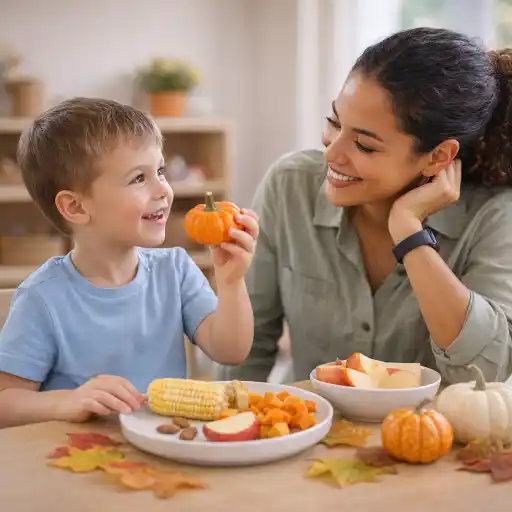
Begin with one or two foods and model thinking aloud: “I see an orange pumpkin. Its outside has ridges. I wonder what the inside looks like.” Then pause. Children need time to observe and respond in their own way. Use prompts that invite discovery rather than testing knowledge:
- “What do you notice about this apple?”
- “How does the outside look different from the inside?”
- “What sound do you hear when I cut it?”
- “Would you like to describe it, draw it, or pass?”
Children may participate by watching, sorting picture cards, using tongs, describing a smell from a comfortable distance, or choosing not to join. A mat supports conversation; it should never imply that every child must complete every section. One productive sequence is to introduce the food, model one descriptive word, invite child observations, and record children’s exact words where possible.
🍎 Try comparing two apple varieties by color, shape, and sound as an adult slices them; tasting is not needed for a rich discussion.
How can you support children with different preferences and communication styles?
Food exploration can feel exciting to one child and uncomfortable to another. Some children are sensitive to strong smells or sticky textures; others may prefer to watch before joining. Respectful teaching treats these reactions as useful information, not defiance. Tell children clearly that tasting is optional, and make it easy to observe, use a tool, move away, or stop.
Offer several ways to participate. Children can point to a texture card, use a communication device, draw a food, describe it in a home language, or dictate an observation. For children who do not want direct contact, provide tongs, scoops, gloves, sealed containers, photographs, or play food. Keep choices genuine: avoid repeatedly asking a child to smell or taste after they have declined.
Use neutral, responsive language. If a child says “yucky,” you might reply, “You don’t want to taste it. What do you notice about it?” If they do not want to describe it, accept that response. Adults can model curiosity without praising tasting as the desired outcome. These practices support #choice and #belonging, while food exploration remains a learning invitation rather than a feeding intervention.
- Offer verbal, visual, gestural, tactile, and non-food ways to take part.
- Accept “no,” silence, and observing as valid participation.
- Talk about differences without labeling a child as a picky eater or asking them to justify a preference.
How do you plan for safety, inclusion, and meaningful follow-up?
Before an activity involving real food, review children’s allergy and dietary information, family instructions, program procedures, and appropriate food-handling practices. Check ingredients when food will be served, prevent cross-contact as required by children’s plans, clean surfaces and tools, wash hands, and supervise closely. Select developmentally appropriate materials and address choking hazards; small seeds and firm food pieces may not be suitable for every age or child. When details are uncertain, use pictures, play food, or sealed visual materials instead.
Food is connected to family and culture, so choose examples and prompts with care. Invite families to share food names or seasonal traditions if they wish, without requiring contributions or asking a child to represent a whole community. Avoid describing unfamiliar foods as “strange” or using food preferences to judge a family. State requirements vary - check your state licensing agency, particularly when activities include food preparation, tasting, sanitation, allergies, or meals.
Afterward, review the description mats for evidence of learning—not whether children tasted or liked the food. Note new words, comparisons, questions, gestures, and changes in how children describe an ingredient across repeated experiences. The fall food activity can extend into a drawing, a pretend market, a seasonal story, or a second observation with a different variety. A brief, factual update to families can share what their child noticed while respecting privacy and individual preferences.
Conclusion: How can fall food exploration build descriptive language?
Fall food exploration builds descriptive language when providers slow down, notice alongside children, and offer precise words without pressuring anyone to taste. Description mats and an optional tasting record can make observations visible, give children varied ways to communicate, and help educators plan meaningful follow-up.
Start with a few accessible words, model them in context, and invite children to look, listen, smell, touch when comfortable, draw, or pass. Respect allergies, sensory preferences, home languages, family traditions, and licensing procedures. The central goal is not to replace “yummy” or “yucky” with a required vocabulary list; it is to help every child express what they notice in a safe, responsive, and language-rich classroom.
Five relevant ChildCareEd courses
- Building Bridges for Dual Language Learners
- Building Bridges for Dual Language Learners: For Workforce Solutions
- CDA Home Visitor Subject Area 5 Part 3 Birth to 5
- Language and Literacy Foundations in Pre-K
- Pediatric RSV First Aid & CPR/AED
- 45 Hour School Age Methods and Materials
- Art from the Heart for Preschoolers: Open Ended Art Projects that Build Self-Esteem
- Staff Supervision, Observation & Feedback
- Texas Director Credential
- Supporting Families and Caregivers in Language and Literacy
- CDA Certification en Español: Recursos y Consejos para Educadores Bilingües
- ❤️ ¿Cómo ayudan los educadores a las familias a acceder a los servicios que necesitan?
- 👶 ¿Cuáles son las proporciones y grupos requeridos en Dakota del Norte? 🏫
- Cómo Abrir Una Quardería En Casa Sin Dinero?
- Requisitos Para Ser Maestra Principal En Un Daycare: Lo Que Necesitas Para Empezar
- Apoyo en Español para Capacitaciones Grupales Presenciales y por Zoom en Cursos Selectos
- 10 Ejemplos de Cómo la Cultura Influye en el Desarrollo Infantil
- Cómo Empezar una Guardería en Casa: Requisitos y Pasos
- Proporciones de Cuidado Infantil y Tamaños de Grupo por Edad en Virginia (Guía Rápida para Centros y Hogares)
- Actividades de Otoño Fáciles para Preescolares esta Temporada
- Lista para Guardería en Casa en Texas: Cómo Iniciar una Guardería en el Hogar
- Apoyo en Preescolar para Retrasos del Habla: Estrategias Simples que Ayudan
- Retraso del Habla en la Guardería: Cómo Pueden Ayudar los Proveedores
- Cómo Trabajar en el Cuidado Infantil en Carolina del Norte: Requisitos y Pasos
- Cómo Ser Maestra de Preescolar en Illinois
- Celebrando la amistad en el cuidado infantil durante el Día de los Mejores Amigos
- Diversión fresca de verano: actividades del Día Nacional del Helado para niños
- Canciones, juegos y preguntas de círculo para niños
- Cómo simplificar la capacitación para sus empleados de daycare
- How Can Fall Food Exploration Build Descriptive Language Beyond “Yummy” or “Yucky”?
