Outdoor time is great for kids. It helps them move, learn, and calm down. But in DC, we also need to watch for insects,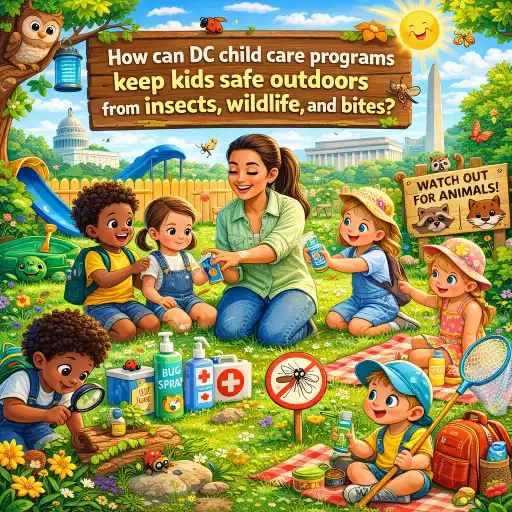 ticks, and wild animals. This article gives clear steps for child care providers and directors to keep children safe while still enjoying play outside. You will find simple prevention tips, what to do after a bite or sting, and how to set up staff and policies so your program stays ready. These tips focus on practical actions you can do today in your #outdoor space for #children #safety.
Why it matters
1) Vector-borne diseases and bites are rising and can start from a tiny tick or a wasp nest nearby. The CDC explains why avoiding bites is the best prevention and where ticks live. Preventing Tick Bites | CDC. 2) Young children are more likely to touch animals, put their hands in their mouths, or play close to the ground. ChildCareEd covers outdoor hazards and why regular checks of your play area help stop problems early. Creating Safe Outdoor Play Environments.
What hazards should I watch for around insects, ticks, and wildlife?
1) Common outdoor hazards in DC include:
- Ticks in leaf litter, tall grass, and at trail edges. The CDC notes that ticks can be found even in yards and that most tick bites happen in warmer months. CDC Tick Prevention.
- Stinging insects like bees, wasps, and hornets are near trash, flowering plants, and picnic areas. ChildCareEd suggests keeping trash covered and teaching kids not to disturb nests. Outdoor Hazards.
- Mosquitoes where water collects (drains, birdbaths, buckets). Mosquito bite prevention is important to avoid arboviral disease CDC Yellow Book.
- Wild animals (squirrels, raccoons, deer) can carry germs or may bite if fed or cornered. CDC guidance for animals in schools helps programs plan safe animal contact. Healthy Pets, Healthy People | CDC.
2) Look for triggers that attract pests and wildlife. Simple fixes include removing standing water, keeping food sealed, and storing woodpiles away from play areas as recommended by tick and yard management guidance CDC Tick Prevention, and the EPA Integrated Pest Management tips EPA IPM for Child Care.
How can we prevent bites, stings, and tick-borne illness during outdoor play?
Follow these simple steps. Use enumeration so staff can remember them easily:
- Clothing and gear
- 👕 Dress kids in light-colored clothes, long sleeves, and long pants when ticks are likely (spring–fall). Tuck pants into socks for extra protection (How Can I Protect My Family From Ticks? | Nemours).
- 👟 Use permethrin-treated clothing or treat gear (not skin) for staff and older children when appropriate; follow label directions (CDC Yellow Book).
- Repellents and sunscreen
- 🧴 Use EPA-registered repellents with DEET, picaridin, IR3535, or oil of lemon eucalyptus where allowed. Follow label rules for child age and application. The CDC and NPIC explain safe use and age limits (CDC, Insect Repellents Fact Sheet).
- ☀️ Apply sunscreen first, then repellent if both are needed; do not use combined products.
- Yard and equipment checks (daily quick walk-through)
- 🔍 Remove standing water, clear leaf litter near play zones, and place a gravel/wood chip border between lawn and woods to reduce ticks (CDC).
- 🪵 Store woodpiles and trash away from play areas and keep trash lids closed to reduce wasps (ChildCareEd).
- Program rules and supervision
- ✅ Teach kids: “Don’t touch unfamiliar animals, nests, or dead wildlife,” and model calm moves around insects. Supervise closely when exploring brush or wooded edges (Splinters, Stings, and Rashes Guide).
State requirements vary - check your state licensing agency
What should staff do right away if a child is bitten, stung, or finds wildlife?
Use a clear, step-by-step response. Here is an easy checklist you can train staff to follow:
- Immediate safety and calm
- 🧑⚕️ Move the child away from the hazard. Stay calm and keep the child seated.
- 🧤 Put on gloves if there is blood or broken skin.
- Treat the site
- 🩺 For stings: remove visible stinger by scraping with a flat edge (do not squeeze). Wash with soap and water. Apply a cold pack for 10 minutes on/10 minutes off (ChildCareEd quick guide, Nemours).
- 🦟 For tick removal: use fine-point tweezers, grasp the tick close to the skin, and pull straight up slowly. Wash the area and save the tick in a sealed bag for identification if needed (How to properly remove a tick | Canada.ca).
- Watch for allergic or infection signs
- 🚨 Call 911 or emergency care if the child has trouble breathing, swelling of the face or mouth, fainting, or widespread hives (possible anaphylaxis). If your program has an allergy plan and epinephrine, follow it immediately (Nemours).
- 📞 Call parents for bites on the face, many stings, or if swelling grows after 30–60 minutes. Document what happened and care given (ChildCareEd guidance).
- Follow-up and record keeping
- 📝 Save a photo, note date/time, location on body, and any treatments. Keep the tick if removed in a sealed container; some clinics may want to test it (Canada.ca).
How do we build plans, train staff, and avoid common mistakes?
Here are clear steps you can take to make safety part of daily practice. Use enumeration so it’s easy to follow.
- Plan and check
- 📅 Do a daily hazard walk before children go outside. Note water, nests, broken fences, or rough wood on play equipment (ChildCareEd).
- 📍 Map play areas and mark where ticks, water, or animal signs are more likely. ChildCareEd offers a Hazard Mapping tool to help programs plan.
- Train staff and families
- 👩🏫 Teach staff how to remove ticks, how to give first aid for stings, and when to call 911. Use the ChildCareEd quick guide and local health resources for training materials (Splinters, Stings Guide). Consider providing basic life support (BLS) training so staff are prepared to deliver effective CPR and other immediate emergency care while awaiting EMS; learn why BLS certification is important for providers (BLS certification).
- 📢 Share simple prevention tips with families (what repellents you allow, clothing tips, allergy plans). Get written permissions for repellent use if required by your state licensing—state requirements vary - check your state licensing agency.
- Policies and IPM (Integrated Pest Management)
- ✅ Adopt an IPM plan to reduce pesticide use and lower exposure. The EPA provides child care IPM resources to guide safer pest control, EPA IPM for Child Care.
Common mistakes and how to avoid them
- Relying only on spraying: use IPM and habitat changes like removing standing water and trimming brush (CDC).
- Not checking clothing/gear: dry clothes on high heat or wash after tick exposure to kill ticks (CDC).
- Delay in tick removal: remove ticks promptly with tweezers and document the bite (Canada.ca).
Quick FAQ for staff
- Q: Can we use DEET on toddlers? A: DEET is allowed for children older than 2 months; follow label limits and program policy (NPIC).
- Q: Should we keep chickens or reptiles? A: Avoid reptiles, amphibians, poultry, and rodents in settings with kids under 5, per CDC guidance, CDC Pets in Schools.
- Q: Do we always call parents after a sting? A: Call for stings on the face, many stings, allergic signs, or if you used epinephrine. For small bites, document and monitor (ChildCareEd).
- Q: What if a child has Lyme concerns? A: Keep the tick (if removed), document the bite, and advise parents to contact their healthcare provider; CDC has Lyme prevention tips: Preventing Lyme Disease.
Conclusion
Keeping kids safe outside in DC is about simple routines: check the yard, use good clothing and repellents, teach safe behavior, and train staff to act fast if a bite or sting occurs. Use the ChildCareEd resources linked here for planning tools and quick response guides (Creating Safe Outdoor Play Environments, Splinters, Stings, and Rashes). For medical questions or possible infections, encourage families to contact their healthcare provider. You can also share broader, year-round health strategies with families—nutrition guidance, illness-prevention tips, and activity ideas that support overall resilience—via Keeping kids healthy! Tips and tricks. Remember: small prevention steps make outdoor time safer and more fun for everyone in your #preschool program.
- Creating the Natural Outdoor Classroom
- 1,2,3, Eyes on Me: Classroom Safety
- Birth to Five CDA Credential with Portfolio Review
- Play Safe, Think Big: Literacy Through Play
- 24 Hour Texas Pre-Service
- CDA Bridge Bundle: Family Child Care without Portfolio Review
- CDA Bridge Bundle: Infant/Toddler without Portfolio Review
- CDA Bridge Bundle: Preschool without Portfolio Review
- Responding to Emergencies
- Family Child Care: Building, Premises, and Outdoor Safety
- CDA Certification en Español: Recursos y Consejos para Educadores Bilingües
- 🥦✨ ¿Cómo apoyar a los niños selectivos a probar nuevos alimentos sin presión?
- Menos Estrés a la Hora de Comer: Rutinas Simples Que Sí Funcionan
- Recursos en Español sobre el Sueño Seguro del Bebé
- 10 Ejemplos de Cómo la Cultura Influye en el Desarrollo Infantil
- Capacitación en Salud y Seguridad Preventiva en Línea para Proveedores de Cuidado Infantil
- Proporciones de Cuidado Infantil y Tamaños de Grupo por Edad en Maryland (Guía Rápida para Centros y Hogares)
- Proporciones de Cuidado Infantil y Tamaños de Grupo por Edad en Nueva Jersey (Guía Rápida para Centros y Hogares)
- Proporciones de Cuidado Infantil y Tamaños de Grupo por Edad en Virginia (Guía Rápida para Centros y Hogares)
- Cómo Trabajar en el Cuidado Infantil en Wisconsin: Requisitos y Pasos
- How can Florida early childhood educators protect children from poisonous plants, bugs, and outdoor hazards?
- How can Washington early childhood programs keep children safe from poisonous plants and forest wildlife outdoors?
- How can DC child care programs keep kids safe outdoors from insects, wildlife, and bites?
- How can Florida child care programs keep kids safe from snakes, insects, and harmful plants on the playground?
- How can North Dakota early childhood programs teach children about nature and wildlife?
- Celebrando la amistad en el cuidado infantil durante el Día de los Mejores Amigos
- Canciones, juegos y preguntas de círculo para niños
- La mejor manera de hacer seguimiento a la capacitación de su equipo de daycare How to Organize Staff Training for Your Child Care Center Cómo organizar la capacitación del personal para su centro de cuidado infantil
- How can North Dakota programs teach children about bug safety?
- Cómo simplificar la capacitación para sus empleados de daycare
