Cold-weather comfort should never come at the cost of burn, fire, or carbon monoxide risks. A practical heating-safety plan helps your team spot hazards, respond quickly, and protect children during the months when heating systems work hardest. For a focused starting point, explore ChildCareEd’s Building and Physical Premises Safety  Buy Now $10.00 course, which builds skills in identifying and reducing hazards in child care settings.
For practice that connects hazard prevention with classroom routines and wider safety systems, consider Creating Safe & Healthy Child Care Environments Buy Now $55.00. These courses can help strengthen your team’s safety knowledge; check course details and your state’s training rules to determine what applies to your program.
Why does indoor heating safety deserve a seasonal plan?
Heating hazards often become more visible when temperatures drop: radiators and hot-water pipes may be touched during play, portable heaters can be brought in to address cold rooms, and fuel-burning equipment runs more frequently. Young children explore with their hands and move quickly through the room, while infants and toddlers may not recognize heat or danger. That makes prevention a part of everyday supervision and environment design, not simply a maintenance task.
Heating safety also involves several distinct risks. A child can suffer a contact burn from a hot surface; combustible materials near equipment can ignite; and a malfunctioning or poorly vented fuel-burning appliance can release carbon monoxide (CO), an odorless, colorless gas. Each hazard calls for a different prevention and response routine.
A written seasonal review gives directors and educators a shared way to check equipment, clarify staff responsibilities, and document follow-up. Federal child care health and safety guidance emphasizes protection from physical-premises hazards, and the EPA’s facility self-assessment specifically prompts programs to review fuel-burning appliance venting and CO detection. A dependable plan helps make those checks routine rather than reactive.
How can programs prevent burns from radiators and heating equipment?
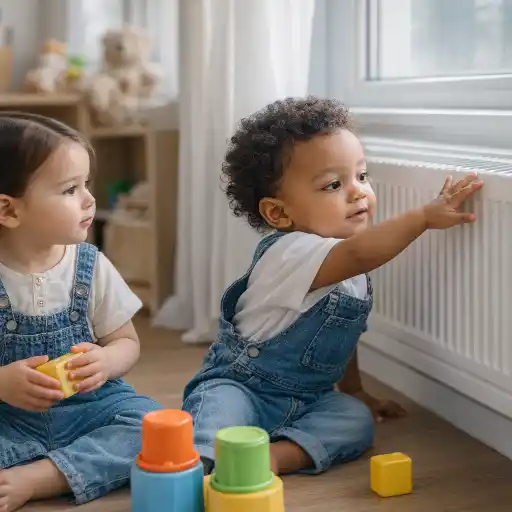
Start by mapping the locations of radiators, baseboard heaters, hot-water pipes, fireplaces, and any other warm surfaces children can reach. Include low-level pipes and spaces children use for crawling, floor play, and naps. The Children’s Burns Trust notes that radiators and pipes can become hot enough to cause serious burns, so do not assume a familiar fixture is harmless.
- Arrange shelves, play areas, and furniture to create a clear buffer between children and hot surfaces.
- Use appropriate, securely installed guards or barriers where children might touch a heater or fireplace. Make sure barriers do not create climbing, entrapment, or evacuation hazards.
- Ask a qualified maintenance professional about insulating accessible hot-water pipes where suitable.
- Keep blankets, artwork, toys, and other materials from being placed over or against heating equipment.
- Include heater surfaces and protective barriers in daily classroom hazard checks, and report damaged or loose guards promptly.
Supervision complements physical safeguards. During room changes, active play, and transitions, staff can position themselves to notice children approaching a heating source and guide them toward a safer activity. Use calm, consistent language—“That surface is hot; let’s play over here”—rather than relying on a child to remember a warning. Record burns and near misses according to program procedures, then review what the incident reveals about layout, supervision, or equipment.
What practices reduce heater-related fire and electrical hazards?
For child care programs, the safest heating approach is generally to maintain and use the building’s approved heating system rather than improvise with portable equipment. Do not bring in a space heater without confirming that it is permitted by your licensing rules, fire code, building policy, and manufacturer instructions. Some jurisdictions or facility standards prohibit portable heaters or restrict their use. The Minnesota Department of Health bulletin describes hazards including fire, electrical overload, damaged cords, and trip risks; it also underscores that persistent cold may indicate a heating-system problem requiring attention.
Keep combustible items away from heat sources, and make sure equipment and cords do not obstruct exits or walkways. Never drape clothing or bedding over a heater, and do not use damaged cords or improvised electrical connections. Smoke alarms and fire-detection systems should remain operable and be tested and documented according to applicable rules and manufacturer guidance.
Directors can assign staff a brief seasonal walkthrough that checks for:
- Items stored too close to radiators, furnaces, boilers, or other heat sources.
- Portable heaters or extension cords being used without authorization.
- Blocked vents, damaged equipment, unusual smells, or visible signs of overheating.
- Clear exit routes and accessible fire-safety equipment.
If a room cannot stay comfortably warm, contact building maintenance or a qualified technician rather than relying on an unapproved workaround. Follow your emergency plan if the facility’s heat becomes inadequate for safe care.
How can a daycare prevent carbon monoxide exposure?
CO can be produced when fuel such as natural gas, propane, oil, wood, or gasoline burns. Furnaces, boilers, water heaters, fireplaces, and vehicles near attached garages can be potential sources. Because CO has no reliable smell or visible warning, detectors, proper venting, equipment maintenance, and a clear response procedure are essential layers of protection.
Follow state and local requirements for where detectors are required and how they must be installed. Guidance in Caring for Our Children recommends that providers comply with applicable laws, test detectors monthly, document test dates, replace batteries at least annually when applicable, and follow the manufacturer’s instructions. The EPA’s healthy-facility self-assessment also asks programs to check that fuel-burning and open-flame heating systems are properly vented and that CO detection is in use as recommended.
- Identify all fuel-burning equipment and have it inspected and maintained by qualified professionals on the appropriate schedule.
- Keep vents and combustion-air openings unobstructed; do not store materials around equipment.
- Test CO detectors and record the date, location or unit, result, and any action taken.
- Replace detectors and batteries in accordance with manufacturer directions and local rules.
- Make sure staff know the alarm response and how to account for every child during an evacuation.
Children may not be able to describe how they feel, and symptoms of exposure can resemble common illness. Treat an alarm or suspected exposure as an urgent safety concern; do not try to locate or repair the source while children remain in the building.
What should staff do if a CO alarm sounds or a heating hazard is found?
Every staff member should know the center’s evacuation route, meeting location, attendance procedure, and who contacts emergency services and families. If a CO alarm sounds, follow the facility emergency plan and instructions from emergency responders: move children and staff to fresh air, account for everyone, and call emergency services from a safe location. Do not re-enter until officials say it is safe. A detector alarm should never be silenced and dismissed as a false alarm without the appropriate assessment.
For a fire, smoke, gas odor, damaged heating equipment, or an immediate burn hazard, prioritize moving children away from danger and activating the relevant emergency procedures. Notify the director and maintenance contact. A qualified professional should assess equipment concerns; staff should not attempt repairs or restart a system that has been shut down because of a suspected fault.
After the immediate response, document the event and corrective actions. Record alarm or equipment details, locations, times, people notified, children accounted for, and the clearance or repair information provided by the appropriate professional or authority. Review the event with staff and update the emergency plan or inspection checklist if the experience revealed a gap. Practice evacuation and communication steps so everyone can act quickly without confusion.
How can directors build a reliable heating-safety routine?
Make heating safety visible in facility operations. Assign clear responsibility for monthly detector checks, seasonal maintenance coordination, and daily classroom observations. Keep inspection and service records together with the written emergency plan, detector instructions, and staff training documentation. These habits make it easier to notice overdue tasks and explain the program’s process during a licensing or fire-safety review.
State requirements vary - check your state licensing agency. Also consult local fire officials, building management, equipment manufacturers, and qualified heating professionals for requirements specific to the facility. Do not assume that a rule or guidance from one state applies elsewhere. Pennsylvania’s child care regulations, for example, list separate provisions for indoor temperature, hot pipes and other heat sources, space heaters, fire detection, and fire drills—illustrating why providers should review the rules that apply to their own location.
A concise routine can include:
- 🌡️ At opening: note unusual room temperatures, odors, sounds, or visible equipment concerns and report them promptly.
- Daily: check that children cannot access hot surfaces and that equipment and exit paths are unobstructed.
- Monthly or as required: test CO detectors, record results, and follow the manufacturer’s instructions.
- Seasonally and as directed: arrange qualified inspection and maintenance of heating and venting systems.
- At staff meetings: review the alarm response, evacuation roles, and how children with mobility or medical needs will be supported.
Conclusion: What are the most important heating-safety takeaways?
Indoor heating safety in daycare centers depends on combining prevention, maintenance, supervision, and preparation. Protect children from hot radiators and pipes with thoughtful room arrangement and appropriate barriers. Avoid unapproved portable heaters and keep combustible materials, cords, and exits clear. Maintain fuel-burning equipment, ensure proper venting, and test and document CO detectors in line with manufacturer directions and local requirements.
Most importantly, staff should know exactly what to do when an alarm sounds or a hazard appears: move children to safety, account for everyone, contact emergency responders when needed, and wait for qualified clearance before re-entry. A written, practiced routine helps the team respond calmly and consistently. The central question—how can a daycare heat its rooms without exposing children to burns, fire, or CO?—is answered through regular checks, clear responsibilities, and a commitment to act early when something seems wrong.
Additional ChildCareEd courses
- Stay Alert! Steps for Emergency Prep
- Reducing the Risk of Sudden Infant Death Syndrome
- Healthy Starts: Safety, Nutrition, and Wellness in Child Care
- Pediatric RSV First Aid & CPR/AED
- Emergent Learning & Development
- Creating Environments that Nurture Growth and Community
- CDA Infant/Toddler Credential with Portfolio Review
- Texas Director Credential
- 45-Hour Infant and Toddler Curriculum
- Family Child Care: Building, Premises, and Outdoor Safety
- 💛🧩 ¿Cómo puedo hacer que mi enseñanza sea inclusiva para los niños con autismo?
- Recursos en Español sobre el Sueño Seguro del Bebé
- Cómo Iniciar el Proceso de Obtención de la Licencia de Cuidado Infantil
- Requisitos de Cuidado Infantil en Nueva Jersey para Centros y Proveedores de Cuidado Infantil Familiar
- Proporciones de Cuidado Infantil y Tamaños de Grupo por Edad en Maryland (Guía Rápida para Centros y Hogares)
- Proporciones de Cuidado Infantil y Tamaños de Grupo por Edad en Nueva Jersey (Guía Rápida para Centros y Hogares)
- Proporciones de Cuidado Infantil y Tamaños de Grupo por Edad en Virginia (Guía Rápida para Centros y Hogares)
- Lista para Guardería en Casa en Illinois: Cómo Iniciar una Guardería en el Hogar
- Cómo Trabajar en el Cuidado Infantil en Wisconsin: Requisitos y Pasos
- Safe Temperature Regulations in Daycare: Virginia Rules for Child Care Providers
- Safe Temperature Regulations in Daycare: Illinois Rules for Child Care Providers
- Canciones, juegos y preguntas de círculo para niños
- Cómo simplificar la capacitación para sus empleados de daycare
- How Long Can a Daycare Stay Open Without Power?
- Should Washington Child Care Centers Rethink Parking Lots, Barriers, and Building-Side Safety?
- Daycare Temperature Regulations in Utah: How Hot or Cold Is Too Much?
- How Do You Start a Daycare in Illinois: Home Daycare or Child Care Center?
- How Can Daycare Centers Make Indoor Heating Safer for Children?
- How Can Child Care Centers Create a Practical Winter Wellness Plan?
- How Can Child Care Providers Manage Dry Skin, Chapped Lips, and Eczema in Winter?
