Recognizing religious holidays can help children learn about the people and traditions around them—but it can also leave families feeling overlooked when one observance is treated as everyone’s. Build a thoughtful, inclusive approach with Cultures in the Classroom  Buy Now $24.00, a course that supports providers in fostering acceptance and cultural understanding, and Bridging Cultures: Family Communication & Collaboration Buy Now
$55.00$42.00, which offers strategies for meaningful family partnership. Read on for practical ways to honor religious holidays while protecting every family’s choice and sense of belonging.
Why does thoughtful recognition of religious holidays matter?
Holidays can offer children a window into history, beliefs, family relationships, and community life. A carefully planned story or conversation may help a child feel proud of a family tradition and invite classmates to practice respectful curiosity. Yet no religious observance is universal, and families within the same faith may mark a holiday differently—or not observe it. Treating one familiar tradition as the classroom default can send an unintended message about whose experiences matter.
Recognizing a holiday does not have to mean asking every child to celebrate it. The distinction matters: teaching about a holiday means giving accurate, age-appropriate information about what it means to people who observe it; celebrating it as a shared classroom event can imply that everyone accepts its religious meaning. NAEYC recommends anti-bias reflection when programs decide whether and how holidays belong in the curriculum.
For directors and educators, the goal is not to fit every holiday onto a calendar. It is to make deliberate choices that support children’s identities, respect family beliefs, and help children encounter differences without pressure. A written, revisited approach gives staff a shared foundation instead of leaving sensitive decisions to last-minute improvisation.
- Children benefit when their identities and family lives are treated with respect.
- Families can trust educators who ask rather than assume.
- Children can learn about difference without being asked to participate in beliefs that are not theirs.
How can centers distinguish learning about a holiday from celebrating it?
Begin by stating the learning purpose. Are children exploring what a particular holiday means to some families, learning about a historical event, or taking part in a religious or cultural practice? The purpose should guide the activity and the words educators use. If the activity centers a religious observance, avoid framing it as a universal classroom celebration. Use clear language such as, “Some families observe this holiday in different ways,” and explain that other families may not observe it.
For young children, concise explanations, accurate picture books, and family-shared examples can make abstract ideas understandable. A teacher might say, “Some Jewish families celebrate Passover and tell stories about freedom. Families have different traditions, and not everyone celebrates Passover.” Keep the focus on learning, not on asking children to adopt a belief, perform a ritual, or explain a whole religion.
Activities should reflect the holiday’s meaning rather than use symbols as decoration without context. Consult credible sources and, when families choose to contribute, treat their account as one family’s perspective—not a definitive description of an entire community. NAEYC notes that commercialized versions of familiar holidays are not automatically culturally or religiously neutral. That reminder can help staff examine even activities that feel customary.
- Explain what the class is learning and why.
- Use “some families” and “this family” rather than “everyone” or “they all.”
- Do not equate a seasonal activity with a religious holiday simply because it is popular.
- Offer a parallel activity or an option to observe or pass without explanation.
How can family input guide respectful planning?
Family partnership begins with curiosity and choice. Ask caregivers what they would like the program to know about seasonal traditions or preferences, without asking them to disclose a religious identity or teach the whole group. A brief conversation, optional questionnaire, or private message can help staff understand what feels comfortable for a child. Give families time to respond and explain how their information will be used.
Keep invitations genuinely voluntary. Families should not have to bring food, supplies, photographs, or a presentation to make their traditions visible. If a family chooses to share a story, song, object, or photograph, ask permission before displaying or discussing it, and follow their guidance on what is appropriate. A child should never be expected to represent a religion or culture just because their family may observe a holiday.
Make communication accessible: use the family’s preferred communication channel and provide translated information or interpretation when available and appropriate. Invite feedback without implying that every suggestion can be adopted exactly as requested; respond respectfully and explain program decisions. Family input should inform a broader inclusion plan, not become a one-time request for a family to solve the center’s planning challenge.
- Ask: “Are there traditions or preferences you would like us to consider?”
- Ask: “Are there activities you would prefer your child not take part in?”
- Make sharing optional, private when requested, and free of cost or performance expectations.
- Never infer beliefs from a child’s name, appearance, language, or family background.
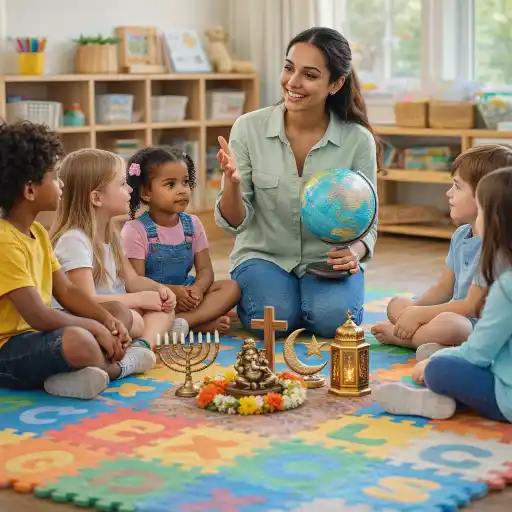
What classroom practices help every child feel included?
Build representation into the everyday environment instead of confining it to a holiday week. Books, music, family photographs shared with permission, dramatic-play materials, and classroom conversations can reflect a range of religions, cultures, family structures, and choices—including not celebrating holidays. Select resources that are accurate and varied, and avoid reducing a tradition to a single food, costume, or symbol.
Offer meaningful ways for children to participate. A child may listen to a story, ask a question, make open-ended art, choose another classroom activity, or simply observe. Alternatives should be engaging and available without isolating the child or making their choice public. For infants and toddlers, brief books, gentle music, and familiar interactions may be more appropriate than extended explanations or elaborate events.
Use everyday language to normalize difference. If a child says, “We don’t do that,” an educator might respond, “Families have different traditions. You can listen, choose another activity, or tell me what you prefer.” If questions arise, answer matter-of-factly and correct stereotypes calmly. Protect children from being teased or singled out, and do not require them to disclose private beliefs.
- Use books and images that show traditions in context and people as individuals.
- Offer choices such as participating, observing, choosing an alternative, or passing.
- Build in quiet space and predictable routines if an event changes the classroom rhythm.
- 🎨 Invite open-ended art about ideas such as family, light, care, or community without requiring a holiday-specific craft.
What common mistakes should centers avoid?
One common pitfall is assuming a widely known or commercially popular holiday is neutral. Symbols such as trees, characters, or egg hunts can carry cultural or religious meanings even when adults describe them as “just for fun.” Staff should consider what a child may reasonably understand the activity to mean, whose traditions it centers, and whether it asks children to take part rather than learn.
Another mistake is treating a single child or family as a spokesperson. One family’s practice cannot stand for everyone who shares a religion, and a child should not have to correct inaccurate materials in front of peers. Avoid tokenism, stereotypes, and displays of meaningful objects without explanation or permission. If the team is unsure, pause, consult reliable sources, and ask families for input only if they freely wish to share.
Centers should also avoid treating nonparticipation as a problem or making an alternative feel like a penalty. If a family raises a concern, listen without defensiveness, thank them, and discuss a practical response. Review the activity and the program’s policy with staff, then follow up as appropriate. For events involving food, supervision, accommodations, or other regulated practices, state requirements vary - check your state licensing agency.
- Do not say “everyone celebrates” or assume a child’s beliefs.
- Do not require participation, family contributions, or public explanations.
- Do not present a craft or symbol without checking its meaning and context.
- Do not treat one holiday as the only opportunity to represent family diversity.
How can directors create a consistent, inclusive holiday approach?
Directors can support educators by developing a concise written policy that explains the program’s goals, how holiday activities are selected, how religious content is handled, and how families can express preferences. There is no single policy that fits every community. Revisit it as families, staff, and community needs change, and make sure educators know where to turn when questions arise.
Before an activity, staff can discuss its purpose, accuracy, participation options, and possible impact on children who do not observe the holiday. Afterward, reflect on what children experienced: Were choices real? Did the activity communicate respect? Did any child feel singled out? Use observations and family feedback to improve future plans. Shared, nonreligious gatherings—such as a classroom community day, garden celebration, or kindness project—can also build connection without centering one faith tradition.
Professional learning can help teams develop practical skills for culturally responsive curriculum and family communication. In addition to the courses introduced above, consider Strength in Differences: Cultural Diversity Buy Now $24.00, From Play to Planning: Building Culturally Competent, Child-Centered Curriculum Buy Now $55.00, and Family Voices Matter: Tools for Meaningful Collaboration Buy Now $55.00. These English-language courses address cultural responsiveness, curriculum planning, and family collaboration.
Conclusion: How can centers recognize holidays without excluding families?
Childcare centers can recognize religious holidays without excluding families by teaching about traditions with accuracy, distinguishing learning from participation, and making family choice visible in everyday practice. Ask families rather than assume, keep sharing voluntary, use trustworthy materials, and provide meaningful ways to participate—or not participate—without stigma.
Directors strengthen this work by creating a shared policy, supporting staff reflection, and revisiting plans with family feedback. The goal is not to celebrate every holiday in the same way; it is to ensure that children learn about one another while every family’s beliefs, traditions, and choices are treated with dignity.
- What Makes Me Special: An Overview of Autism and ADHD
- Children at the Wheel: Emergent Curriculum
- CDA Bridge Bundle: Preschool
- CDA Bridge Bundle: Family Child Care
- CDA Bridge Bundle: Family Child Care without Portfolio Review
- CDA Bridge Bundle: Infant/Toddler without Portfolio Review
- CDA Bridge Bundle: Preschool without Portfolio Review
- CDA Family Child Care Credential with Portfolio Review
- Bienvenido! Welcoming All Families
- 🤝¿Cómo fomentar respeto e inclusión en el aula infantil? 🌻
- 10 Ejemplos de Cómo la Cultura Influye en el Desarrollo Infantil
- Requisitos de Cuidado Infantil en Nueva Jersey para Centros y Proveedores de Cuidado Infantil Familiar
- Proporciones de Cuidado Infantil y Tamaños de Grupo por Edad en Maryland (Guía Rápida para Centros y Hogares)
- Proporciones de Cuidado Infantil y Tamaños de Grupo por Edad en Nueva Jersey (Guía Rápida para Centros y Hogares)
- Proporciones de Cuidado Infantil y Tamaños de Grupo por Edad en Virginia (Guía Rápida para Centros y Hogares)
- ¿Cuál es la Diferencia Entre la Crianza Respetuosa y la Crianza Permisiva?
- Cómo Trabajar en el Cuidado Infantil en Carolina del Norte: Requisitos y Pasos
- Celebrando la amistad en el cuidado infantil durante el Día de los Mejores Amigos
- Canciones, juegos y preguntas de círculo para niños
- Cómo simplificar la capacitación para sus empleados de daycare
- Rosh Hashanah Kindergarten Lesson Plans: 5 Days of Apples, Kindness, and New Beginnings
- How Can We Celebrate Every Family and Create a Classroom Where Everyone Is Represented?
- ¿Todos los niños deben participar en el tiempo de círculo?
- How Can Child Care Programs Make Classroom Holiday Invitations Clearly Optional?
- How Can Child Care Providers Make Christmas Classroom Activities Optional and Inclusive?
- How Can Child Care Providers Create Inclusive Christmas Celebrations for Every Family?
- How Can Child Care Providers Teach Christmas, Hanukkah, and Kwanzaa Respectfully?
- How Can Childcare Centers Recognize Religious Holidays Without Excluding Other Families?
- How Can Childcare Providers Celebrate Christmas While Respecting Different Family Beliefs?
