Young children learn through movement, yet busy schedules, limited space, and safety concerns can make active play feel difficult to plan. A thoughtful approach can help providers build frequent, inclusive opportunities into ordinary routines while supporting motor, cognitive, social-emotional, and health outcomes. For practical strategies on balancing active, creative, and sedentary time, explore Balancing Active Play in Child Care  Buy Now $16.00; the online course can strengthen staff knowledge and may support professional-development goals, subject to local requirements.
Why does physical activity matter in early care and education?
Physical activity is not an “extra” that competes with learning. It is one of the ways young children explore ideas, practice self-regulation, develop coordination, and build relationships. The CDC identifies 11 high-impact obesity-prevention standards that support movement in early care settings, including adequate indoor and outdoor space, staff training, written policies, active adult participation, daily outdoor opportunities, structured movement experiences, and supervised tummy time.
Research summarized in the Early Childhood Education Journal connects energetic play with developing attention, working memory, inhibitory control, and broader self-regulation. Movement can therefore reinforce literacy, mathematics, science, and social learning rather than interrupt them.
- Active play strengthens large-muscle development, balance, coordination, and confidence.
- Movement-rich routines can support attention, mood, and participation.
- Playful physical experiences create opportunities for cooperation, communication, and problem solving.
- Consistent access helps children view #physicalactivity as a normal, enjoyable part of daily life.
A strengths-based perspective is essential. Children do not need identical performance; they need meaningful chances to move, make choices, practice skills, and experience success.
How much movement should programs provide for different ages?
Movement needs vary by age, development, health, ability, setting, and local regulation. The Caring for Our Children guidance recommends daily opportunities for child-led and adult-led activity, including tummy time for awake infants and moderate-to-vigorous outdoor play when conditions permit.
- Infants: Provide supervised floor play and tummy time every day while infants are awake. Interact face-to-face, place interesting objects within reach, and gradually extend tummy-time experiences as the child shows readiness. Avoid prolonged use of restrictive equipment.
- Toddlers: Plan multiple opportunities for structured movement, free exploration, walking, climbing, pushing, pulling, dancing, and carrying. A commonly cited benchmark is at least 30 minutes of structured and 60 minutes of unstructured activity daily.
- Preschoolers: Offer at least 60 minutes of structured and 60 minutes of unstructured physical activity as a practical planning benchmark, while recognizing that children benefit from being active throughout the day.
- School-age children: Provide opportunities to reach age-appropriate daily activity goals through active games, outdoor play, sports exploration, walking, and recreation.
These figures are planning references, not a reason to pressure children or treat movement as a performance test. Track activity across short bursts rather than expecting one uninterrupted block. State requirements vary - check your state licensing agency.
How can teachers embed movement into ordinary routines?
The most sustainable plan is often to replace sedentary waiting with purposeful movement. A classroom does not need a gymnasium or expensive equipment. Teachers can use transitions, songs, stories, classroom jobs, and learning centers to create repeated opportunities for #movement.
- March, tiptoe, or move like an animal while transitioning between activities.
- Invite children to hop to a letter, count jumps, sort objects while walking, or follow a shape path.
- Use action songs, freeze dance, scarves, beanbags, balloons, and soft balls for brief indoor sessions.
- Offer open-ended outdoor choices such as tricycles, climbing, running routes, balancing, digging, and transporting materials.
- Schedule two or more adult-led movement experiences while protecting substantial time for child-directed play.
Teachers can also model participation. When adults dance, crawl, stretch, or join a cooperative game, children often see movement as relational rather than remedial. The goal is not constant high intensity; it is a healthy rhythm that alternates active play, focused learning, rest, meals, and sleep.
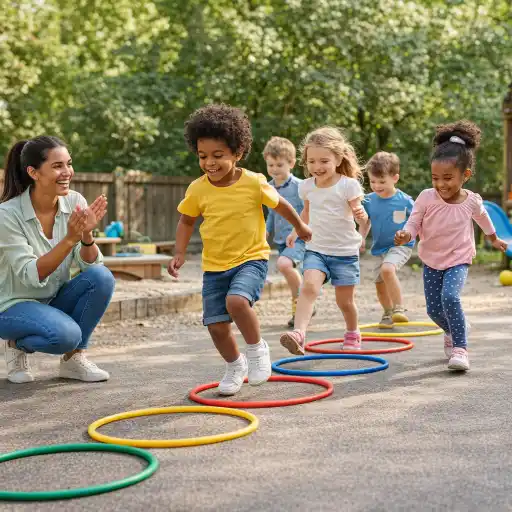 Directors can support consistency by adding movement expectations to lesson-plan templates, staff orientation, observations, and team meetings. The Teacher & Me Playtime Buy Now $24.00 course may help staff connect developmentally appropriate activities with teacher- and child-directed experiences, especially for infants and toddlers.
How should programs design safe and inclusive movement environments?
Safety and challenge are not opposites. Children need reasonable opportunities to test balance, strength, coordination, and judgment, while adults remain attentive to hazards and developmental readiness. The environment should make movement visible, accessible, and welcome.
- Prepare the space: Clear pathways, inspect equipment, use appropriate surfaces, secure furniture, and establish boundaries.
- Supervise actively: Maintain sight and sound awareness, position adults strategically, scan continuously, and stay close to activities requiring additional support.
- Plan for weather: Follow local procedures for heat, cold, air quality, sun exposure, hydration, and clothing. When outdoor play is unsafe, provide meaningful indoor alternatives.
- Offer access: Use wide pathways, soft or lightweight materials, visual directions, seated options, shorter distances, and varied levels of challenge.
- Protect dignity: Avoid public comparisons, forced participation, or activities that label children as “good” or “bad” movers.
Inclusive planning begins with the question, “What change would allow this child to participate?” A child might step instead of hop, roll instead of throw, use a larger ball, follow a picture sequence, or work with a peer. Consult families and specialists when appropriate, and document adaptations that are effective.
For teams redesigning indoor spaces, Playful Spaces: Designing the Infant & Toddler Classroom Buy Now $35.00 offers focused training on room arrangement, materials, and equipment that promote exploration and activity.
What common mistakes limit children’s physical activity?
Programs often value active play but unintentionally create barriers. Recognizing these patterns allows directors and teachers to make manageable changes without blaming staff or children.
- Withholding active play as punishment: Active play supports well-being and should not be removed because a child struggled with behavior. Use logical, respectful guidance instead.
- Relying on one long outdoor period: A single block may be disrupted by transitions, waiting, weather, or uneven participation. Add several shorter opportunities.
- Creating long lines: Rotate small groups through stations so children spend more time moving and less time waiting.
- Using one activity for every child: Offer choices and adaptations rather than assuming identical interests, skills, or sensory preferences.
- Confusing noise with poor practice: Active play can be joyful and energetic. Teach clear stop signals, boundaries, and routines instead of eliminating movement.
- Overlooking infants: Infants need responsive floor experiences and supervised tummy time, not extended periods in seats, swings, or activity centers.
Programs can conduct a brief weekly review: When were children moving? Who participated? Where did waiting occur? Which children needed adaptations? Use a checklist, staff reflection, or simple observation notes to identify one improvement for the following week. The Inclusive Lessons for Preschoolers Buy Now $16.00 course can help educators connect differentiated planning with welcoming participation.
How can directors sustain a culture of physical activity?
Lasting improvement depends on systems, not individual enthusiasm alone. Directors can establish a written physical-activity policy that identifies expectations for indoor and outdoor play, staff modeling, supervision, inclusion, screen use, weather decisions, and the prohibition against using activity as punishment. Policies should be reviewed with staff and communicated clearly to families.
- Train staff during orientation and provide annual refreshers on age-appropriate movement, active supervision, adaptations, and equipment safety.
- Audit the schedule and environment using observations or a physical-activity checklist.
- Budget for versatile, low-cost materials such as balls, scarves, hoops, cones, mats, chalk, and recycled containers.
- Invite families to share cultural movement traditions and simple home activities.
- Celebrate effort, cooperation, confidence, and growth rather than athletic ability.
Directors should also consider how staffing patterns, ratios, transitions, and room design affect participation. A movement plan is more likely to succeed when it is realistic for the team’s workload and embedded into existing routines. The online Balancing Active Play in Child Care Buy Now $16.00 course provides a deeper learning experience on structured and unstructured activity, sedentary time, materials, and developmental goals.
Conclusion
How can child care programs make physical activity a daily practice? Begin with frequent, developmentally appropriate opportunities that are safe, inclusive, playful, and integrated into the schedule. Provide supervised tummy time for infants, active exploration for toddlers, a balanced mix of structured and unstructured play for preschoolers, and meaningful choices for school-age children.
The strongest programs combine thoughtful environments, engaged adults, clear policies, family partnerships, and continuous reflection. Start with two small changes this week: replace one waiting period with movement and add one accessible activity choice. Over time, these ordinary decisions can create a culture in which every child feels capable, welcomed, and eager to move. Keep #play joyful, protect children’s dignity, and remember that small bursts of activity add up to significant developmental opportunities.
- CDA Home Visitor Subject Area 3 Part 3 Birth to 5
- Balancing Physically Active Play in Child Care
- Building Equity: Inclusionary Practices in Preschool
- CDA Bridge Bundle: Family Child Care without Portfolio Review
- CDA Bridge Bundle: Infant/Toddler without Portfolio Review
- CDA Bridge Bundle: Preschool without Portfolio Review
- Texas Director Credential
- Wellness in Action: Teaching Healthy Habits to Children
- Balancing Active Play in Child Care
- CDA Infants/Toddlers: Lesson Planning Made Easy
- Ohio Healthy Programs (OHP)
- Mental Health for Tiny Elves: Supporting Kids Through Winter Blues
- CDA Certification en Español: Recursos y Consejos para Educadores Bilingües
- Actividades de Motricidad Gruesa que Desarrollan el Equilibrio, la Coordinación y la Fuerza
- Capacitación Previa al Servicio para Proveedores de Cuidado Infantil en Nevada
- How can child care programs boost physical activity for young children?
- How Do Minnesota Winters Affect Young Children's Mental Health?
- Canciones, juegos y preguntas de círculo para niños
- Cómo simplificar la capacitación para sus empleados de daycare
- The Role of the Environment in Children’s Physical Activity
- Can simple soccer games build gross motor skills in young children?
- Get Moving: How Can Child Care Programs Build Physical Activity Into the Daily Routine?
- Should Early Childhood Programs Give Children More Outdoor Time?
- How can we include children with physical disabilities in daily activities?
- What Should a School-Age Curriculum Include? A Guide for After-School Programs
- How Can Child Care Providers Support Gross Motor Development in Every Child?
- How Can Child Care Providers Build Healthy Habits for Young Children?
- How Can Child Care Programs Make Physical Activity a Daily Practice?
- How Much Outdoor Play Do Preschoolers Need Each Day?
