Why does counting 10, 20, 30, 40... matter so much? Learning to count by tens helps children notice number patterns and begin to understand how our base-ten number system works. In this article, we’ll explore how counting by tens builds a foundation for place value, with ideas from No Such Thing as Boring Math  Buy Now $24.00 and hands-on practice using the Color the Multiples of 10: Hundreds Chart Coloring Activity Buy Now $1.49.
Why does counting by tens matter beyond memorizing a sequence?
Counting by tens is not simply a faster version of counting by ones. It introduces children to unitizing: understanding that ten individual objects can be treated as one larger unit. When a child recognizes that ten ones make one ten, the child is beginning to coordinate quantity, grouping, language, and symbolic notation.
This idea is central to the base-ten system. Each position to the left is worth ten times the position immediately to its right. Thus, 34 can be interpreted as three tens and four ones, while 340 can be interpreted as three hundreds and four tens. The digit “3” has not changed visually; its value changes because its position changes.
Research and professional guidance emphasize that early counting involves more than reciting number words. Children must connect the final number word to the quantity in a set, recognize patterns, compare magnitude, and explain their reasoning. Counting by tens supports each of these understandings because it makes numerical structure visible.
For providers, the practical implication is encouraging: ordinary routines can become rich mathematics experiences. Counting ten cups, bundling ten craft sticks, or noticing that the classroom chart increases by ten in each column can help children build concepts before formal worksheets are introduced.
How does counting by tens develop unitizing and magnitude?
Unitizing asks children to see one collection in two ways: ten separate ones and one group called a ten. This flexible perspective is a major conceptual shift. Children initially tend to count every object individually. With repeated experiences, they begin to recognize that a bundle of ten can be counted as a single unit while retaining a value of ten.
Counting by tens also strengthens magnitude. A child who knows that 40 is four groups of ten can reason that 40 is greater than 30 because it contains one additional group of ten. This is more powerful than memorizing that 40 comes after 30 in a sequence. It gives children a reason for the relationship.
Use intentional questions to elicit this thinking:
- How many groups of ten do you see?
- How many objects are in each group?
- How many are there altogether?
- What would change if we added one more group?
- Can you show the same number another way?
Hundreds charts can support this reasoning when their spatial organization is clear. Children may notice that moving vertically changes a number by ten, while moving horizontally changes it by one. A chart should be treated as a tool for investigation rather than a poster to memorize. Invite children to predict, explain, and test patterns.
Which concrete materials make tens visible?
Young children benefit from materials they can physically group, separate, exchange, and describe. Proportional, groupable materials are especially useful because they preserve the relationship between one and ten.
- Use linking cubes to build towers of ten and compare them with individual cubes.
- Use ten-frames so children can recognize a full frame as ten without recounting every counter.
- Bundle straws, craft sticks, or pipe cleaners in groups of ten.
- Use base-ten blocks after children have explored materials that can be grouped and ungrouped.
- Provide place-value mats labeled “tens” and “ones” to organize children’s representations.
Begin with a quantity such as 23. Ask children to build it with two bundles of ten and three individual objects. Then ask them to represent 23 with ten-frames, a drawing, and numerals. This concrete-representational-abstract progression helps children connect objects, images, spoken language, and symbols rather than treating each as a separate lesson.
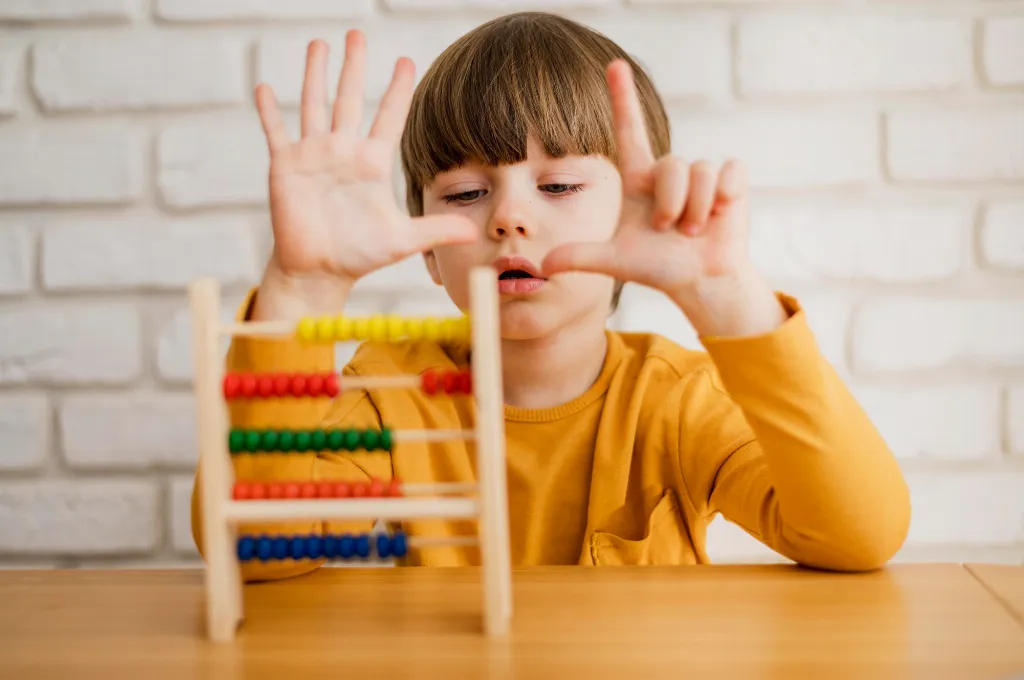 🧩 A simple “trade” game can be highly effective: children exchange ten individual counters for one ten-stick. Narrate the exchange precisely: “You still have the same quantity. We changed how it is organized.” That sentence reinforces equivalence and prepares children for regrouping.
Some children will need longer access to groupable materials, while others may be ready for charts and symbols. Differentiation is not a sign that instruction has failed; it is a way to honor developmental variation.
How can providers teach counting by tens through play and routines?
Play-based mathematics can be intentional without becoming overly formal. Choose a weekly goal and embed short opportunities throughout the day. For example, a goal might be “children will represent a number as groups of ten and leftover ones.”
- Arrival: Count ten name cards, then ask how many cards remain.
- Snack: Place crackers into groups of ten and compare groups.
- Block area: Build towers of ten and record how many towers were made.
- Outdoor play: Collect ten natural objects, bundle them, and estimate how many objects are in a larger collection.
- Music and movement: March or clap in groups of ten, pausing to discuss the total.
Story contexts also make the idea memorable. A pretend shop can sell items in packs of ten. A construction center can require ten blocks for each “floor.” A dramatic-play bakery can arrange ten pretend cookies on each tray. These contexts give children reasons to group, count, compare, and communicate.
Use mathematical language consistently. Say “three tens and two ones” rather than only “the 3 is in the tens place.” Ask children to explain both the position and the value of a digit. Invite home connections as well: families can count socks in groups, organize utensils, or notice packages containing ten items.
Children’s cultural, linguistic, and community experiences should inform these examples. Encourage children to count in home languages when possible and accept multiple ways of explaining a grouping strategy. A responsive classroom communicates that mathematics belongs to every child.
What misconceptions should teachers anticipate and address?
Counting by tens can be memorized without being understood. A child may say “10, 20, 30” but be unable to build 30 with three groups of ten. Another child may identify the digit in the tens position but describe its value as “three” instead of “thirty.” These responses provide useful information about the child’s current thinking.
Common misconceptions include:
- Recitation without quantity: The child knows the sequence but cannot connect each word to a group.
- Position without value: The child names “tens place” but does not understand that the digit represents groups of ten.
- Ignoring zero: In 204, the child may overlook zero even though it preserves the position of the ones.
- Reversing digits: The child may confuse 14 and 41 because spoken number words and written notation do not always follow the same order.
- Premature abstraction: The child is expected to use symbols before building, drawing, and discussing quantities.
Respond with questions rather than correction alone. If a child says 42 has four ones and two tens, ask the child to build 42 with materials. Then compare the model with the written number. Encourage the child to revise the explanation after seeing the quantity.
Assessment can remain brief and embedded in play. Record whether a child can make a group of ten, count by tens from a given number, represent a two-digit number, and explain the value of a digit. State requirements vary - check your state licensing agency when documenting training or aligning instruction with local expectations.
How does counting by tens prepare children for later mathematics?
Counting by tens establishes relationships that later support addition, subtraction, multiplication, division, rounding, estimation, measurement, money, and decimals. When children understand that 56 is five tens and six ones, they have a conceptual basis for decomposing and recomposing numbers. They can reason that 56 plus 10 is 66 because one more group of ten has been added.
The same understanding supports efficient strategies. A child may solve 28 + 20 by recognizing that two tens can be added without recounting every object. Later, the child can connect ten groups of ten to one hundred and interpret multiplication as the formation of equal groups.
For directors, a coherent progression across classrooms is valuable. Infant and toddler teachers can use quantity language and rhythmic counting. Preschool teachers can introduce ten-frames, grouping, and number stories. Pre-kindergarten and early elementary staff can connect these experiences to place-value charts, expanded notation, and operations.
Consider a team reflection question: “What evidence do we have that children understand tens as units, rather than merely reciting the tens sequence?” Photographs of models, transcripts of children’s explanations, and short observation notes can guide planning more effectively than worksheets alone.
Conclusion: Why is counting by tens a foundation for place value?
Counting by tens lays the foundation for place value because it helps children understand that ten ones can be composed into one unit, that units can be compared and exchanged, and that a digit’s value depends on its position. The goal is not faster recitation; it is flexible reasoning about quantities.
Effective practice is concrete, conversational, playful, and progressive. Provide groupable materials, use ten-frames and charts thoughtfully, connect numbers to meaningful routines, ask children to explain their representations, and observe misconceptions as opportunities for responsive teaching.
For additional professional learning, providers may explore Early Mathematics Through Play Buy Now $24.00, Math Foundations in Early Childhood Buy Now $16.00, No Such Thing as Boring Math Buy Now $24.00, Letter & Number Planning in Child Care Buy Now $24.00, and Lesson Planning for Preschoolers Buy Now $24.00. Course acceptance and training-hour requirements vary by location, so verify details with the relevant licensing or professional-development agency.
Quick FAQ
- When should counting by tens begin? Introduce grouping and quantity language as children show readiness; toddlers can explore groups informally, while older preschoolers may represent tens with materials.
- Is memorizing the tens sequence enough? No. Children should connect each number to groups of ten and explain what the quantity represents.
- Are ten-frames appropriate for preschool? Yes, when used flexibly with counters, conversation, and play rather than as isolated worksheets.
- What should I do if a child reverses digits? Return to concrete models, compare spoken and written forms, and give repeated opportunities to build and describe numbers.
- Early Mathematics Through Play
- CDA Home Visitor Subject Area 3 Part 3 Birth to 5
- CDA Home Visitor Subject Area 2 Part 3 Birth to 5
- Birth to Five CDA Credential with Portfolio Review
- Pediatric RSV First Aid & CPR/AED
- Creating Environments that Nurture Growth and Community
- Connections That Count: Building Relationships in Child Care
- Texas Director Credential
- The Emotional First Aid Kit for kids: Grounding Techniques, Calming Exercises, and Comforting Words
- Little Zen Masters: Ways to Incorporate Mindfulness into Play to Help Navigate Emotions
- 🥦✨ ¿Cómo apoyar a los niños selectivos a probar nuevos alimentos sin presión?
- How to Prepare for a Licensing Visit Without the Stress
- ¿Qué es la dopamina en los niños?
- Cómo Iniciar el Proceso de Obtención de la Licencia de Cuidado Infantil
- Por Qué la Supervisión Activa Es Clave para la Seguridad en el Cuidado Infantil
- Retraso del Habla en la Guardería: Cómo Pueden Ayudar los Proveedores
- Will DC’s Early Childhood Educator Pay Equity Fund Survive?
- La mejor manera de hacer seguimiento a la capacitación de su equipo de daycare How to Organize Staff Training for Your Child Care Center Cómo organizar la capacitación del personal para su centro de cuidado infantil
- Cómo simplificar la capacitación para sus empleados de daycare
- How Did DC’s Pay Equity Fund Help Early Educators Be Seen as Professionals?
- How Can Child Care Providers Extend Ten-Frame Learning from 11 to 20?
- How Can You Use a Hundreds Chart Beyond Rote Counting?
- ¿Cómo puede la retroalimentación visual apoyar la fluidez en la multiplicación?
