A preschooler who zips a coat, asks for help, or joins play with one adult may need different support to use that skill with someone else. Use the All About My Preschooler Buy Now $1.49 family information form to start a conversation about familiar routines, communication, and comfort, then compare those insights with what educators observe across the day. For deeper learning about individual developmental patterns and responsive practice, explore Recognize, Respond, Respect: Supporting Diverse Learners  Buy Now $55.00. Read on for ways to identify helpful cues, build trust, and support children in using their skills with different people and routines.
Why does this pattern matter for a preschool classroom?
When a skill appears with only one adult, it can be tempting to conclude that the child is being uncooperative, testing limits, or has not really learned the skill. Those explanations may miss the more useful question: under what conditions can the child succeed? A child’s performance can vary with the person present, the words used, the materials, the setting, the emotional climate, and the amount of time available to respond.
This distinction matters because learning is more than performing a skill once in a familiar interaction. If a child can request a turn only with a trusted teacher, for example, that ability is a meaningful starting point. The next professional task is to identify which features of that interaction support success and gradually make them available with other adults and in other contexts.
Research on developmentally appropriate practice emphasizes that teaching should respond to children’s development, individual characteristics, and family and cultural contexts. A child’s different response with different adults is information for planning—not a verdict about motivation or ability. That strengths-based stance helps preserve belonging while supporting growth in #learning, communication, and independence.
What does it mean when a skill does not generalize?
Educators use the term generalization for a learned behavior or skill appearing under conditions beyond those in which it was directly taught. A preschooler may know how to wash hands after snack with one teacher but pause when a substitute gives the direction, the sink is unfamiliar, or the routine changes. The underlying skill may be emerging, yet still depend on cues present in the original situation.
Learning is often tied to multiple signals at once: a familiar adult’s tone, a gesture, a particular phrase, a visual schedule, or a predictable sequence. When several signals change at the same time, the child may not recognize that the same skill is useful. This is not necessarily a deliberate choice. It may indicate that the child has learned the response in a narrower context than adults realized.
Generalization is not an all-or-nothing milestone, and skills do not automatically transfer simply because a child can perform them in one place. The review of naturalistic language teaching describes generalization across people, settings, behaviors, and time, and notes that adults can plan for it rather than simply assume it will happen.
- Notice the context where the child succeeds: person, wording, activity, materials, timing, and support.
- Identify what changes when the skill is less visible elsewhere.
- Measure progress as increased flexibility and participation, not instant consistency.
How can relationships, temperament, and context influence performance?
Young children often take emotional cues from adults. A familiar, responsive adult may help a child feel secure enough to attempt a challenging task or communicate a need. Another adult may be less familiar, move more quickly, use different language, or be present during a noisier routine. A pause or withdrawal can reflect uncertainty, stress, or a need for more time—not a lack of knowledge.
Relationships are specific to the people involved. Research on professional caregivers describes children building connections with multiple adults over time, while studies of preschool teacher-child relationships highlight links between relationship quality, temperament, and children’s emotional functioning. These findings do not allow an educator to diagnose attachment or infer a child’s inner state from one interaction. They do support patient, consistent relationship-building and careful observation of the particular adult-child pair.
Consider the whole situation: Is the child tired, rushed, unsure of the words, or navigating a language difference? Does the adult give enough processing time? Are sensory demands or competing activity making the response harder? Developmentally appropriate practice asks educators to adapt support to the child and context, while honoring family language and culture. A respectful response is to learn what helps this child feel ready, then broaden participation gradually.
How can providers help skills transfer across adults and routines?
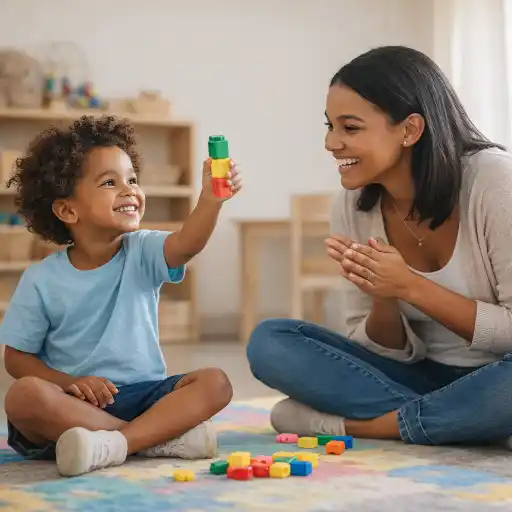
Plan for the skill to appear in more than one situation, beginning with small and predictable changes. First, the adult who has seen success can describe the cues and supports that worked. Then another familiar staff member can join the routine, using a similar pace and giving the child time to respond. As the child becomes comfortable, adults can gradually vary the wording, location, materials, or routine.
- Keep the goal functional. Practice skills the child can use in daily play, care routines, and peer interactions.
- Change one feature at a time. For example, keep the same materials and routine while a second adult gives the cue.
- Offer varied examples. Practice asking for help with a puzzle, a coat, and a container—not only one familiar object.
- Use natural opportunities. Embed practice in play, clean-up, meals, and transitions instead of relying only on drills.
- Share strategies with families. Ask what language, gestures, or routines are familiar at home; invite family input without expecting identical routines.
- 💛 Celebrate an attempt, gesture, or partial response, and provide a prompt only as needed.
Record what support was present when the child succeeded. If a child requests a turn after an adult models the phrase, try a brief pause next time to see whether the child initiates independently. The aim is not to withdraw help abruptly; it is to adjust support responsively while building opportunities with more than one trusted adult.
How should a team observe progress and decide on next steps?
Use brief, objective notes to clarify the pattern. Describe the activity, adult, cue, child’s observable response, and support offered. Instead of writing “will not follow directions for other teachers,” note: “During block cleanup on Tuesday, the assistant said ‘put the blocks away’; the child continued building. When the lead teacher pointed to the picture cue and said ‘blocks in the bin,’ the child put away three blocks.” This makes the difference in context visible and suggests a practical next step.
Across several days, look for trends: Does the child respond more readily in one-to-one interactions than in groups? Do gestures or visual cues help? Does the skill appear with a peer nearby or in a quieter area? Share observations with colleagues and families, and agree on one manageable practice plan. Avoid comparing the child with peers or treating a single missed response as proof of inability.
If the child rarely demonstrates a skill across contexts, loses a previously acquired skill, or has difficulty participating in daily routines despite appropriate supports, discuss the pattern with the director and family. Providers observe and support; they do not diagnose. Families may choose to consult a health care provider or ask about developmental screening. State requirements vary - check your state licensing agency.
- Document strengths and the conditions that make participation easier.
- Set a small goal, such as trying the skill with one additional familiar adult.
- Review the plan together and adjust based on the child’s response.
Conclusion: What should providers remember?
A preschooler who shows a skill with only one adult may have learned it under specific cues, relationships, or routines. That difference is useful information: it helps educators uncover how the child experiences the task and what support makes success possible. It does not, by itself, mean the child is choosing not to cooperate or cannot learn.
Observe without labeling, build trust with additional adults, and create varied, low-pressure opportunities to use the skill in meaningful routines. Change one feature at a time, partner with families, and recognize small steps toward greater flexibility. The central question—why does the skill show up with only one adult?—is best answered through curiosity, careful observation, and responsive teaching that helps the child use what they know in more places and with more people.
Further learning for child care providers:
- Connections That Count: Building Relationships in Child Care Buy Now $55.00 — strategies for building trust with children and families.
- The Science of Growing Up: Typical and Atypical Development Buy Now $55.00 — development, individual differences, and contextual influences.
- Preschool Assessments & Observations Buy Now $24.00 — objective observation and individualized planning.
- Language Development in Early Childhood Buy Now $16.00 — practical support for young children’s communication.
- 45 Hour Child Growth and Development
- CDA Preschool Credential
- CDA Preschool Credential with Portfolio Review
- Basic Life Support (BLS) In-Person Healthcare Providers
- Birth to Five CDA Credential with Portfolio Review
- CDA Bridge Bundle: Preschool
- Recognize, Respond, Respect: Supporting Diverse Learners
- CDA Bridge Bundle: Preschool without Portfolio Review
- Cómo Abrir Una Quardería En Casa Sin Dinero?
- ¿Cuáles son las mejores actividades de primeros auxilios para adultos?
- Cómo simplificar la capacitación para sus empleados de daycare
- Time-In or Time-Out? 7 Real Classroom Scenarios and What to Try
- Which First Aid Course Do Child Care Providers Need for Licensing?
- How Can Child Care Providers Use Positive Discipline to Teach, Connect, and Guide Young Children?
- Why Are Coping Skills Important for Preschoolers?
- What Is the Behavior Trying to Tell You?
- Why Do Young Children Show Challenging Behavior, and What Are They Trying to Communicate?
- How Can Child Care Providers Turn Everyday Routines into Learning Opportunities?
- Why Is My Preschooler Suddenly Aggressive, and How Can Child Care Providers Help?
- What Should You Do When a Preschooler Has a Meltdown in the Classroom?
- How Can Child Care Providers Document Learning During Ordinary Routines?
- What Should You Do When a Preschooler Refuses to Clean Up?
- How Can You Adapt Classroom Activities for Mixed-Age Groups?
- How Should Child Care Providers Respond When a Treasured Item from Home Breaks?
- When a Preschool Rule Expects More Self-Control Than Children Can Manage, What Should Educators Do?
- Why Doesn’t Knowing a Safety Rule Mean a Preschooler Can Follow It?
- Why Does a Preschooler Show a Skill with Only One Adult?
- How Can Preschool Teachers Build Independence Without Giving Too Much Help?
