Play is full of evidence of children’s thinking—but capturing it can feel like one more task in an already busy classroom. Preschool Assessments & Observations  Buy Now $24.00 can help you strengthen objective observation and connect what children do with responsive teaching. For a practical classroom tool, explore the free Preschool Learning Evidence Record Sheet: Observation and Next Steps Buy Now $0.00, which helps educators document children’s actions and words during play, identify learning progress, and plan meaningful next steps without overwhelming their daily routines.
Why is documenting play worth the effort?
Play is not separate from learning. A child negotiating roles in a pretend restaurant may be using language, perspective-taking, memory, and self-regulation; a child rebuilding a fallen tower may be testing ideas, comparing materials, and persisting through a challenge. When teachers make these moments visible, they gain evidence for planning and can share specific examples of learning with families.
Documentation is most useful when it serves a clear purpose—not when it becomes a mountain of notes. NAEYC explains that observation, documentation, and assessment should be ongoing, purposeful, reflective, and responsive to children’s development, culture, and language. The goal is to notice what a child can do, understand the context, and use that information to shape experiences and interactions. A single observation is a snapshot, not a complete account of a child’s abilities.
This kind of formative assessment can also make teaching feel more manageable. Instead of trying to assess everything at once, choose one question and gather a few meaningful examples over time. Thoughtful #observation helps educators recognize strengths and emerging skills without relying exclusively on formal assessments or interrupting children’s play.
What learning indicators can teachers notice during play?
Start with observable indicators: actions, words, gestures, choices, and interactions. Look beyond whether a child finishes a product. The process—how the child begins, changes a plan, asks for help, or responds to a peer—often provides richer evidence about learning.
- Thinking and problem-solving: testing, sorting, comparing, predicting, counting, planning, or changing strategies.
- Communication: explaining an idea, asking questions, using new words, telling a story, gesturing, or communicating in a home language.
- Social participation: inviting a peer, negotiating roles, taking turns, responding to another child’s idea, or choosing to observe before joining.
- Approaches to learning: sustaining interest, trying again, making choices, seeking support, or adapting when materials do not work as expected.
- Physical and creative skills: manipulating small materials, balancing, drawing, constructing, moving expressively, or representing ideas symbolically.
Use a focused question to guide attention: “How does this child test balance?” or “What communication strategies appear during dramatic play?” For example, a child who lines up toy animals and says, “These ones need a bigger home,” may be demonstrating categorization, spatial reasoning, and expressive language. Those are possible interpretations; record the child’s actual words and actions first. Children’s competencies can appear differently across contexts, so observe across routines, materials, peers, and languages.
What should a useful play observation note include?
A helpful note lets another educator picture what happened and understand the circumstances. Include the date, approximate time, setting or activity, relevant materials and participants, and specific actions or exact words. Add only context that clarifies the moment. Keep the observation separate from your interpretation.
For example: “At 9:40 a.m. in the block area, Eli placed two wide blocks at the base of a bridge. After the bridge tipped when he added a long block, he said, ‘It needs a strong bottom,’ moved the wide blocks closer together, and tried again.” This gives a colleague evidence to consider. “Eli is an excellent engineer” is a conclusion, not an observation.
- Write what could be seen or heard—the “video-camera test.”
- Capture exact quotes, gestures, attempts, and changes in strategy.
- Note what materials or adult support were available.
- Document strengths and successful participation as deliberately as challenges.
- Use a jotting for a quick reminder, an anecdotal note for a specific event, or a running record when a detailed sequence is needed and supervision allows.
🌱 Quick practice: After a short play episode, write two factual sentences before adding a separate reflection. This small distinction helps keep #documentation clear, respectful, and useful for future decisions.
How can teachers document play without disrupting it?
Documentation should support attentive teaching, not compete with supervision or children’s engagement. Choose a manageable focus, then record briefly when it is safe to do so. Head Start distinguishes quick jottings from more detailed anecdotal notes and running records; the right method depends on the question, available time, and classroom coverage.
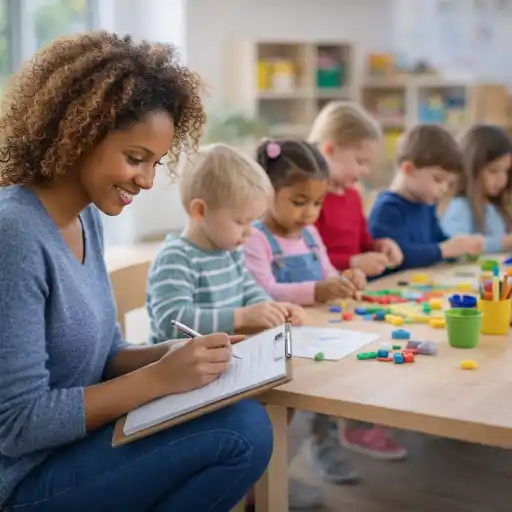
- Choose a focus. Select one child, routine, interaction, or skill to notice rather than attempting to capture everything.
- Plan where to observe. Familiar activities such as blocks, art, outdoor exploration, meals, or dramatic play may show the skill naturally.
- Make a brief record. Jot a key phrase or action while maintaining active supervision; complete relevant details when appropriate.
- Rotate attention. Use a simple schedule so every child is observed across different settings and developmental areas over time.
- Protect records. Follow program rules for consent, photography, digital tools, secure storage, access, and sharing.
Photographs, work samples, or children’s comments may add useful evidence when permitted, but they are not substitutes for context. A photo of a finished structure does not show how a child planned, collaborated, or revised an idea. Avoid taking notes or images in ways that reduce supervision or pull you away from children. State requirements vary - check your state licensing agency.
How does documentation guide instruction and family conversations?
Use a simple cycle: observe, document, reflect, plan, and observe again. First, describe what happened. Then consider what the evidence may suggest, what additional information is needed, and how the environment or teaching could support the child’s next steps. Treat interpretations as working ideas to check across more than one moment—not as conclusions based on a single episode.
If notes show that a child repeatedly tests how objects roll down ramps, you might offer ramps at different angles, balls and cylinders, and opportunities to predict and compare. Reobserve to see what the child explores with these materials. This connects evidence to intentional teaching while keeping learning embedded in play.
Specific examples also make family conversations more meaningful. Share an observation in plain language and invite the family’s perspective: “During outdoor play, Noor compared two sticks and said, ‘This one is longer.’ What kinds of collecting or comparing does Noor enjoy at home?” Family knowledge can reveal how a child communicates or uses skills in other settings. NAEYC recommends using assessment information to inform teaching and communicate with families; screening and documentation support discussion but do not diagnose.
What common documentation mistakes should teams avoid?
Even experienced educators can slip into assumptions when a moment is memorable or a classroom is demanding. A brief review can help teams make documentation fair, accurate, and actionable.
- Using labels instead of evidence: Replace “shy” with an observable description, such as “watched the group for several minutes, then handed a block to a peer.”
- Inferring feelings or motives: Record words and actions first; note interpretations separately and cautiously.
- Overgeneralizing from one moment: Look for patterns across times, people, activities, and languages.
- Recording only concerns: Include interests, persistence, relationships, strategies, and accomplishments.
- Collecting without a question: Identify how the note might inform instruction, reflection, or a family conversation.
- Letting documentation interrupt care: Maintain supervision and use brief notes or scheduled observation coverage.
Teams can compare how different educators describe the same appropriate observation to notice assumptions and improve consistency. Include family perspectives and consider whether every child has fair opportunities to demonstrate skills. Assessment should be developmentally, culturally, and linguistically responsive, and formal tools should be used for appropriate purposes.
Conclusion: What should preschool teachers document during play?
Preschool teachers should document specific, observable evidence of children’s actions, words, strategies, interactions, and use of materials—along with enough context to make the moment understandable. Focus on indicators such as communication, problem-solving, persistence, social participation, and physical or creative skills. Keep facts distinct from interpretation, protect children’s privacy, and record without compromising supervision.
Most importantly, use what you notice. Review evidence over time, adjust materials or interactions, and invite families to add their knowledge. Play-based documentation does not need to be lengthy or formal to matter: a concise, objective note can help teachers make thoughtful instructional decisions and see each child’s learning more clearly.
Explore five related ChildCareEd courses
- Preschool Assessments & Observations Buy Now $24.00 — practice objective observation and appropriate assessment in preschool.
- Observing & Assessing in Child Care Buy Now $16.00 — explore ways to document development and plan tailored learning experiences.
- Tracking Progress, Shaping Futures: Observation & Assessment Skills Buy Now $55.00 — learn observation methods, multiple measures, and goal setting.
- Assessing through Observation Buy Now $24.00 — review practical observation and assessment methods.
- Observations And Goal Setting in Childcare Buy Now $24.00 — connect observations with meaningful goals and planning.
- CDA Preschool Credential
- CDA Preschool Credential with Portfolio Review
- What Makes Me Special: An Overview of Autism and ADHD
- Birth to Five CDA Credential with Portfolio Review
- CDA Bridge Bundle: Preschool
- CDA Bridge Bundle: Family Child Care without Portfolio Review
- CDA Bridge Bundle: Infant/Toddler without Portfolio Review
- CDA Bridge Bundle: Preschool without Portfolio Review
- CDA Infants/Toddlers: Benefits to Observing
- Lesson Planning for Preschoolers
- 😫🧸 ¿Qué hacer cuando un bebé no quiere dormir la siesta en el aula?
- ❄️ ¿Qué actividades al aire libre funcionan bien para los niños de Illinois en cada estación? 🌷🍂
- ¿Cómo pueden los equipos de cuidado infantil practicar habilidades rápidas de primeros auxilios en situaciones reales?
- Consejos de Supervisión Activa para Salones de Preescolar y el Juego al Aire Libre
- Celebrando la amistad en el cuidado infantil durante el Día de los Mejores Amigos
- Preschool Curriculum Types: Play-Based, Montessori, Reggio, and More
- California Preschool Ratios: How Many Children Can One Teacher Supervise?
- How Can Child Care Programs Build Meaningful School Readiness?
- Which Low-Cost Printables Make the Biggest Classroom Impact?
- How Can Child Care Providers Make Individualized Learning Practical and Inclusive?
- What Does a Developmentally Appropriate Daily Schedule Look Like?
- How Much Screen Time Is Appropriate for Preschool Children?
- How Can Child Care Providers Support Kindergarten Emotions on the First Day of School?
- How Can Early Childhood Teachers Set Goals They Actually Use?
- Is Your Preschool Day Too Sedentary—and How Can You Tell?
- Is Your Preschool Lesson-Planning Routine Taking Too Much Time?
- Why Isn’t One Successful Preschool Activity Enough to Know It Worked?
- What Should Teachers Check Before Placing an Infant Down to Sleep?
- Should Preschool Teachers Use AI to Help Plan Classroom Activities?
- What Should Preschool Teachers Actually Document During Play?
