What does a five-year-old really need before entering kindergarten? A balanced view can help providers guide families without turning readiness into a high-pressure test. For practical strategies on cognitive, physical, and social-emotional preparation, explore Are They Ready for Kindergarten? Buy Now $35.00, a focused training that can strengthen classroom practice and support professional learning hours where applicable.
Why Is Kindergarten Readiness More Than ABCs and 123s?
Kindergarten readiness is best understood as a constellation of developing abilities rather than a pass-or-fail score. The Head Start Early Learning Outcomes Framework identifies interconnected domains that include approaches to learning, social and emotional development, language and literacy, cognition, and physical development. These domains influence one another: a child who can regulate emotions and ask for help is better positioned to participate in a literacy or mathematics activity.
The goal is not to require mastery of every skill. Children develop unevenly, and readiness expectations vary by community, school, culture, language, and individual development. North Carolina’s Department of Public Instruction similarly explains that family readiness guides should support development and transition rather than determine whether a child is “ready.”
Providers can use the kindergarten readiness checklist as a conversation tool. Observe what children can do independently, what they can do with support, and which environments help them participate successfully.
- Focus on strengths before identifying next steps.
- Use play, routines, and relationships as primary learning contexts.
- Communicate expectations in clear, family-friendly language.
- Remember that state requirements vary - check your state licensing agency.
Which Social-Emotional Skills Should a Five-Year-Old Be Developing?
Social-emotional competence is central to kindergarten participation. A five-year-old does not need perfect self-control, but the child should have repeated opportunities to practice managing feelings, interacting with peers, and recovering from frustration with adult support.
Many children approaching kindergarten are developing the ability to follow rules and take turns during games, sustain back-and-forth conversations, join cooperative play, and adjust behavior to different settings. These abilities emerge through relationships and practice rather than through lectures.
- Separate from a familiar caregiver with predictable reassurance.
- Wait briefly, take turns, and participate in small-group experiences.
- Use words, gestures, visuals, or an alternative communication system to request help.
- Identify basic feelings and notice emotions in others.
- Try a calming strategy, such as breathing, moving to a quiet area, or seeking an adult.
- Begin solving peer problems through language and adult coaching.
Teachers can build these skills through emotion stories, puppets, role-play, cooperative games, visual schedules, and transition warnings. Model the process: “You are frustrated because the blocks fell. Let’s pause, breathe, and decide what to try next.” For deeper support, Social Foundations and Responsive Classrooms Buy Now $24.00 explores positive guidance, self-regulation, relationships, and conflict resolution.
What Language, Literacy, and Early Math Skills Matter Before Kindergarten?
Most children do not need to read fluently before kindergarten. More useful indicators include oral language, listening comprehension, print awareness, sound play, storytelling, and meaningful early mathematics. Children may demonstrate knowledge through conversation, drawing, dramatic play, gestures, or a home language; providers should honor these varied forms of expression.
- Listen to a story, answer simple questions, predict, and retell events.
- Participate in back-and-forth conversation and express needs, ideas, and experiences.
- Enjoy books, handle them appropriately, and notice illustrations or print.
- Recognize some letters, especially meaningful letters such as those in the child’s name.
- Notice rhymes, syllables, repeated sounds, and environmental print.
- Count objects, compare quantities, sort materials, and identify simple patterns.
- Use spatial and measurement words such as beside, under, longer, heavier, more, and less.
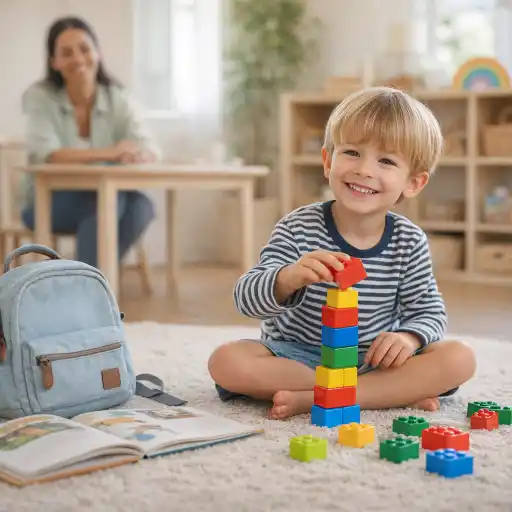
Build these foundations through daily read-alouds, storytelling with props, name cards, songs, block construction, snack counting, and sorting games. Keep activities playful and brief. A two-minute rhyme game at transition can be as valuable as a formal lesson when it is repeated consistently.
For staff development, Science of Reading Foundations in the Pre-K Classroom Buy Now $16.00 addresses print knowledge, phonological awareness, alphabet knowledge, vocabulary, comprehension, emergent writing, reading aloud, and storytelling.
How Much Independence and Motor Control Should a Five-Year-Old Have?
Self-help and motor skills affect how comfortably children participate in a kindergarten classroom. Independence does not mean doing everything without assistance. It means attempting tasks, communicating needs, accepting appropriate support, and gradually taking responsibility for familiar routines.
- Use the toilet, wash hands, and communicate basic health or comfort needs.
- Put on or remove outerwear and attempt zippers, buttons, or other accessible fasteners.
- Open familiar snack or lunch containers and clean up afterward.
- Carry, locate, and store a backpack or personal belongings.
- Use crayons, pencils, scissors, playdough, and small manipulatives with increasing control.
- Run, jump, hop, balance, climb, and participate safely in active play.
- Follow one- or two-step directions and persist briefly through manageable challenges.
Offer adequate time, child-sized materials, picture cues, and calm coaching. Instead of taking over, say, “You brought the zipper to the starting point. Would you like a prompt or another try?” This approach builds #independence while preserving dignity.
The course Supporting Children’s Independence  Buy Now $24.00 gives providers practical strategies for self-regulation, conflict resolution, confidence, and age-appropriate self-help expectations.
How Can Providers Assess Readiness Without Labeling Children?
Observation should guide responsive teaching, not rank children. Use multiple observations across routines, settings, languages, and relationships. A note such as “During cleanup, Jordan followed the picture cue, put away three blocks, and requested help with the shelf” is more useful than marking “independence: developing.”
- Observe: Record what the child says, does, attempts, and enjoys.
- Interpret: Consider strengths, communication methods, culture, language, disability, temperament, and environmental demands.
- Adapt: Add modeling, visuals, peer support, accessible materials, smaller steps, or more time.
- Revisit: Document whether the support helped and revise the plan.
- Partner: Ask families how the child manages routines and communicates at home.
The Head Start framework cautions that developmental indicators are not intended to function as a curriculum, diagnostic tool, or rigid checklist. If a child loses previously acquired skills, shows persistent communication or participation concerns, or makes limited progress despite consistent support, discuss the observations with the family and recommend consultation with the child’s health care provider or local early intervention system.
Screening is a pathway to support, not a prediction of a child’s future. Avoid assuming that bilingual development represents a delay, and provide accessible communication for children who use gestures, devices, or other forms of expression.
How Can Programs Prepare Children and Families for a Smooth Transition?
Readiness grows through coordinated, everyday experiences. Programs can reduce uncertainty by making kindergarten routines familiar and by treating families as knowledgeable partners.
- 🌱 Practice arrival, cleanup, lining up, carrying belongings, and asking for help in short, playful routines.
- Protect sustained #play, including blocks, dramatic play, art, puzzles, books, and outdoor movement.
- Read aloud for 5–15 minutes and ask one open-ended question.
- Count snack pieces, compare tower heights, and sort materials during ordinary routines.
- Share one manageable home idea at a time in the family’s preferred language or communication format.
- Arrange school visits, photo tours, orientations, or conversations with receiving teachers when possible.
- With appropriate consent, share strengths, successful supports, and relevant transition information.
Common mistakes include overemphasizing worksheets, using long pass-or-fail checklists, waiting until summer to plan, and communicating concerns without mentioning strengths. Instead, select two or three individualized goals, document brief observations, celebrate progress, and adjust supports.
For broader professional learning, providers may also explore How Preschoolers Develop Buy Now $32.00, which supports understanding of preschool development and age-appropriate instruction.
Conclusion: What Should a Five-Year-Old Know Before Kindergarten?
A five-year-old should be developing the communication, social-emotional, motor, cognitive, and self-help abilities needed to participate in a learning community—not mastering every item on a rigid list. Children benefit from being able to communicate needs, engage in play, follow simple routines, attempt self-help tasks, listen to stories, explore early math and literacy, and recover from challenges with support.
For providers and directors, the most effective plan is practical and strengths-based: protect play, embed learning into routines, coach emotional regulation, build #language and #literacy through conversation and books, provide meaningful independence opportunities, and partner respectfully with families. When concerns persist, document patterns and act early through appropriate screening and referral pathways.
These resources can help transform readiness goals into responsive classroom experiences while supporting ongoing professional growth.
- 45 Hour Child Growth and Development
- CDA Home Visitor Subject Area 3 Part 3 Birth to 5
- Birth to Five CDA Credential with Portfolio Review
- Pediatric RSV First Aid & CPR/AED
- CDA Bridge Bundle: Family Child Care without Portfolio Review
- Are They Ready for Kindergarten?
- CDA Bridge Bundle: Infant/Toddler without Portfolio Review
- CDA Bridge Bundle: Preschool without Portfolio Review
- Supporting Children's Independence
- Child Development Associate Certification
- Baltimore County CDA training right in Maryland! ChildCareEd
- A Guide to Smooth School Transitions
- Why Every Caregiver Needs Adult, Child, and Infant CPR Training
- How Old Do You Have to Be to Work at a Daycare?
- Child Care Licensing in Texas: What You Need to Know to Stay Compliant
- Child Care Licensing in Texas: Requirements, Updates, and Compliance Tips
- Your Path to a CDA Certification in Florida: What You Need to Know to Get Started
- 😫🧸 ¿Qué hacer cuando un bebé no quiere dormir la siesta en el aula?
- Illinois Child Care Ratios and Group Sizes by Age (Center + Home Quick Guide)
- ¿Cómo pueden los equipos de cuidado infantil practicar habilidades rápidas de primeros auxilios en situaciones reales?
- Capacitación en Salud y Seguridad Preventiva en Línea para Proveedores de Cuidado Infantil
- Proporciones de Cuidado Infantil y Tamaños de Grupo por Edad en Maryland (Guía Rápida para Centros y Hogares)
- How Can Preschool Programs Best Prepare Children for Kindergarten?
- How to Become a Kindergarten Teacher in Texas: Which Certification Path Should You Choose?
- Rosh Hashanah Kindergarten Lesson Plans: 5 Days of Apples, Kindness, and New Beginnings
- What Should a 5-Year-Old Know Before Kindergarten?
