Minnesota providers are watching big headlines and feeling worried. The recent investigations and criminal cases show how fragile program money and trust can be. Good news: clear paperwork and simple systems lower risk and protect your program, staff, and families. This article is for directors and #providers who want practical steps to stay steady. It focuses on #Minnesota lessons, strong #recordkeeping, basic #compliance steps, and how to protect CCAP and other funds like #CCAP.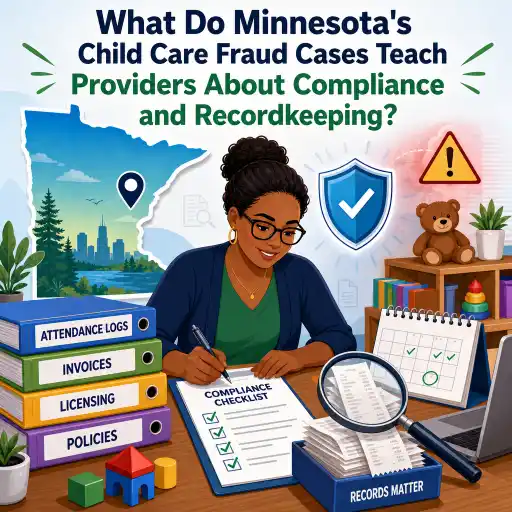
What happened in Minnesota and why does it matter?
1. Quick timeline (numbered to make it clear):
- 📌 Federal review and action: The U.S. Department of Health and Human Services announced a temporary freeze of some federal child care funds to Minnesota and other states while they review suspected misuse of funds; see the HHS announcement for details: HHS freezes federal child care funds.
- 🔍 Rule changes: HHS also moved to roll back earlier rules that let states pay providers without verifying attendance — returning to attendance-based checks as a stronger control: HHS rule update.
- 📺 Local events and prosecutions: Viral videos and investigations led to many state and federal probes into alleged fraud, plus criminal charges in several cases tied to large misuse of funds and related programs — local reporting and court actions explain the scope and impact (see reporting on prosecutions and the Feeding Our Future cases, like recent convictions and sentences).
Why it matters for you:
- 📉 Funding risk: When federal or state agencies see weak controls, payments can pause,e and programs can lose money quickly — this affects every program using public funds (HHS action described above).
- 🛡️ Reputation and safety: Allegations can trigger inspections, audits, and even raids that disrupt children and staff.
- 🔁 System changes: Expect more verification and attendance checks from state licensors and funders. State requirements vary - check your state licensing agency and be ready to show clear documentation.
What records and documentation should my program keep to stay audit-ready?
Good recordkeeping is simple and saves time. Follow these clear steps so you can quickly show what happened if anyone asks.
- 📁 Have a folder for each child. Each child's file should include: enrollment, emergency contacts, CCAP authorizations (if used), immunizations, allergy plans, medication permissions, and daily pick-up/sign-out records. ChildCareEd has a full list of recommended child records: Recordkeeping and Documentation Tips for Child Care Providers.
- 🕘 Keep accurate attendance daily. Use signed sign-in/out sheets that show arrival and departure times. With federal attention on attendance-based payments, daily logs are critical — HHS returned to attendance verification in the recent rule change: HHS update.
- 📑 Store staff records together. Keep training certificates, background checks, job descriptions, and schedules in one place. Use a Group Admin or similar system to track completions and expirations — ChildCareEd explains tracking tools for directors: Child Care Compliance Tracking.
- 🔁 Keep billing and subsidy documentation. For CCAP and vouchers, save authorizations, invoices, copies of payments, and any communication with county or state staff. ChildCareEd offers Minnesota-specific notes on CCAP paperwork and retention: How to meet MN DHS Rule 2 & 3 requirements.
- 🧾 Use a 3-place system: 1) Child file, 2) Classroom binder (daily logs, medicine, behavior), 3) Program file (policies, drills, inspections). This simple method beats confusion during an audit; see examples at ChildCareEd recordkeeping.
Tip: Scan important paper files and keep a secure digital backup. If records are missing, try to restore or explain steps taken right away — honest, timely responses matter.
How can providers avoid common mistakes and make internal controls stronger?
Simple internal controls lower the chance of fraud and make audits smoother. Follow these numbered controls adapted for child care programs.
- 🧾 Separation of duties — don’t let one person do everything for billing and banking. If your program is small, arrange for a board member or an outside bookkeeper to review monthly bank reconciliations. The NY State guidance on internal controls highlights this as a top protection: Top Ten Internal Controls.
- 🔎 Reconcile bank accounts monthly. Have an independent person check deposits, checks, and payroll before filing. Keep canceled checks and note unusual vendors — this helps catch odd activity fast.
- 📋 Verify eligibility and attendance before billing. The GAO has shown that weak verification invites abuse; use ID checks, employer verification when required, and solid attendance logs: GAO review of CCDF fraud vulnerabilities.
- ✅ Keep written policies and a small audit trail. Create simple written policies for purchases, receipts, and the use of grant funds. File receipts and tag each purchase to a grant line item so audits are quick and transparent.
- 📋 Legal and ethical compliance: To help directors and staff understand their legal obligations around funding, documentation, and ethical program practices, ChildCareEd's Legal & Ethical Essentials in Child Care
 Buy Now $55.00 is a 6-hour online course covering the legal and ethical responsibilities providers must follow — directly supporting the internal controls, separation of duties, and written policy steps outlined in this guide.
 - 📚 Train staff on documentation habits. Make objective notes (what happened, time/date, action taken) and avoid opinions. ChildCareEd explains clear note-writing and daily 5-minute checklists: Recordkeeping and Documentation Tips.
- 🗂️ Record keeping and supervision: For staff who want to build stronger daily documentation habits, ChildCareEd's Balancing Act: Record Keeping & Supervision Buy Now $16.00 is a 2-hour online course covering how to maintain accurate attendance logs, organize child and staff files, and balance documentation responsibilities with supervision duties — a direct match for the 3-place file system, daily sign-in procedures, and audit packet preparation steps described throughout this article.
Common mistakes and quick fixes:
- ❌ Weak attendance logs — Fix: require parent signatures and keep daily digital backups.
- ❌ Missing training IDs or certificates — Fix: add staff registry IDs before training so state records match (ChildCareEd Group Admin helps with this: Group Admin).
- ❌ Mixing personal and program funds — Fix: keep a single business account and limit card users. Use monthly reviews of credit card statements.
What should directors do now if payments are paused or an investigation starts?
Stay calm and follow a clear plan. Use this numbered action plan to protect children, staff, and your program’s future.
- 📞 Notify stakeholders quickly. Tell families, staff, and your board about possible short-term impacts and your plan. Be honest but factual; avoid speculation that fuels panic.
- 📂 Put an audit packet together. Include 1) child files for funded children, 2) attendance logs, 3) CCAP authorizations and invoices, 4) bank deposit records, and 5) staff training/background checks. ChildCareEd gives sample checklists for getting audit-ready in Minnesota: MN provider checklist.
- 🔍 Cooperate but get advice. If investigators ask for records, provide them or ask for a written request. If criminal exposure is possible, consult legal counsel. For non-criminal licensing issues, your CCR&R or state licensing help line can guide the next steps.
- 🛠️ Fix quick problems first. If missing forms or expired training are found, correct them immediately and document the correction. Note the date and who made the fix — this shows good faith and responsibility.
- 💰 Plan cash flow. If federal funds pause, reduce non-essential spending, discuss short-term payroll options with staff, and apply for grants or emergency funds. ChildCareEd lists Minnesota grant and voucher resources: MN grants and vouchers. Remember: state requirements vary - check your state licensing agency.
If you are audited, be professional, organized, and transparent. Keep copies of everything you hand over. These steps help protect families and show you run a careful, child-first program.
Conclusion: What are the simplest steps to protect my program today?
Keep it simple. Here’s a quick, numbered checklist you can use this week:
- 📌 Update daily attendance and scan this week’s logs into a secure folder.
- 📁 Build a 3-place file system: child file, classroom binder, program file.
- 📚 Verify staff training and add registry IDs so certificates post correctly.
- 🔎 Reconcile bank and subsidy deposits monthly and document approvals.
- 📬 Prepare an audit packet with CCAP authorizations, invoices, and receipts.
FAQ (quick):
- Q: What if I find missing signatures? A: Restore them if possible, note when you found the gap, and correct procedures immediately. Document your fix.
- Q: Will my program automatically lose funding? A: Not always. Agencies often ask for documentation first. But slow responses can delay payments — act quickly.
- Q: Who can help? A: Your local Child Care Resource & Referral (CCR&R), your state licensing agency, and legal counsel for serious matters. ChildCareEd has Minnesota resources and training links: MN resources.
- Q: Where can I learn better recordkeeping habits? A: See ChildCareEd’s practical guides on recordkeeping and compliance: Recordkeeping tips and Group Admin tracking.
You're doing vital work. Clear records, simple controls, and steady communication protect kids and families — and keep your program open to serve the children who need you most.
- CDA Certification en Español: Recursos y Consejos para Educadores Bilingües
- Capacitación en Salud y Seguridad Preventiva en Línea para Proveedores de Cuidado Infantil
- Regulaciones de Licenciamiento de Cuidado Infantil en California para Centros y Hogares de Cuidado Infantil Familiar
- Reglas de Cuidado Infantil en Carolina del Norte para Centros y Hogares de Cuidado Infantil Familiar
- Requisitos de Cuidado Infantil en Nueva Jersey para Centros y Proveedores de Cuidado Infantil Familiar
- Proporciones de Cuidado Infantil y Tamaños de Grupo por Edad en Maryland (Guía Rápida para Centros y Hogares)
- Lista para Abrir una Guardería en Casa en Virginia: Cómo Empezar
- Lista para Guardería en Casa en Texas: Cómo Iniciar una Guardería en el Hogar
- Cómo Trabajar en el Cuidado Infantil en Carolina del Norte: Requisitos y Pasos
- Cómo Trabajar en el Cuidado Infantil en California: Requisitos y Pasos
- Capacitación Previa al Servicio para Proveedores de Cuidado Infantil en Dakota del Norte
- Capacitación Previa al Servicio para Proveedores de Cuidado Infantil en Georgia
- Capacitación Previa al Servicio para Proveedores de Cuidado Infantil en Virginia
- Requisitos para Guarderías en Casa en Georgia
- Celebrando la amistad en el cuidado infantil durante el Día de los Mejores Amigos
- What Do Minnesota's Child Care Fraud Cases Teach Providers About Compliance and Recordkeeping?
- How Can Minnesota CCAP Providers Keep Documentation That Holds Up?
- How Can Providers Prepare Their Recordkeeping for Attendance-Based Billing?
- How Can You Build Bulletproof Attendance Records During Minnesota's Fraud Crackdown?
- Reglas y regulaciones de guarderías en Minnesota 2026: Requisitos actuales y próximos cambios
