Reflective teaching means taking a closer look at your daily work with children: noticing what happened, questioning your assumptions, and deciding what to try next. A few notes after an activity or a conversation with a colleague can help you recognize strengths and adjust your approach to children’s needs. ChildCareEd’s Evaluating Performance  Buy Now $16.00 course explores self-evaluation, reflective practice, observation, and constructive feedback within coaching and mentoring. Whether practiced individually or as a team, reflection can become a manageable habit that turns everyday experiences into opportunities to improve your program.
Why it matters:
1. Reflection helps you see what is working for learning and what is not.
2. It helps you tune lesson plans to children’s needs. For simple tips on planning and reflection, see the ChildCareEd guide on developmentally-appropriate lesson plans.
3. Reflection also supports staff wellness.
Please remember: state requirements vary - check your state licensing agency.
What is reflective teaching and why does it help children learn?
Why it helps :
- It makes your teaching clearer and more intentional.
- It helps you notice small changes in children’s play and thinking.
- It builds stronger relationships when you use tools like reflective listening (great tips at Using Reflective Listening).
Use #reflection every day for short times. When teachers reflect, #teachers learn more, rooms become calmer, and #practice becomes more thoughtful. This supports real #learning for young children.
How do I reflect step-by-step in my classroom?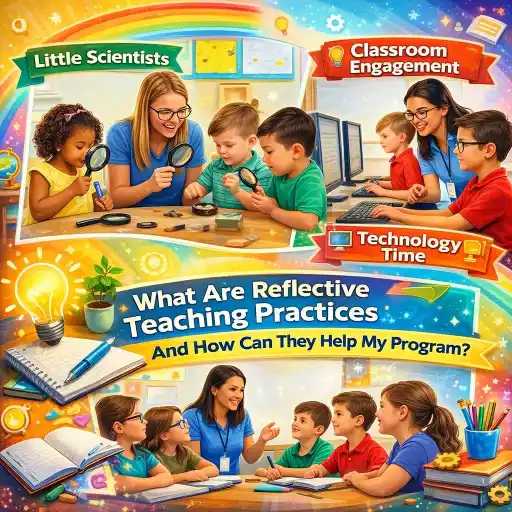
- 🔍 Observe: Watch the child or group for 5–10 minutes. Take one quick note. (Tip: keep a small notebook.)
- ✍️ Describe: Write one clear sentence: who, what, where. Example: "Noah dropped blocks and cried during group."
- 🙂 Feelings: Note how the child felt. Write one word like "frustrated" or "curious."
- 🔎 Evaluate & Analyze: Ask: What worked? What didn’t? Use simple prompts from Gibbs' cycle at Gibbs Reflective Cycle.
- 🛠️ Plan: Choose one small change to try next time. For example: offer two block sizes or give a helper job.
- 🔁 Try & Repeat: Try the change, watch again, and write one sentence about what happened next.
Use quick notes during the day and a longer weekly review. For planning help, check the ChildCareEd lesson plan article at How to Create Developmentally Appropriate Lesson Plans.
What tools and models can help me reflect effectively?
- 🗂️ Observation notes: Short, timed notes during play. Use the form style from the Cycle of Inquiry to link observation to planning.
- 📘 Gibbs' Reflective Cycle: A six-part guide to help you think about feelings, evaluation, and action. See Gibbs' Reflective Cycle.
- 🔁 Kolb’s Learning Cycle: Use the do-reflect-plan-try loop to test new ideas in class. More at Kolb.
- 👥 Reflective supervision or coaching: Meet with a mentor or director to talk about cases. Programs like reflective supervision are described by the University of Sydney.
- 🧾 Short staff huddles: 10-minute team talks after snack or at day end to share one win and one question. These quick talks build trust and new ideas. For supports and resources for teacher growth, see ideas on ChildCareEd such as CDA reflective resources Buy Now $0.00.
When you pick tools, choose ones your team can keep using every day. Small, steady habits beat big, rare efforts.
How can I avoid common mistakes and keep reflection useful?
Common mistakes happen when people try to do too much or worry about being judged. Here are easy ways to avoid pitfalls:
- 😬 Mistake: Reflection becomes a blame session. Fix: Start with one positive and one question each time.
- 📚 Mistake: Using big theory only. Fix: Mix short practice notes with one model idea (Gibbs or Kolb) for weekly planning.
- ⏰ Mistake: Doing long reflections that never get used. Fix: Keep daily notes to 1–2 sentences and a 15-minute weekly team review.
- 🔇 Mistake: A leader talks more than listens. Fix: Use a talking stone or timer so everyone speaks briefly.
Quick checklist to keep reflection helpful:
- Keep notes short.
- Pick one idea to try each week.
- Share results with your team.
FAQ (short answers):
- Q: How long should reflection take?
A: 5 minutes daily + 15 minutes weekly is enough to start. - Q: Who should be involved?
A: Teachers, aides, and your director for at least one weekly talk. - Q: Do I need to write everything down?
A: No. Write the big idea and one line of evidence. - Q: What if staff resist reflecting?
A: Start with praise and simple prompts. Use examples from your program and link to self-care supports at Resolutions for Resilient Educators.
Summary
Reflective teaching is a clear, helpful habit. It uses short observations, simple questions, and small experiments to improve how you teach. Try easy steps, pick a model like Gibbs or Kolb, and meet with your team for short shares. Use ChildCareEd resources for planning and listening skills and consider tools like the Cycle of Inquiry and reflective supervision for deeper work (see Cycle of Inquiry and Reflective Supervision).
Small regular steps mean better days for you and your #children. Try one short change this week, watch, and try again. Your #teachers and program will grow with steady #reflection and strong #practice.
Here is a simple 6-step process you can use. It mixes ideas from Gibbs and Kolb and is easy to do in a busy day.There are easy tools that fit child care settings. Reflective teaching means looking back at a lesson or day and asking simple questions: What happened? What did children learn? What could I try next? This is like a scientist testing ideas. Models like Kolb’s cycle show how doing, thinking, planning, and trying again create better learning. See Kolb’s ideas at Kolb's Learning Cycle.
- CDA Preschool Credential with Portfolio Review
- Birth to Five CDA Credential with Portfolio Review
- CDA Family Child Care Credential with Portfolio Review
- CDA Bridge Bundle: Preschool
- CDA Bridge Bundle: Family Child Care
- CDA Bridge Bundle: Family Child Care without Portfolio Review
- CDA Bridge Bundle: Infant/Toddler without Portfolio Review
- CDA Bridge Bundle: Preschool without Portfolio Review
- CDA Bridge Bundle: Infant/Toddler
- Texas Director Credential
- Slaying Metaphorical Dragons of Fear and Self-Doubt in Childcare Educators
- CDA Certification en Español: Recursos y Consejos para Educadores Bilingües
- What are reflective teaching practices and how can they help my program?
- Celebrando la amistad en el cuidado infantil durante el Día de los Mejores Amigos
- How can child care providers understand and respond to tantrums?
- Can Play Be a Primary Strategy for Supporting Children’s Mental Health?
- What Makes a Great Home Daycare? 10 Things Parents Notice First
- Diversity and Inclusion in Childcare: What Does It Look Like in Everyday Practice?
- Are You Ready to Be a Lead Teacher? 7 Signs You’re Prepared to Step Up
- What Do I Need to Become a Pre-K Teacher? 7 Things to Have Ready Before You Apply
- Glow and Grow for Teacher Self-Reflection: What Went Well—and What Will You Try Next?
- How Can Child Care Providers Build More Effective Classroom Management?
- How Can Early Childhood Educators Navigate the Emotional Side of Classroom Observation?
- How Can Child Care Providers Integrate Social-Emotional Learning into Daily Activities?
