A toddler who leaves circle time may be giving you clues about how they engage, what interests them, or when they need a different kind of activity. The All About My Toddler: Family Information Form Buy Now $1.49 can help you gather family insights about favorite toys, routines, communication, and comfort strategies to consider alongside your classroom observations. Use those insights to build on what the child already enjoys and does well. The Playful Learning: Infant & Toddler Activities Buy Now $25.00 course offers practical guidance for planning age- and ability-appropriate experiences around individual interests. Read on for ways to turn a toddler’s strengths into meaningful participation while allowing children to engage in different ways.
Why might a group activity not fit a toddler?
Toddlers are developing rapidly, and their attention, communication, movement, sensory preferences, and social interest can vary widely. A whole-group song or story may be enjoyable for one child and difficult for another because it involves waiting, sitting still, processing many voices, or following several directions. A child who walks away may be communicating a need for movement, a quieter setting, more time, or a more concrete way to engage.
Rather than treating group participation as the sole measure of learning, consider what the activity asks of the child and whether those demands match the child’s current skills and interests. NAEYC notes that toddlers are actively developing identity and autonomy; opportunities for choice and responsive relationships can support this developmental work. Developmentally appropriate practice asks educators to build on children’s assets and offer varied ways to engage, rather than expecting identical responses from everyone.
This perspective matters for the whole group. When participation has multiple pathways, children can stay connected to a shared experience while exploring in ways that feel manageable. A toddler might listen from the edge, handle a related prop, join for one song, or revisit the activity later through play. These are valid ways to learn and belong.
How can observation reveal a toddler’s strengths?
Start with careful observation across different times and contexts. Notice what captures the toddler’s attention, what they return to, how they communicate interest, and what conditions support sustained engagement. Look for strengths in action: persistence while stacking, close attention to music, curiosity about objects, delight in movement, imitation, problem-solving, or warm interactions with a familiar adult.
Record what you see without interpreting it too quickly. “Mina carried the animal figures to the rug and made a growling sound for six minutes” gives the team more useful information than “Mina won’t join group.” Also note the setting: Was the room noisy? Was the child tired or hungry? Did a familiar peer or material help them participate? Patterns across observations can guide sensible adaptations.
Families can add essential context, including interests at home, comfort routines, home-language words, and ways the child communicates. Head Start’s guidance on individualizing care for infants and toddlers describes how observations and family knowledge inform individualized plans. Keep documentation brief and strengths-focused, and revisit it with colleagues to identify a practical next step.
How can you adapt a group activity without excluding the child?
Keep the shared learning goal, then change the pathway. If the group goal is to notice animal sounds, a toddler might hold a toy animal, choose a picture, imitate a sound, or listen nearby before joining. For a movement song, offer space to sway, clap, march, or watch with an adult. The purpose is access and participation, not making every child perform the same action at the same moment.
- Offer a related object or visual cue the child can explore while listening.
- Use a smaller group, shorter activity, or flexible seating position.
- Preview the activity with a familiar adult or repeat a predictable phrase.
- Allow a child to observe first and join when ready, without pressure.
- Provide choices for how to respond, including gesture, movement, vocalization, or words.
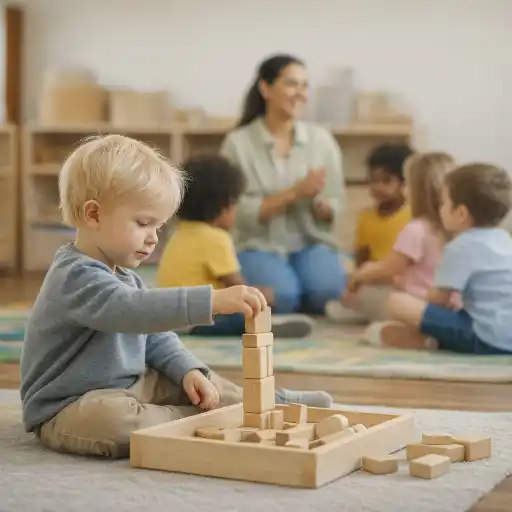
These adaptations reflect the inclusive priorities of access, participation, and support described in NAEYC’s guidance on inclusion in infant and toddler settings. Keep the child within the community experience whenever possible. A meaningful role—turning a page, holding a prop, or choosing the next song—can connect a toddler to peers without demanding prolonged group sitting.
How do you build from strengths into meaningful learning?
Use a toddler’s interests as an entry point to the learning intention. If a child loves vehicles, bring toy buses into a song about sounds or use a small vehicle during a group counting moment. If a child is drawn to leaves, offer a leaf to hold during a nature story and follow up with sorting or outdoor exploration. An interest is not a distraction from learning; it can be the bridge into it.
Plan an achievable next step, then provide just enough support. If the toddler watches peers during a song, an educator might sit beside them, model one gesture, and pause for the child’s response. If the child joins briefly, acknowledge that participation specifically: “You tapped when the drum sounded.” Gradually reduce prompts as the child becomes more comfortable and capable.
NAEYC’s developmentally appropriate practice guidance emphasizes choice, play, and multiple ways for children to engage and express understanding. Consider a simple reflection cycle after an activity:
- What did the child choose, notice, or communicate?
- Which materials, people, or conditions helped participation?
- What small adjustment could extend engagement next time?
This approach keeps plans intentional while respecting the toddler’s agency and individual pace.
How can families and staff collaborate on responsive plans?
Partnership makes individualization more accurate and consistent. Ask families open, respectful questions: “What does your child enjoy doing with other people?” “How do they show they need a break?” or “What helps them feel ready to join something new?” Share specific observations as well as questions, and welcome information about family culture, language, routines, and the child’s interests.
Within the staff team, agree on a small number of strategies that are easy to use throughout the day. For example, everyone might offer the toddler a related prop before group time, accept gestures as responses, and avoid insisting on sitting in one place. Document whether the strategy helped and adapt it if needed. Consistency should not mean rigidity: a toddler may participate differently on different days.
If a child has an IFSP, IEP, or other support plan, coordinate classroom strategies with the family and relevant specialists, following program procedures and privacy expectations. Seek guidance when a child’s participation needs involve specialized equipment, communication supports, or safety considerations. Remember: state requirements vary - check your state licensing agency.
To deepen your planning toolkit, explore CDA Infants/Toddlers: Individualized Learning and Inclusion  Buy Now $16.00, Playful Spaces for Infants & Toddlers Buy Now $24.00, Planning for Every Child: Responsive Strategies in Action Buy Now $55.00, and Early Learning with Infants and Toddlers Buy Now $24.00. These courses address individualized learning, accessible play spaces, responsive planning, and infant-toddler interactions.
What common planning pitfalls should you avoid?
When a group activity is challenging, it can be tempting to focus on compliance: “How can I get the toddler to sit?” A more useful question is, “What would make this experience accessible and worthwhile for this child?” The shift does not lower expectations; it removes barriers that are unrelated to the learning goal.
- Assuming disinterest: Observe what the child attends to and how they engage before concluding they are not interested.
- Expecting one kind of participation: Accept watching, moving, handling materials, gesturing, or brief engagement as possible entry points.
- Overprompting or physically directing: Pause, offer a simple cue, and give the child time to respond.
- Separating the child by default: Adapt within the group when feasible so the child can remain part of the shared experience.
- Using a fixed plan despite new information: Reflect afterward and adjust based on the child’s actual response.
Some activities may not suit a toddler at a particular moment. That is not a failure. Offer a safe, purposeful alternative connected to the same theme, then invite the child to return when ready. Responsive planning is an ongoing practice of noticing, trying, and refining—not a test of whether every child follows the same script.
How can providers plan around strengths when group activities do not fit?
When group activities do not fit a toddler, begin with what the child can do, enjoys, and communicates. Observe across contexts, partner with the family, preserve the shared learning intention, and offer more than one way to participate. A prop, movement option, shorter invitation, or chance to watch before joining can turn a difficult moment into an accessible experience.
Most of all, remember that belonging does not depend on sitting still or responding in a uniform way. Thoughtful adjustments let toddlers learn at their own pace while remaining valued members of the group. Keep observing, celebrate small signs of engagement, and use each child’s strengths to shape the next invitation.
- 45 Hour Child Growth and Development
- Birth to Five CDA Credential with Portfolio Review
- 45 Hour Infant and Toddler Methods and Materials
- CDA Infant/Toddler Credential with Portfolio Review
- CDA Bridge Bundle: Infant/Toddler without Portfolio Review
- CDA Bridge Bundle: Infant/Toddler
- 45-Hour Infant and Toddler Curriculum
- Texas Director Credential
- 💛🧩 ¿Cómo puedo hacer que mi enseñanza sea inclusiva para los niños con autismo?
- Recursos en Español sobre el Sueño Seguro del Bebé
- 10 Ejemplos de Cómo la Cultura Influye en el Desarrollo Infantil
- Proporciones de Cuidado Infantil y Tamaños de Grupo por Edad en Virginia (Guía Rápida para Centros y Hogares)
- Lista para Guardería en Casa en Texas: Cómo Iniciar una Guardería en el Hogar
- Retraso del Habla en la Guardería: Cómo Pueden Ayudar los Proveedores
- Cómo Trabajar en el Cuidado Infantil en Carolina del Norte: Requisitos y Pasos
- Cómo Trabajar en el Cuidado Infantil en California: Requisitos y Pasos
- Cómo Ser Maestra de Preescolar en Dakota del Norte
- Capacitación Previa al Servicio para Proveedores de Cuidado Infantil en Dakota del Norte
- Las Mejores Ideas de Excursiones para Guarderías en Georgia
- Celebrando la amistad en el cuidado infantil durante el Día de los Mejores Amigos
- Cómo simplificar la capacitación para sus empleados de daycare
- Mixed-Age Daycare Schedule: How to Plan a Day for Different Age Groups
- What Milestones Should You Watch Between Age 2 and 30 Months?
- How Can Child Care Providers Plan Infant Activities Around Developmental Milestones?
- How Can You Plan Around a Toddler’s Strengths When Group Activities Do Not Fit?
- How Can Toddlers Contribute to Classroom Jobs Without Turning Them into Rewards?
- How Can You Choose Classroom Jobs a Toddler Is Ready to Try?
