Preschoolers are capable of thoughtful choices, but they need repeated practice, clear language, and supportive adults to understand what keeps a classroom safe. The Everyday Safety: Creating Healthy Environments  Buy Now $55.00 course helps providers strengthen routines, transitions, hygiene practices, and predictable care while building professional knowledge that can support required training hours where applicable.
Why Does Teaching Safety Through Decisions Matter?
Young children learn safety most effectively when they are active participants rather than passive recipients of rules. A statement such as “Do not run” may stop behavior briefly, but asking, “What can your feet do inside?” invites children to reason, communicate, and practice a replacement behavior. Decision-making instruction transforms safety from a list of prohibitions into a developmental skill.
This approach also respects preschoolers’ growing autonomy. Children are learning to manage impulses, consider consequences, recognize others’ needs, and recover from mistakes. They will not make perfect decisions every time; the goal is to help them increasingly notice risk, pause, and choose a safer action.
Safety instruction supports both physical and emotional well-being. Predictable expectations help children feel secure, while respectful guidance protects their dignity. The CDC emphasizes that early care providers help children develop foundational skills for staying healthy and safe, alongside environmental and supervision practices.
- Use brief, positive language: “Walking feet” instead of “Don’t run.”
- Teach the reason behind a rule in developmentally appropriate terms.
- Model the choice, let children practice it, and acknowledge their effort.
- Connect safety to caring for oneself, peers, and shared materials.
How Can Providers Explain Safe and Unsafe Choices Clearly?
Preschoolers benefit from concrete examples, visual cues, and repetition. Abstract explanations about future consequences are less useful than observable descriptions: “The blocks are on the floor. Someone could trip. Where can we put them?” Keep the distinction between safe and unsafe focused on the action, not the child’s character. A child may make an unsafe choice without being an “unsafe child.”
The Safe or Unsafe? Classroom Choices Activity Buy Now $0.49 gives providers a practical, print-and-go way to discuss walking feet, kind words, cleanup, pushing, yelling, and running. Children can sort, draw, or write examples and then create a classroom safety rule. Because the resource uses familiar classroom situations, it can be adapted for circle time, small groups, back-to-school lessons, or individual conversations.
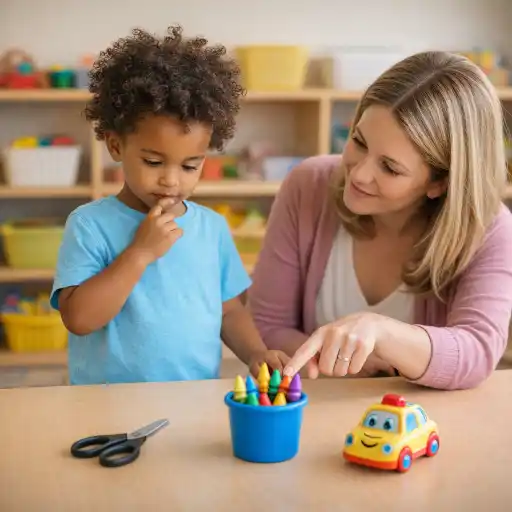
Introduce one idea at a time. Show a picture or act out a scenario, ask children what they notice, and invite more than one possible solution. For example, if a child reaches across a crowded table, ask, “What could you do instead?” Possible responses might include waiting, asking for help, or walking around the table.
- Use photographs or drawings at children’s eye level.
- Pair words with gestures: point to feet for walking or ears for listening.
- Ask open-ended questions: “What do you notice?” and “What could happen next?”
- Accept drawing, pointing, movement, home-language responses, or verbal explanations.
- Repeat the same safety vocabulary across routines and classrooms.
How Can Classroom Routines Make Safer Choices Easier?
Children make better decisions when the environment and schedule reduce unnecessary confusion. A well-organized room communicates expectations before an adult speaks. Clear pathways, defined activity areas, labeled bins, and accessible materials help children understand how to move and participate safely. As the ChildCareEd guidance on safe and supportive learning environments explains, predictable routines and thoughtful room design support both physical and emotional security. For practical planning guidance, see how to plan a safe and healthy learning environment.
Transitions deserve particular attention. Rushing from one activity to another can produce running, grabbing, yelling, and accidental collisions. Give children a brief warning, use a consistent signal, and explain the next step. A visual schedule can help children anticipate what is coming. When possible, move small groups rather than the entire class at once.
Directors can support consistency by ensuring that all staff use the same short phrases and procedures. State requirements vary - check your state licensing agency.
- Keep traffic lanes open and remove unnecessary obstacles.
- Place frequently used materials where children can reach them safely.
- Use pictures and words to identify shelves, centers, and cleanup locations.
- Offer a calm space where children can pause and regain control.
- Build handwashing, cleanup, and walking practice into daily routines.
- Provide warnings before transitions and allow enough time to complete them.
When routines are predictable, children spend less energy figuring out what will happen and more energy practicing responsible choices.
How Can Active Supervision Support Children’s Decision-Making?
Teaching choices does not reduce the adult’s responsibility for supervision. Active supervision means positioning yourself to see and hear children, scanning the environment, counting during transitions, listening for changes, anticipating behavior, and engaging with play. The goal is not to control every movement; it is to notice risk early and provide just enough support for children to act safely.
Before a challenging activity, identify likely decision points. During block play, children may need support with carrying large pieces, sharing space, or preventing structures from falling. At the sensory table, they may need reminders about keeping materials in the bin. Outdoors, children may need clear boundaries for climbing, running, or using wheeled equipment.
Use supervision as a teaching opportunity. Instead of calling across the room, move close and offer a brief prompt: “The truck is coming toward your feet. What can you do?” This invites the child to notice the hazard and select an action. When immediate intervention is needed, act calmly and explain the safer alternative afterward.
- 😊 Position yourself where sight and sound lines are clear.
- Scan continuously rather than focusing on one child or activity.
- Count children at arrival, departure, transitions, and outdoor movement.
- Anticipate high-interest materials, crowding, climbing, and conflicts.
- Engage in play so you can hear children’s plans and concerns.
For providers seeking deeper training, Active Supervision: A Strategy That Works Buy Now $35.00 focuses on watching, listening, interacting, monitoring, and preventing problems across child care settings.
How Should Providers Respond When a Child Makes an Unsafe Choice?
An unsafe choice is a moment for protection and instruction, not shame. First, secure the environment and prevent harm. Then state the expectation briefly and teach the next action. A calm script might be: “I won’t let you push. Pushing can hurt. You can say, ‘Move please,’ or ask me for space.” The shorter and more specific the response, the easier it is for a preschooler to process.
Offer limited choices when appropriate: “You may walk beside me or hold the rope.” Both options meet the safety expectation while preserving agency. If a child runs indoors, guide the child back, practice walking, and then rejoin the activity when ready. If a child throws a toy, remove the toy temporarily and offer a safe way to use it or a comparable alternative.
After the child is regulated, invite reflection without conducting an extended lecture. Ask, “What happened? Who was affected? What can we try next time?” Repair may include helping rebuild a structure, checking on a peer, or practicing a phrase. This strengthens #guidance, empathy, and problem-solving.
- Describe the action rather than labeling the child.
- Use a calm voice and move to the child’s level.
- State the limit and immediately teach a replacement behavior.
- Follow through consistently across adults and settings.
- Look for environmental triggers such as crowding, fatigue, or unclear directions.
Common mistakes include too many rules, posting expectations without teaching them, relying on long lectures, and using inconsistent adult responses. Positive guidance is most effective when the team agrees on a few essential expectations and practices them repeatedly.
How Can Families and Children Help Build a Safety Culture?
Children are more invested when they help create classroom expectations. Invite them to suggest a rule after observing a scenario: “What rule would help everyone stay safe here?” Adults should refine children’s ideas into short, positive statements such as “Walking feet,” “Hands help,” “Kind words,” and “Toys stay on the floor.” Add a child-created drawing or photograph to make the rule meaningful.
Family partnership adds important context. Families can share words, routines, cultural expectations, and strategies that help their child pause and communicate. Use strengths-based communication: begin with something the child enjoys or does well, describe one observable situation, and explain the strategy the classroom will practice. Invite the family’s perspective rather than presenting the conversation as a complaint.
Directors can build a program-wide safety culture through staff huddles, observation, coaching, and brief reviews of near misses. A near miss is valuable information when the team examines what happened and adjusts the environment or routine without blame.
- Invite children to draw or act out a new safety rule.
- Share the same safety language with families and substitute staff.
- Document patterns by time, location, activity, and possible trigger.
- Celebrate specific decisions: “You stopped, looked, and asked for help.”
- Review whether rules are accessible to children with different abilities and communication styles.
Conclusion: What Helps Preschoolers Make Safer Classroom Decisions?
Preschoolers learn safer decision-making when adults combine clear expectations, meaningful practice, active supervision, supportive routines, and respectful responses. The central question is not simply, “Did the child follow the rule?” It is, “What skill does the child need in order to recognize the situation, consider others, and choose a safer action?”
Begin this week with one expectation. Use the Safe or Unsafe? Classroom Choices Activity Buy Now $0.49 to introduce examples, then practice the same choice during transitions and play. Pair this classroom work with professional learning such as Everyday Safety: Creating Healthy Environments Buy Now $55.00 and explore additional ChildCareEd options including Active Supervision: A Strategy That Works Buy Now $35.00, Staying Positive: Guidance for Preschoolers Buy Now $24.00, and Creating Engaging and Meaningful Learning Experiences Buy Now $55.00.
Small, repeated teaching moments help children become more observant, confident, and responsible. With thoughtful preparation and warm guidance, your classroom can remain a place where children explore freely while learning how to protect themselves and one another.
- Lesson Planning for Preschoolers
- CDA Home Visitor Subject Area 3 Part 3 Birth to 5
- Birth to Five CDA Credential with Portfolio Review
- Children at the Wheel: Emergent Curriculum
- CDA Bridge Bundle: Preschool
- CDA Bridge Bundle: Family Child Care without Portfolio Review
- Art from the Heart for Preschoolers: Open Ended Art Projects that Build Self-Esteem
- CDA Bridge Bundle: Infant/Toddler without Portfolio Review
- CDA Bridge Bundle: Preschool without Portfolio Review
- Texas Director Credential
- CDA Certification en Español: Recursos y Consejos para Educadores Bilingües
- 💛🧩 ¿Cómo puedo hacer que mi enseñanza sea inclusiva para los niños con autismo?
- Recursos en Español sobre el Sueño Seguro del Bebé
- 10 Ejemplos de Cómo la Cultura Influye en el Desarrollo Infantil
- Proporciones de Cuidado Infantil y Tamaños de Grupo por Edad en Maryland (Guía Rápida para Centros y Hogares)
- Proporciones de Cuidado Infantil y Tamaños de Grupo por Edad en Nueva Jersey (Guía Rápida para Centros y Hogares)
- Proporciones de Cuidado Infantil y Tamaños de Grupo por Edad en Virginia (Guía Rápida para Centros y Hogares)
- Retraso del Habla en la Guardería: Cómo Pueden Ayudar los Proveedores
- Celebrando la amistad en el cuidado infantil durante el Día de los Mejores Amigos
- Canciones, juegos y preguntas de círculo para niños
- Cómo simplificar la capacitación para sus empleados de daycare
- Open-Ended Art Activities for Preschoolers: 15 “What Can You Make?” Invitations
- Attention Signals: Which Ones Work Best for Toddlers, Preschoolers, and School-Age Kids?
- Title 22 Home Daycare Ratios: How Age Mix Changes Your California Capacity
- How Can Child Care Providers Teach School Bus Safety Through Realistic Choices?
- How Can Preschoolers Learn to Make Safer Classroom Decisions?
- How Can Flag Design Help Children Explore Symbols, Patterns, and Individual Expression?
- How Can You Plan Patriotic Crafts Without Limiting Children’s Creativity?
- How Often Should Preschool Teachers Change Classroom Activities?
- Is It Safe to Put Child Assessment Notes into an AI Tool?
