Children thrive outdoors when they can explore, make choices, and test emerging abilities—but freedom works best within a thoughtful safety plan. The Mindful Supervision: Balancing Safety & Independence in Montessori  Buy Now $24.00 course offers practical guidance for supervising classroom and outdoor experiences while respecting children’s autonomy. For a deeper look at designing nature-rich learning spaces, explore Creating the Natural Outdoor Classroom Buy Now $16.00; both courses can help you strengthen everyday practice and your professional knowledge.
Why does this balance matter in a Montessori outdoor environment?
Outdoor time is more than a break from indoor learning. In a Montessori setting, it can extend the prepared environment: children care for plants, investigate insects, carry tools, observe weather, and move their bodies through meaningful challenges. The natural world invites concentration and wonder while offering experiences that are difficult to replicate indoors. As the CDC explains, outdoor play supports physical activity as well as opportunities for children to explore, test limits, and practice new skills.
At the same time, supervision is not simply being present in the yard. It is an intentional, continuous practice of seeing, hearing, and understanding what children are doing, then responding at the right moment. Head Start’s active-supervision guidance identifies positioning, scanning and counting, listening, anticipating behavior, and engaging or redirecting as interconnected strategies. When educators use them consistently, children can take appropriate, supported risks without being left to manage hazards on their own.
This balance also matters for children’s agency. Excessive restriction can narrow opportunities for problem-solving, self-regulation, and confidence; inadequate supervision can expose children to preventable harm. The goal is not to eliminate every challenge, but to distinguish a manageable developmental risk from a hazard and prepare for both. When discussing this balance with families, the guide to freedom within limits can help explain how clear boundaries support children’s independence.
How can educators prepare an outdoor space for both choice and safety?
A well-prepared outdoor environment gives children meaningful choices while helping adults maintain clear sightlines and access. Montessori-inspired outdoor spaces can include gardening, sensory exploration, nature observation, practical-life tasks, and open areas for movement. A few recognizable activity zones can support independent movement without making supervision feel like a game of catching up.
Before children arrive, inspect the space and consider how each child may use it. Check gates and boundaries, surfaces, equipment, natural materials, weather conditions, and any areas that create blind spots. Arrange materials so children can reach and return them safely, and position higher-challenge activities where staff can remain close. Outdoor freedom depends partly on predictable boundaries: children need to know where they may explore and how to ask for help.
- Divide the yard into visible zones—such as garden, climbing, and sensory areas—and assign staff coverage.
- Keep clear routes between zones and remove or block access to hazards before play begins.
- Choose child-sized tools and developmentally appropriate materials; check them regularly for damage.
- Offer a quiet, shaded place where children can rest, observe, or regroup.
- 🌿 Invite children to help with safe, age-appropriate setup tasks, such as watering plants or arranging baskets.
A prepared space is not a substitute for adult attention. It makes attentive supervision more workable and lets educators spend more time observing children’s interests and supporting purposeful exploration. For program-specific rules, state requirements vary—check your state licensing agency.
What does active supervision look like during outdoor play?
Effective outdoor supervision combines a plan with ongoing adjustment. Before going outside, staff can hold a brief huddle: confirm who is present, assign zones, identify children who may need closer proximity, and agree on how to communicate if a child moves across the yard or a staff member must respond to a need. Staff should spread out rather than cluster together, while keeping coverage clear and coordinated.
Once play begins, educators scan the whole space systematically instead of relying on a general impression that everything is fine. Count children at transitions and whenever the group changes locations, and use name-to-face recognition when practical. Listen for changes in sound: sudden silence, distress, conflict, or an unexpected crash may call for immediate attention. Positioning should change as the play changes; if several children begin climbing, an adult may need to move nearer to that area.
- Maintain sight and sound access to children and keep a clear route for quick response.
- Scan from one zone to the next, then focus briefly on children whose activity or needs call for closer observation.
- Count before leaving the play area, on arrival at the next space, and at other transitions required by program procedure.
- Use calm, specific language to guide safe use of materials and equipment.
- Keep phones, paperwork, and extended conversations from competing with supervision.
Active supervision is relational as well as protective. A warm check-in—“What are you noticing in the garden?”—lets a child know an adult is attentive without taking over the child’s work. The ChildCareEd guide “Where Did They Go?”: Fun Ways to Stay Mindful During Outdoor Play offers additional ideas for remaining connected while children explore.
How can adults support appropriate risk-taking without hovering?
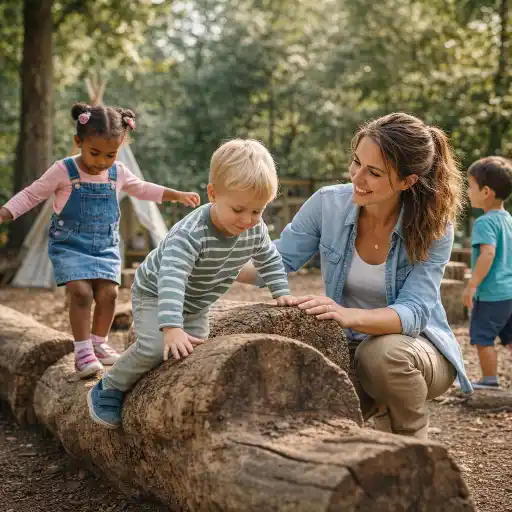
Children develop judgment by encountering manageable challenges, making decisions, and noticing what happens. Research discussed by NAEYC on outdoor risk-taking highlights how physical challenges can support problem-solving, self-regulation, and social-emotional development. Montessori educators can preserve that learning by observing first, evaluating the situation, and offering only as much help as is needed.
Risk is not the same as a hazard. A child deciding whether to step across a stable, low log may be practicing balance and evaluating their own comfort. Broken equipment, contaminated ground, an unsecured gate, or a structure beyond a child’s ability presents a different concern. Educators should intervene when there is a serious likelihood of injury, a child shows distress, or the environment is unsafe. They can also adjust the challenge—offering a lower step, a nearby hand, or a safer route—rather than ending exploration automatically.
- Observe the child’s movement, confidence, and current skill before deciding how close to stand.
- Use questions such as, “What could help you keep your balance?” to invite the child to assess a challenge.
- Describe a safety boundary clearly: “You can climb on this stable log; we leave the loose stack alone.”
- Offer a choice or a small amount of support, then step back when the child is ready.
Children differ in temperament, experience, mobility, communication, and comfort with challenge. Adapt supervision to each child rather than expecting everyone to approach the same activity in the same way. The aim is confident, supported exploration—not adult control of every movement.
How can directors build consistent supervision routines across the team?
Even skilled educators benefit from shared routines. Directors can make active supervision a program-wide practice by describing expectations clearly, modeling them in the outdoor space, and providing regular opportunities to rehearse. A written zone map can show primary coverage, high-attention areas, gates, first-aid supplies, and backup coverage. It should be easy for substitutes and new staff to understand.
Use short pre-play check-ins to confirm staff assignments and note relevant changes, such as a child who is tired, recovering from illness, or trying unfamiliar equipment. After outdoor time, staff can report near-misses, damaged materials, or areas where visibility was poor. Review these observations as information about the system, not as an invitation to blame an individual. Small changes—moving a shelf, changing a staff position, repairing a boundary—can prevent recurring supervision gaps.
- Teach and practice positioning, scanning, listening, counting, anticipation, and respectful redirection.
- Clarify how staff communicate when a child changes zones or an adult must step away.
- Schedule administrative tasks for times when another staff member can fully cover supervision.
- Offer brief, specific coaching: name a strength and one practical next step.
- Review incident and near-miss patterns, then update the outdoor plan and staff practice.
Keep staffing, ratios, documentation, and supervision procedures aligned with applicable rules and each child’s needs. Requirements differ by jurisdiction and program type; state requirements vary—check your state licensing agency. Strong routines support staff as well as children: when roles are clear, educators can stay attentive without feeling they must monitor every part of the yard alone.
Conclusion: What is the key to balancing independence and supervision outdoors?
Montessori outdoor independence and active supervision work together when the environment is thoughtfully prepared and adults remain intentionally present. Clear boundaries, visible zones, regular checks, strategic positioning, attentive listening, and respectful guidance give children room to explore while ensuring an adult can respond. Supporting reasonable risk does not mean ignoring safety; it means distinguishing a useful challenge from a genuine hazard and adjusting support to the child and situation.
For providers and directors, the practical next step is to review one outdoor routine with the team: inspect the space, clarify zone assignments, decide how children will be counted during transitions, and identify when closer support is needed. Then observe how children use the space and adjust the setup. In this way, supervision becomes part of the prepared environment—protecting children while honoring their curiosity, competence, and growing #independence. Consistent #supervision can help make #outdoorplay safer and more purposeful, while supporting children’s #exploration and #safety.
Five ChildCareEd courses for continued learning
- Mindful Supervision: Balancing Safety & Independence in Montessori Buy Now $24.00
- Active Supervision: A Strategy That Works Buy Now $35.00
- Creating the Natural Outdoor Classroom Buy Now $16.00
- CDA: Creating the Outdoor Classroom Buy Now $16.00
- Safe Supervision in Child Care: Birth to School Age Buy Now $24.00
- Mastering Supervision: Keeping Children Safe in All Settings
- CDA Infants/Toddlers: Lesson Planning Made Easy
- Active Supervision: A Strategy That Works: For Workforce Solutions
- 45-Hour Infant and Toddler Curriculum
- Creating Environments that Nurture Growth and Community
- Safe Supervision in Child Care: Birth to School Age
- Texas Director Credential
- Child Care Orientation
- Family Child Care: Building, Premises, and Outdoor Safety
- Mindful Supervision: Balancing Safety & Independence in Montessori
- CDA Certification en Español: Recursos y Consejos para Educadores Bilingües
- “Where Did They Go?” — Fun Ways to Stay Mindful During Outdoor Play
- Actividades de Motricidad Gruesa que Desarrollan el Equilibrio, la Coordinación y la Fuerza
- Actividades de Fiesta para Niños de Preescolar y Primaria
- Proporciones de Cuidado Infantil y Tamaños de Grupo por Edad en Nueva Jersey (Guía Rápida para Centros y Hogares)
- Proporciones de Cuidado Infantil y Tamaños de Grupo por Edad en Virginia (Guía Rápida para Centros y Hogares)
- Actividades de Otoño Fáciles para Preescolares esta Temporada
- Get Moving: How Can Child Care Programs Build Physical Activity Into the Daily Routine?
- How Can Child Care Programs Make Nature-Based Learning Meaningful, Inclusive, and Safe?
- How Can Montessori Educators Balance Outdoor Independence with Active Supervision?
- How Can Montessori Field Trips Support Independence While Keeping Children Safe?
