If you run a small childcare program in a Minnesota town, you wear many hats. This short guide helps directors manage required staff #training when money is tight. It shows practical steps, free or low-cost options, ways to document hours, and tips to get help from grants and community partners. This is written for busy #Minnesota #providers who need clear, simple steps to protect children, keep programs open, and support #staff without breaking the bank. State requirements vary - check your state licensing agency.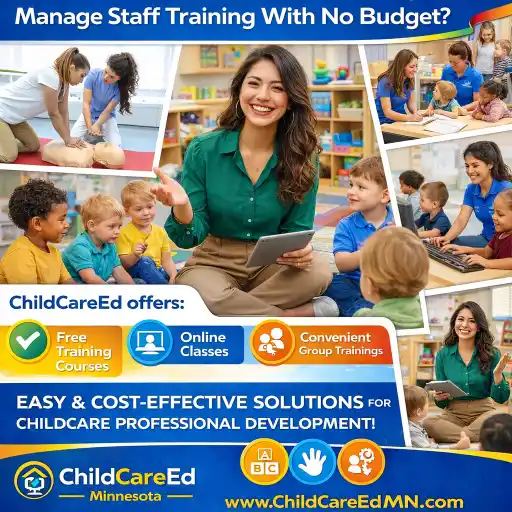
Why does staff training on a shoestring matter for small-town programs?
Key reasons, numbered:
- 😀 Keep children safe: basic health, SIDS, and first-aid training are essential and often required (see ChildCareEd's health & safety resources here Buy Now $0.00).
- 📘 Meet state rules: ChildCareEd lists Develop-approved Minnesota courses and bundles that count for MN credit (Complete Guide for Minnesota).
- 🔁 Build steady habits: spreading a few low-cost modules across the year avoids last-minute scramble before inspections.
How can ChildCareEd provide low-cost or free training options my staff can do now?
- 🔍 Find free courses first: ChildCareEd lists free trainings like "Building Vocabulary" and "CDA Introduction" with certificates—see the free course page: Free Online Childcare Training. For an easy-to-scan overview of no-cost courses, practical tips for fitting short modules into staff schedules, and where to download certificates, see Did Someone Say Free? ChildCareEd Does!.
- 📦 Use Minnesota bundles: For annual hours, choose a role-based bundle (family 16-hour or center 24-hour), so staff completes needed topics in one package (Which Minnesota bundle).
- 📘 New staff orientation: For programs onboarding new hires on a tight budget, ChildCareEd's Child Care Orientation
 Buy Now $24.00 is a 3-hour online course covering the core responsibilities, professional expectations, and foundational practices every child care worker needs to know — an affordable first course to assign at hire that counts toward Develop hours and gives staff a strong professional start.
 - 💻 Mix self-paced and short live sessions: pick 0.1–0.5 CEU modules that fit shift patterns—ChildCareEd lists short low-cost courses on the Minnesota course page Courses in Minnesota.
- 📚 Use free resources and templates: download forms, handbooks, and activity guides to support staff learning—see ChildCareEd Free Resources here.
- 🧾 Prioritize must-have topics: start with health & safety, abuse/neglect reporting, and SUID/AHT so you cover licensing priorities quickly (Health & Safety Buy Now $0.00).
- 🩺 Health and safety basics: For small programs that need to cover licensing-priority topics quickly and affordably, ChildCareEd's Administering Basic Health and Safety Buy Now $24.00 is a 3-hour online course covering the core health and safety practices every Minnesota provider needs — a fast, low-cost way to check a required topic off the list and add a clean certificate to each staff file before inspection.
How do I track and report staff training when I have zero admin budget?
- 📌 Step 1 — Add Develop IDs: have each staff member add their Develop (MN) Registry ID to their ChildCareEd profile before they start any course so completions can auto-report. ChildCareEd explains the Develop sync process in their Minnesota guide (How ChildCareEd helps MN providers).
- 📥 Step 2 — Use bundle/group tools: buy a bundle or use the Group Admin portal to enroll multiple staff at once and see progress in one place (see bundle pages on ChildCareEd MN bundles).
- ✅ Step 3 — Save certificates instantly: download the PDF certificate right after completion and store it in one shared digital folder (cloud or a program drive). Keep a paper backup in the staff file.
- 🔁 Step 4 — Verify: wait the usual upload time (ChildCareEd often posts weekly) and check the Develop Registry. If something is missing, contact ChildCareEd support with the staff name and course details.
- 🗂️ Step 5 — One-page tracker: maintain a simple spreadsheet with staff name, Develop ID, course name, date, and certificate file link. This takes minutes and saves many hours at inspection time.
How can I stretch grants, reimbursements, and local help to pay for staff training?
Small towns often have hidden funds and local partners. Try these numbered actions to bring money or in-kind help to your training plan.
- 🔎 Search ChildCareEd grant lists and free-money posts: ChildCareEd posts guides on funding and free-money options for providers (FREE MONEY). Start there for ideas and links.
- 💰 Apply for Minnesota CDA reimbursement: if staff are doing CDA training, the Minnesota CDA Reimbursement can cover training and application fees—this can free up local funds for other staff.
- 📞 Contact local CCR&R, county offices, and your county health or rural health grants: they often know small grants or partnership funds. Minnesota Department of Health lists rural grants that sometimes fund training or staffing support (MDH ORHPC grants).
- 🤝 Partner with local schools or colleges: ask for student interns, joint training, or guest trainers from Minnesota State toolkits and workforce partners (MinnState toolkits).
- 📣 Use in-kind help: invite local nurses, fire staff, or public health to run a low-cost CPR or health session for your staff—many will volunteer or charge a small fee.
Common mistakes and quick fixes:
- ❌ Forgetting to add Develop IDs BEFORE training — ✅ Fix: collect IDs at hire and add to accounts first.
- ❌ Letting staff do all training at year-end — ✅ Fix: spread modules across quarters and schedule short monthly goals.
- ❌ Losing certificates — ✅ Fix: require certificate upload to one shared folder the same day staff finishes.
Conclusion and quick FAQ
Small-town directors can meet training needs even with no budget by using free ChildCareEd courses, Minnesota bundles, smart tracking, and local grants or partners. Start with one free course for each staff member this month, add Develop IDs, and keep a one-page tracker. State requirements vary - check your state licensing agency.
Quick FAQ (short):
- Q: Can free ChildCareEd courses count for Minnesota hours? A: Some do—use the Minnesota course pages and confirm Develop approval (MN Guide).
- Q: How do I get training paid? A: Try the Minnesota CDA reimbursement, local CCR&R grants, and small state grants listed on ChildCareEd and MDH (CDA grant, MDH grants).
- Q: What if hours don’t post to Develop? A: Wait 5 business days for weekly upload, then contact ChildCareEd support with staff and course details (sync guide).
- Q: One thing to do today? A: Add each staff member's Develop ID to their ChildCareEd profile and enroll them in one short free course. That small step gives proof and momentum.
You are doing important work. Use these simple, numbered steps, free resources, and local partners to keep staff learning and children safe even without a big budget.
ChildCareEd offers many budget-friendly paths for small programs. Use these numbered steps to pick quick wins you can start this week. Documentation is as important as the learning itself. These easy steps reduce admin time and help training count for Minnesota.1) Safety and licensing: Training keeps children safer and helps you meet licensing checks. 2) Quality and retention: Well-trained staff feel more confident and stay longer. 3) Family trust: Parents expect up-to-date training when they select care. Why it matters: small steps—like one free course a month—can prevent big problems and show inspectors you run a professional program.
- CDA Certification en Español: Recursos y Consejos para Educadores Bilingües
- Proporciones de Cuidado Infantil y Tamaños de Grupo por Edad en Maryland (Guía Rápida para Centros y Hogares)
- Proporciones de Cuidado Infantil y Tamaños de Grupo por Edad en Nueva Jersey (Guía Rápida para Centros y Hogares)
- Proporciones de Cuidado Infantil y Tamaños de Grupo por Edad en Virginia (Guía Rápida para Centros y Hogares)
- Cómo Trabajar en el Cuidado Infantil en Carolina del Norte: Requisitos y Pasos
- Which Minnesota training bundle is right for my child care team?
- How does ChildCareEd help Minnesota childcare providers complete their annual training hours online?
- How can childcare programs support farm families with flexible care in rural North Dakota?
- How can ChildCareEd help Minnesota childcare workers complete all Develop Registry hours entirely online?
- How can ChildCareEd help Minnesota childcare directors in small towns manage staff training with no budget?
- Celebrando la amistad en el cuidado infantil durante el Día de los Mejores Amigos
- How can North Dakota child care programs plan now for tourism and population surges?
- Why Are Minnesota Centers Dipping Into Emergency Funds — And How Can Training Help?
- How Can North Dakota Close the Rural Child Care Gap with Funding and Expansion?
- La mejor manera de hacer seguimiento a la capacitación de su equipo de daycare How to Organize Staff Training for Your Child Care Center Cómo organizar la capacitación del personal para su centro de cuidado infantil
- How can child care programs prevent staff burnout during Minnesota’s paid-leave staffing crunch?
- Cómo simplificar la capacitación para sus empleados de daycare
- How can Greater Minnesota providers tap the Rural Child Care Innovation Program?
- How can rural North Dakota child care programs recruit and keep staff?
- What do child care credentialing levels look like in Minnesota?
