Group discussions offer valuable opportunities to share ideas, but overlapping voices and missed cues can make participation difficult for a child with hearing loss. Try using pictures from Community Helpers at Work Buy Now $1.49 to give the group a shared visual topic, while supporting clear turn-taking and keeping speakers’ faces visible. Plan with the child’s family and support team to use communication approaches that fit the child’s needs. For focused professional learning on inclusion, individualized support, and family resources, explore ChildCareEd’s Supporting Children with Hearing Loss  Buy Now $16.00. Read on for practical ways to help children follow the conversation and contribute their own ideas.
Why does access to group discussion matter?
Group discussions are not simply opportunities to answer questions. They help children practice language, listen to peers, share ideas, negotiate turns, and develop a sense of belonging. When a child cannot reliably access what others are saying, they may miss a joke, a direction, or an invitation to join in. The result can look like distraction or quietness, even when the child is interested and ready to participate.
Hearing loss affects children in different ways. A child may use hearing technology, sign language, spoken language, gestures, or more than one communication approach. Noise, distance, lighting, and the number of people speaking can all influence access. Avoid treating a diagnosis as a complete description of what the child can do; learn what communication methods and supports work for this individual.
Intentional access supports benefit the whole group. Picture cues, clear turn-taking, and concise directions help children who missed a comment, are learning the group’s routines, or process information at different speeds. The goal is not to lower expectations, but to make the discussion accessible so the child can engage with the same meaningful ideas as peers.
How can you arrange the room and group for shared communication?
Start with the physical setting. Arrange children in a circle or horseshoe so participants can see one another’s faces. Choose a well-lit location, with the primary speaker’s face visible and not silhouetted against a bright window. Seat the child where they can see both the educator and classmates; ask the child and family what positions are most useful rather than assuming the front is always best.
Reduce competing noise when possible. Turn off background music during discussion, close a noisy door or window when appropriate, and avoid gathering beside loud equipment. These adjustments may improve access for children who use hearing devices, but they do not replace the child’s individualized plan or communication supports.
- Use a visual object, card, or gesture to indicate whose turn it is.
- Keep the group small enough for children to see and follow the exchange.
- Place picture prompts or discussion materials where everyone can view them.
- Follow family and specialist guidance for assistive listening equipment. Staff should handle or adjust a child’s personal device only when trained and authorized.
Universal visual supports can clarify expectations and help children understand what to do next. A predictable environment makes it easier for the child to focus on the discussion rather than work out where the information is coming from.
What communication practices help every child follow along?
Before starting, gain the group’s attention and introduce the topic. Use short, clear sentences and explain unfamiliar words before they become central to the conversation. Pair spoken information with pictures, objects, gestures, or a quick demonstration. For example, when discussing a class garden, show a seed, a photograph of a sprout, and the relevant vocabulary.
While speaking, face the group and keep your mouth visible. Use a natural pace and comfortable volume—shouting or exaggerating speech can make communication less clear. Avoid speaking while turning to write, walking away, or covering your face. Pause between ideas so children have time to process and respond.
Make the discussion turn structure explicit. Call on one speaker at a time, identify the speaker by name, and briefly repeat or summarize a peer’s contribution when needed. If the child misses a message, repeat it once or rephrase it and add a visual cue. Guidance from communication strategies for people who are Deaf or hard of hearing also emphasizes facing the learner, gaining attention, and rephrasing when a message is unclear.
- Offer more than one way to respond: speaking, signing, pointing to a picture, selecting an object, or using an established communication system.
- Pause after asking a question; avoid filling every silence for the child.
- Check understanding by inviting the child to show or choose the next step, rather than relying only on a nod or a yes.
These practices support meaningful #communication without making the child responsible for catching every missed word.
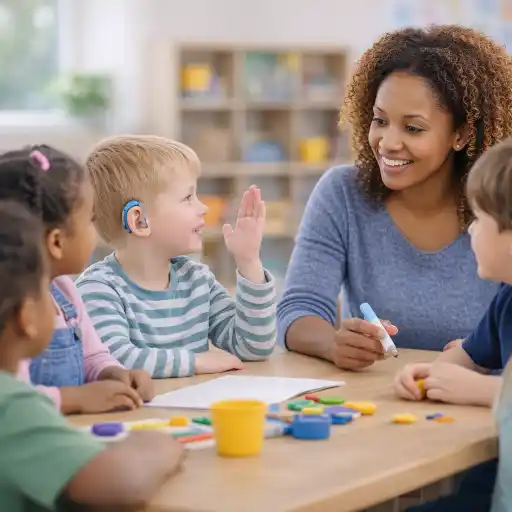
How can you encourage participation and positive peer interaction?
Participation is more than answering an educator’s question. Children also need chances to initiate an idea, respond to a classmate, and be invited into the exchange. Build predictable entry points into discussions: offer a turn-taking object, show a picture choice, or ask each child to contribute one observation. Give the child time to prepare a response, and recognize gestures, signs, and other chosen communication as valid contributions.
Help peers learn simple habits that make conversation inclusive. Model facing the person who is speaking, waiting until a classmate finishes, and getting someone’s attention before talking. Explain that the group takes turns so everyone can follow—not that one child needs special treatment. If the child uses sign language or another communication approach, work with the family and relevant specialists to understand respectful ways peers can communicate and interact.
Studies of preschool peer interaction underscore that placement in a group alone does not guarantee that children will be included or receive invitations to play. Educators can strengthen access by actively structuring opportunities for children to notice one another, respond, and share ideas. Use open-ended prompts that invite different perspectives, such as “What do you notice?” or “What could we try next?”
Observe more than how often a child speaks aloud. Notice whether the child receives turns, initiates interaction, responds in a preferred way, and appears engaged. These observations help you adjust supports while honoring the child’s strengths and agency.
How can you partner with families and the support team?
Families know the child’s communication preferences, experiences, and successful strategies. Ask practical, open questions: What helps your child follow a group conversation? Which visual signals are familiar? How does your child show that they missed something or want a turn? Invite the child’s perspective using communication they can access. These conversations establish a partnership rather than placing the burden on a family to solve every classroom challenge.
With family permission, coordinate with relevant professionals—such as an audiologist, early intervention provider, speech-language pathologist, or teacher of the Deaf or hard of hearing. Share the discussion routine and ask which adjustments fit the child’s established plan. Document agreed strategies in a brief staff guide so substitutes and colleagues can use consistent cues. Keep the child’s information private and share it only with appropriate, authorized team members.
After trying an adaptation, collect simple observations: Was the child able to see who was speaking? Did the visual cue help with turn-taking? Did the child contribute or show enjoyment? Share objective notes with the family and invite feedback. Adjust one or two features at a time—such as room noise, seating, or pacing—so the team can identify what is helpful.
For additional professional development, ChildCareEd offers relevant English-language courses: Supporting Children with Hearing Loss Buy Now $16.00, Language Development in Early Childhood Buy Now $16.00, Special Needs: From Referral to Inclusion Buy Now $24.00, CDA: Special Needs: Understanding the Whole Child Buy Now $24.00, and Building Equity: Inclusionary Practices in Preschool Buy Now $10.00. Course details and availability may change; review each course page for current information.
What common barriers should providers avoid?
Even caring, experienced educators can unintentionally create communication barriers in fast-moving group conversations. A child’s quietness or a nod does not necessarily mean the child understood, and repeated directions are not always enough if the wording, room conditions, or visual access remain unchanged. Focus on removing barriers rather than interpreting missed information as lack of interest.
- Do not speak while facing away, from across a noisy room, or with your face obscured.
- Do not allow several people to speak at once; pause and invite one speaker at a time.
- Do not assume lip-reading alone, hearing technology, or a single visual aid will meet every child’s needs.
- Do not shout or exaggerate speech. Repeat, rephrase, and add a visual cue instead.
- Do not make the child responsible for reminding adults about access or educating classmates about hearing loss.
One common mistake is asking “Do you understand?” and accepting a yes as proof. Instead, invite the child to show the first step, choose a picture, or contribute in their preferred way. Another is adapting an activity only after the child has already been left out. Prepare visual access and clear turn-taking as regular group routines so inclusion is built in from the start.
Requirements and procedures differ by jurisdiction; state requirements vary - check your state licensing agency. When the child has an individualized plan, follow it and ask the family or qualified team members when you need clarification.
Conclusion: What makes group discussions genuinely inclusive?
Including a child with hearing loss in group discussions means ensuring that information, turns, and opportunities to contribute are accessible—not simply having the child present. Arrange the group so faces and visual materials can be seen, reduce avoidable noise, speak clearly while facing the group, and make one-at-a-time turn-taking routine. Pair spoken directions with visuals, allow processing time, and welcome communication in the child’s preferred form.
Most importantly, learn from the child and family, coordinate supports with the appropriate team, and observe whether the adaptations create real participation and belonging. Small, consistent adjustments can change the experience of the whole group: children understand expectations more readily, peers learn to listen and wait, and the child with hearing loss has meaningful space to share ideas. Keep the central question in view—how can each child access and shape this conversation?—and let that guide your planning.
- 45 Hour Child Growth and Development
- CDA Family Child Care Credential
- CDA Family Child Care Credential with Portfolio Review
- 45 Hour Infant and Toddler Methods and Materials
- 45 Hour School Age Methods and Materials
- CDA Bridge Bundle: Family Child Care without Portfolio Review
- Staff Supervision, Observation & Feedback
- Texas Director Credential
- Supporting Children with Hearing Loss
- CDA Certification en Español: Recursos y Consejos para Educadores Bilingües
- 👶 ¿Cuáles son las proporciones y grupos requeridos en Dakota del Norte? 🏫
- Regulaciones de Cuidado Infantil en Maryland para Centros y Hogares de Cuidado Infantil Familiar
- Regulaciones de Licenciamiento de Cuidado Infantil en California para Centros y Hogares de Cuidado Infantil Familiar
- Proporciones de Cuidado Infantil y Tamaños de Grupo por Edad en Maryland (Guía Rápida para Centros y Hogares)
- Proporciones de Cuidado Infantil y Tamaños de Grupo por Edad en Nueva Jersey (Guía Rápida para Centros y Hogares)
- Proporciones de Cuidado Infantil y Tamaños de Grupo por Edad en Virginia (Guía Rápida para Centros y Hogares)
- Lista para Abrir una Guardería en Casa en Georgia: Cómo Empezar
- Lista para Guardería en Casa en California: Cómo Iniciar una Guardería en el Hogar
- Lista para Guardería en Casa en Texas: Cómo Iniciar una Guardería en el Hogar
- Cómo Trabajar en el Cuidado Infantil en California: Requisitos y Pasos
- Cómo Trabajar en el Cuidado Infantil en Wisconsin: Requisitos y Pasos
- La mejor manera de hacer seguimiento a la capacitación de su equipo de daycare How to Organize Staff Training for Your Child Care Center Cómo organizar la capacitación del personal para su centro de cuidado infantil
- Cómo simplificar la capacitación para sus empleados de daycare
- How can Michigan child care programs effectively support children with hearing or vision impairments?
- What Are the Best Ways to Support a Child’s Speech Development?
- When Should Providers Be Concerned About Language Delays?
- When Should a Child Care Provider Be Concerned About Speech Development?
- How Can You Make a Group Listening Game Accessible to a Child with Hearing Loss?
- How Can Child Care Providers Include a Child with Hearing Loss in Group Discussions?
