A new child does not need a perfect first day; they need consistent signals that they matter and belong. This practical guide offers relationship-based strategies for arrival, classroom design, play, communication, and family partnership, while Supporting Social Learning: Creating Classrooms that Care Buy Now $35.00 can help you deepen community-building skills and earn useful professional development hours.
Why Does Feeling Welcomed Matter So Much?
Entering an established child care group is a significant social and emotional transition. A new child must learn unfamiliar names, routines, spaces, expectations, and communication patterns while also separating from familiar caregivers. Some children approach quickly; others observe silently, cling, cry, or communicate through movement and gestures. Each response is meaningful information rather than evidence that a child is unwilling to participate.
Feeling noticed supports exploration. When children experience a responsive adult, predictable routines, and opportunities to participate without pressure, they are more likely to investigate materials, approach peers, and attempt new language. The ZERO TO THREE guidance on transitions emphasizes warm, individualized interactions and consistent support for self-regulation, especially for infants and toddlers. Similarly, NAEYC frames inclusion around recognizing each child’s individuality, family context, strengths, and need for accessible participation.
Welcoming practices also benefit the group. Existing children learn that belonging is something the community actively creates, not something reserved for children who already know the rules. A thoughtful welcome therefore supports #belonging, #confidence, and stronger peer relationships for everyone.
How Can Arrival Routines Help a New Child Feel Recognized?
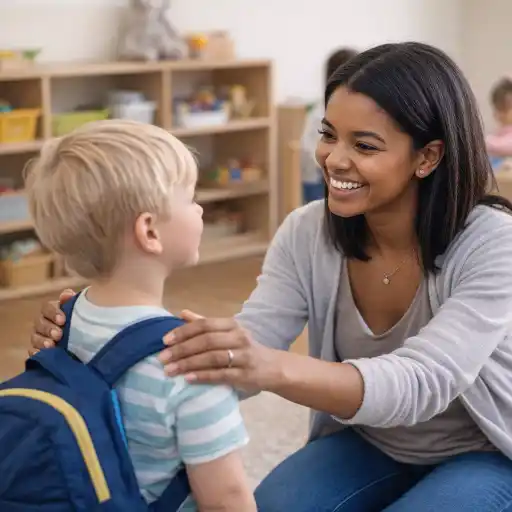
Arrival is often the child’s first daily test of safety. A calm, personal greeting communicates more than a general “hello.” Use the child’s name accurately, move to their level, and notice something specific: “I’m glad you are here, Mateo. I see you brought your blue truck.” If the child does not respond, continue warmly without demanding eye contact, touch, or speech.
- Offer two entry choices, such as placing a picture on the attendance board or choosing a book.
- Create a brief goodbye ritual with families: a hug, wave, phrase, or classroom doorway routine.
- Keep a familiar object, photo, or comfort item available when families approve and the item is safe.
- Use a visual arrival sequence: enter, greet, store belongings, choose an activity.
- Assign a trusted adult or peer connection during the first several days.
Predictability is especially important when separation is difficult. Acknowledge emotion without rushing to distract: “You miss your dad. I will stay with you while your body gets calm.” Then offer a manageable next step. The resource helping children feel safe and welcome in child care similarly highlights names, predictable routines, choices, and cozy spaces as practical supports.
Directors can strengthen arrival by ensuring every staff member follows the same welcoming script and communicates one positive observation to families.
How Can the Classroom Environment Say “You Belong Here”?
Children read the room before they understand its verbal explanations. A welcoming environment makes materials accessible, reduces unnecessary confusion, and reflects the identities of the children and families who use it. Begin with a short audit rather than attempting a complete redesign.
- Place family photos, children’s names, and home-language labels at children’s eye level.
- Use low shelves, clear bins, and picture labels so children can make meaningful choices.
- Define areas for reading, construction, dramatic play, art, sensory exploration, and quiet retreat.
- Display children’s work as evidence of membership, rotating pieces so every child is represented.
- Check that pathways, seating, lighting, and materials support mobility and sensory access.
Representation should be integrated rather than occasional. Select books, dolls, photographs, music, and dramatic-play materials that reflect varied cultures, languages, abilities, family structures, and appearances. Avoid treating one child as a spokesperson for a culture or requiring families to provide personal artifacts. Invite contributions, but make participation voluntary.
Environmental adjustments can be physical, social, and temporal. NAEYC describes examples such as flexible seating, visual supports, intentional peer pairings, smaller groups, and transition warnings. These changes frequently support several children at once. A quiet corner, for example, is not a place to send a child away; it is a taught, accessible option for regulating and returning to community life.
Which Activities Help Children Connect Without Putting Anyone on the Spot?
Effective welcome activities create shared experiences rather than requiring the new child to perform. Choose brief, repeatable activities with multiple ways to participate: speaking, pointing, moving, drawing, holding a prop, or simply observing.
- Name-and-action circle: Children say or point to their names while the group repeats a wave, clap, or movement.
- Favorite-things board: Children place their names beside pictures of books, animals, colors, or play areas they enjoy.
- Partner build: Two children use shared blocks to build a bridge, home, or tower with an adult modeling “Can I add one?”
- Classroom discovery walk: Partners find a book, puppet, blue block, or cozy space using picture cards.
- 🧸 Helper roles: A child may choose materials, hold a picture, turn pages, or observe before joining the main activity.
Interest-based play is particularly powerful because children can connect through a shared purpose. Observe what attracts the new child and use that information for thoughtful invitations: “You are watching the train area. Would you like to place one track beside us?” Never make a peer responsible for managing the newcomer; adult proximity and brief coaching protect both children.
For quiet children, allow a participation step-ladder: watch, hold a prop, complete a small task, communicate with a partner, and eventually share with a larger group if desired. The goal is authentic engagement, not public performance.
How Can Providers Honor Language, Culture, and Individual Differences?
Children feel welcomed when their ways of communicating and living are treated as strengths. Ask families how to pronounce the child’s name, what words are useful during care routines, which greetings feel comfortable, and what helps during transitions. Learn a few important words in the home language and use photographs, gestures, objects, and visual schedules to support understanding.
Do not assume that limited English means limited comprehension. A dual language learner may understand the invitation, follow the routine, and contribute nonverbally before speaking English. Invite home-language songs, stories, labels, and family knowledge into the classroom. The ChildCareEd course Building Bridges for Dual Language Learners Buy Now $25.00 offers focused strategies for language development, culturally responsive environments, and family collaboration.
Individualization also includes disability, temperament, sensory processing, and communication style. Offer flexible seating, adaptive tools, communication boards, extra processing time, and alternatives to eye contact or touch. Consult families and specialists when appropriate, and keep the child participating with peers whenever possible. NAEYC’s developmentally appropriate practice emphasizes knowledge of each child, family, and social-cultural context as the basis for responsive teaching.
State requirements vary - check your state licensing agency. Program policies, confidentiality expectations, and formal referral procedures should guide documentation and collaboration.
How Can Families and Staff Sustain a Welcoming Experience?
Families hold essential knowledge about a child’s routines, interests, relationships, comfort strategies, and communication. Begin with curiosity rather than a checklist: “What helps your child feel secure in a new place?” “What does your child enjoy doing?” “Are there words or routines we should use?” Share information through the family’s preferred communication method and language whenever possible.
- Invite a short pre-enrollment visit or virtual classroom introduction.
- Send a welcome message with a photo of the room, staff names, and a simple daily sequence.
- Share one specific strength or successful moment during the first week.
- Ask families to contribute songs, stories, photographs, or interests without requiring expense or public disclosure.
- Document observations objectively: describe what the child did and what support helped.
Staff consistency matters. Agree on a few shared responses for greetings, separation, refusal, and emotional distress. Review whether adults are unintentionally giving the new child excessive attention, overlooking quiet participation, or interpreting unfamiliar behavior through deficit-based assumptions. Use team reflection to ask: Who is being invited? Who is waiting? Which supports increase engagement?
Common mistakes include forcing introductions, using competitive icebreakers, asking personal questions, tokenizing culture, and stopping after one welcome activity. Avoid these pitfalls by offering choice, repeating low-pressure routines, and measuring small signs of connection over time.
What Can Providers Try This Week?
Helping a new child feel seen is a daily practice built from small, reliable actions. Start with a four-step plan:
- Greet the child by name and offer two arrival choices.
- Add one family or home-language representation to the child’s accessible classroom space.
- Plan a cooperative activity with speaking and non-speaking participation options.
- Share one strength-based observation with the family and ask what support should come next.
Watch for progress in many forms: entering the room more calmly, recognizing a photo, choosing a center, watching peers, accepting a material, using a gesture, or staying near a group. These are meaningful steps. The central question is not whether a new child participates exactly like everyone else, but whether the environment communicates, consistently and sincerely, “You are known, valued, and welcome here.”
For continued professional learning, explore Classroom Setup for Child Care  Buy Now $24.00, Connections That Count: Building Relationships in Child Care Buy Now $55.00, and Family Voices Matter: Tools for Meaningful Collaboration Buy Now $55.00. Review course and state requirements before enrolling.
- Family Voices Matter: Tools for Meaningful Collaboration
- Bienvenido! Welcoming All Families
- Pediatric RSV First Aid & CPR/AED
- CDA Bridge Bundle: Family Child Care without Portfolio Review
- CDA Bridge Bundle: Infant/Toddler without Portfolio Review
- Classroom Setup for Child Care
- CDA Bridge Bundle: Preschool without Portfolio Review
- Early Childhood Education
- Texas Director Credential
- Access for All: Inclusion and the ADA
- CDA Certification en Español: Recursos y Consejos para Educadores Bilingües
- Capacitación en Salud y Seguridad Preventiva en Línea para Proveedores de Cuidado Infantil
- Regulaciones de Licenciamiento de Cuidado Infantil en California para Centros y Hogares de Cuidado Infantil Familiar
- Proporciones de Cuidado Infantil y Tamaños de Grupo por Edad en Maryland (Guía Rápida para Centros y Hogares)
- Proporciones de Cuidado Infantil y Tamaños de Grupo por Edad en Nueva Jersey (Guía Rápida para Centros y Hogares)
- Proporciones de Cuidado Infantil y Tamaños de Grupo por Edad en Virginia (Guía Rápida para Centros y Hogares)
- Horas de Capacitación Anual para Proveedores de Cuidado Infantil en Maryland
- Lista para Abrir una Guardería en Casa en Dakota del Norte: Cómo Empezar
- Lista para Guardería en Casa en Texas: Cómo Iniciar una Guardería en el Hogar
- Cómo Trabajar en el Cuidado Infantil en Carolina del Norte: Requisitos y Pasos
- Cómo Trabajar en el Cuidado Infantil en Wisconsin: Requisitos y Pasos
- Capacitación Previa al Servicio para Proveedores de Cuidado Infantil en Georgia
- Celebrando la amistad en el cuidado infantil durante el Día de los Mejores Amigos
- Canciones, juegos y preguntas de círculo para niños
- Cómo simplificar la capacitación para sus empleados de daycare
- How do I run a simple first-week staff onboarding plan for Pennsylvania child care?
- How can I build a more joyful classroom without buying new supplies?
- How Can Child Care Providers Help New Children Feel Seen and Welcomed?
- How Can You Help a Preschooler Recover After a Difficult Drop-Off?
- How Can You Welcome a Family Who Joins Child Care Midyear?
