Being an assistant teacher is a strong start. This article helps child care providers and directors guide assistants toward better jobs, more pay, and leadership roles. Read simple steps, training tips, and things to avoid. You will find links to trusted ChildCareEd pages and other resources to help plan a real pathway. Remember: state requirements vary - check your state licensing agency.
What does a career pathway for an assistant teacher look like and why does it matter?
1. Children get better care when staff are trained. 2. Programs run smoother with clear staff roles. 3. Staff earn more and stay longer when they see growth paths.
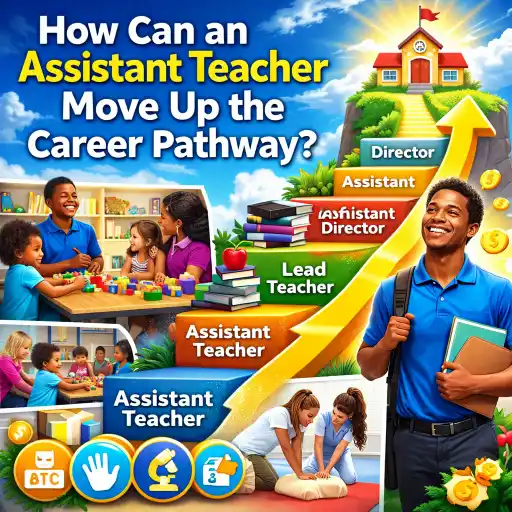
A typical pathway is simple to picture. Think of it as steps you climb:
- 🔹 Entry: Classroom helper/assistant. (High school diploma/GED often ok.)
- 🔹 Skilled assistant: Certificate or short courses and on-the-job hours.
- 🔹 Qualified teacher: CDA, college units, or state permit.
- 🔹 Lead teacher or supervisor: More college credits or director training.
- 🔹 Director or owner: Degree plus admin training and experience.
Examples and places to learn more:
- • For how CDA fits into the ladder see the ChildCareEd CDA guide: Child Development Associate Certification. If you work in Maine, see how a CDA credential can boost your child care career in Maine for state-specific steps, funding options, and local career outcomes.
- • For assistant course ideas see Early Years Teaching Assistant Courses.
Use this pathway to plan training, time, and pay raises. Put the plan on a calendar and review it with staff each year. This makes the dream of #career growth real for your #assistant staff.
What training and credentials should assistants earn next?
Use a step plan. Pick training that meets your state and your program.
- 🎓 Start with essentials:
- 1. Pediatric CPR and First Aid.
- 2. Health & safety orientation (many states want this).
- 3. Background checks and TB or health clearances.
- 📘 Next, take short courses that add skills:
- 1. Child development basics (for example the 45-hour course at ChildCareEd: Child Care Workforce Qualifications Buy Now $0.00).
- 2. Behavior guidance and observation modules (many are on ChildCareEd).
- 🎯 Aim for a recognized credential:
- 1. CDA (120-hour training + portfolio). Read how at CDA Certification.
- 2. Or state permit/associate units that work for your licensing rules.
- 🧭 For long-term moves:
- 1. Director courses (45-hour or state-specific) and admin classes; see Assistant to Director guide.
- 2. College credits, degrees, or apprenticeships (example: apprenticeship info at Nebraska AEYC). If you're in Nebraska, read how a CDA can strengthen in-state qualifications and job prospects: CDA benefits in Nebraska.
Practical tip: choose courses that are state-approved so hours count for licensing. For exam scheduling and testing requirements for the CDA, see Pearson VUE: CDA Exam Info. Keep a record of every certificate and upload them to your state registry when available.
Training helps turn work into credentials. That means your team moves from paid helpers to trusted #CDA holders and future #leadership candidates.
How do assistants gain experience, document it, and get noticed for promotion?
- 📁 Build staff records (do this first):
- 1. Keep a folder with certificates, background check copies, and transcripts.
- 2. Scan everything and keep a shared drive or registry upload.
- 🤝 Create on-the-job leadership chances:
- 1. Mentor new hires for a month.
- 2. Lead a short activity or circle time once a week.
- 3. Run a family event or share notes at staff meetings.
- 🧾 Track verified hours and experience:
- 1. Log classroom hours (480 hours often needed for CDA) and get a supervisor to sign them.
- 2. Use employer letters or timesheets as proof.
- 📣 Help staff apply for supports:
- • Apply for scholarships or scholarship programs (example: DECAL Scholars in Georgia — see Georgia support).
- • Consider apprenticeships or TEACH scholarships like in Nebraska AEYC.
Hiring tip for directors: use short, measurable goals. Example plan for an assistant for 12 months:
- Month 1–3: Complete health & safety and CPR. (✅)
- Month 4–8: Finish 45–120 hours of training (CDA hours). (✅)
- Month 9–12: Lead small group and collect verification for portfolio. (✅)
Show this plan to the assistant. Small wins build confidence, and the evidence helps when you hire for a lead spot. This process turns daily work into a clear #training record and better job chances.
How do we avoid common mistakes and plan pay, promotion, and next steps?
Common mistakes happen, but you can avoid them with simple rules. Here are the top pitfalls and fixes.
- ❗ Not tracking hours properly — Fix: keep a shared tracker and signed forms.
- ❗ Choosing courses that are not state-approved — Fix: confirm approval on your state training roster or pick known vendors like ChildCareEd (training catalog Buy Now $0.00).
- ❗ Letting CPR or background checks lapse — Fix: set calendar reminders 60 days before expiration.
- ❗ Waiting until a job opens before gaining skills — Fix: staff should collect hours and do small leadership tasks now.
- ❗ Assuming one credential fits every state — Fix: state requirements vary - check your state licensing agency early.
Planning pay and promotion:
- • List clear steps that earn raises (example: +$1/hour after CDA; +$2/hour after lead permit).
- • Use your state career ladder if available (example: Utah Career Ladder info: Utah Career Ladder).
- • Offer partial scholarship help or time to study on site when possible.
FAQ (quick):
- Q: Do assistants always need a degree to move up? A: No. Many states accept a CDA or clock-hours plus experience. See career steps.
- Q: How long to get a CDA? A: CDA training can be 120 hours plus 480 hours of experience and portfolio work. Read more at CDA info.
- Q: Where can I take approved courses? A: Start with ChildCareEd course bundles and your state registry.
- Q: Are apprenticeships a good route? A: Yes. They pair work with study and often include scholarships—see apprenticeship example.
Conclusion
Move one step at a time. Use short trainings, collect proof, and create small leadership chances on the job. Directors: make clear pay and promotion rules so assistants can plan. Staff: pick one training this month and one leadership task next month. Together you build stronger programs and happier children. Keep the plan visible, and revisit it often. Your work matters — help your team grow from #assistant to #leadership with steady #training and a focus on #CDA and #career goals.
Why it matters:Good documentation and small leadership chances build big results. Use this 1–2–3 plan at your center.- 45 Hour Child Growth and Development
- 45 Hour Preschool Methods and Materials
- 45 Hour Infant and Toddler Methods and Materials
- 45 Hour School Age Methods and Materials
- CDA Bridge Bundle: Family Child Care without Portfolio Review
- CDA Bridge Bundle: Infant/Toddler without Portfolio Review
- Texas Director Credential
- 45 hour Growth and Development Birth-age 12 ONLINE
- CDA Certification en Español: Recursos y Consejos para Educadores Bilingües
- Proporciones de Cuidado Infantil y Tamaños de Grupo por Edad en Nueva Jersey (Guía Rápida para Centros y Hogares)
- Cómo Trabajar en el Cuidado Infantil en Carolina del Norte: Requisitos y Pasos
- Cómo Trabajar en el Cuidado Infantil en California: Requisitos y Pasos
- Virginia Early Childhood Career Pathways: Provider Guide
- Early Years Teaching Assistant Courses: What to Know
- How can California early educators start strong and grow their careers with ChildCareEd?
- Canciones, juegos y preguntas de círculo para niños
- How can an Assistant Teacher move up the career pathway?
- How can an assistant teacher build a clear career pathway?
- Cómo simplificar la capacitación para sus empleados de daycare
- Online Early Childhood Education Courses: Learn, Grow, and Advance Your Career
- Can You Become a Preschool Teacher in California Without a Degree?
- Do You Need a Bachelor’s Degree to Be a Preschool Teacher—or Can a CDA Be Enough?
- Daycare Job Qualifications: What’s Required vs. What Helps You Stand Out
- Lead Teacher vs. Assistant Teacher: What’s the Difference in a Child Care Classroom?
- Preschool Teacher Qualifications: What’s Required to Get Hired—and What Helps You Move Up?
- What Qualifications Do You Need to Be an Assistant Director at a Daycare?
