Before an AI toy enters your classroom, your team needs to understand what it can hear, store, and say, along with its purpose in children’s learning. Use the Daily Toy Inspection Checklist for Child Care Buy Now $1.49 to support checks of the toy’s physical condition, then separately review its privacy settings, connected features, and generated content. Consider how it would fit alongside hands-on play and responsive interactions with adults and peers. For broader guidance on evaluating technology’s developmental effects and planning intentional use, explore ChildCareEd’s Technology as a Classroom Tool  Buy Now $16.00. Read on for questions to help your team make a thoughtful decision before accepting an AI toy.
Why does an AI toy deserve a closer look?
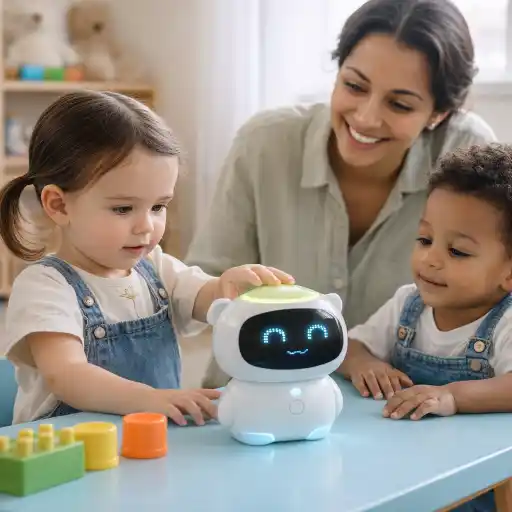
AI toys may include microphones, cameras, internet connections, speech recognition, and software that generates or adapts responses. Unlike a simple sound toy, a conversational product may respond as though it understands a child, remember preferences, or invite ongoing conversation. That difference matters: the device is not only a play object but also a system that may process children’s words and behavior.
There may be possible benefits, such as prompting vocabulary or supporting a brief, adult-guided activity. Yet evidence about developmental benefits and long-term effects remains limited. Small-scale early-years research has observed toys mishearing children, struggling with pretend play, and responding poorly to emotional cues. Independent testing has also reported inappropriate or unreliable outputs in some products. These findings do not prove that every AI toy will cause harm, but they do make a cautious, product-specific review sensible.
For young children, responsive exchanges with educators and peers remain central to language, social understanding, and emotional development. A toy should not become a substitute for those relationships or for hands-on, child-led play. NAEYC’s guidance supports intentional, developmentally appropriate use of technology, with adult knowledge and limitations built into decisions. Treating this as a program-level risk assessment helps directors make a thoughtful choice rather than reacting to novelty or marketing.
What should you find out about the toy’s data and privacy?
Begin with the device’s complete data path—not just the short description on its packaging. Review its manual, privacy notice, app permissions, and vendor answers. If information is unclear, treat that uncertainty as a meaningful concern rather than assuming the toy is private by default.
- What does it collect: voice, transcripts, images, location, identifiers, or interaction history?
- When does collection occur, and can information be stored when the toy appears to be offline or switched off?
- Where is information processed and stored? How long is it kept, and who can access it?
- Is data shared with service providers, advertisers, or other third parties, or used to improve models?
- Can the program or family review, delete, or stop collection of the child’s information?
- Are there clear security practices, software updates, and a way to report a suspected incident?
Audio and interaction patterns can reveal sensitive details about a child and the household. COPPA applies to certain online services directed to children under 13, or services that knowingly collect personal information from them; it has requirements concerning notice, parental consent, and information handling. Its application depends on the service and circumstances, so do not treat a vendor’s general claim as a complete legal review. Ask families for informed, written permission where appropriate, explain what the toy does, and avoid entering identifying or sensitive information. Protect children’s privacy through data minimization and clear, practical rules.
How can you evaluate content, boundaries, and developmental fit?
Marketing language such as “learning companion” or “child-safe” does not tell you how a toy behaves in real conversations. Ask the vendor what age group the product is designed for, how responses are moderated, what testing was done with children, and what limitations are known. Look for independent assessments where available. A confident voice can still give inaccurate information, misunderstand a child, or generate a response that is confusing or inappropriate.
Consider the social message of the design. Does the toy call itself a friend, encourage secrets, invite children to share feelings, or imply that it misses or loves them? Young children may interpret human-like conversation differently from adults. Educators can explain simply that a toy is a machine, but explanation alone does not remove design risks. Observe whether children become frustrated, rely on the toy for comfort, or spend less time talking and playing with people.
Assess development and accessibility individually: a product might offer useful features for some children, yet create privacy or interaction concerns for others. A tool should complement, not replace, an individualized plan or a caregiver’s responsive attention. When questions about safety, boundaries, or age suitability cannot be answered clearly, the most developmentally appropriate decision may be to decline the product or wait.
What practical checklist should directors use before accepting one?
Use a documented review that includes leadership, classroom staff, and family perspectives before purchasing, accepting, or piloting a connected toy. Decide first what educational purpose it would serve. If the goal can be met as well or better with books, blocks, conversation, or open-ended materials, there may be no compelling reason to introduce a new data-collecting device.
- 🧸 Identify the intended learning goal and the ages of children who might encounter the toy.
- Review privacy terms, permissions, data retention, deletion options, security documentation, and third-party sharing.
- Ask for clear details about content controls, age labeling, advertising, subscriptions, and independent testing.
- Confirm that the toy can be used without an account, camera, microphone, or internet connection—or document why those features are necessary.
- Set written rules for adult supervision, location, session length, cleaning, storage, and access to settings.
- Provide families with a plain-language explanation and a meaningful opt-in or opt-out choice.
- Define who can approve use, who will monitor it, and how concerns or incidents will be recorded and addressed.
Where a pilot is justified, keep it small, directly supervised, and time-limited. Observe children’s engagement, peer conversation, frustration, and what the activity displaces; do not judge success by how long the toy holds attention. State requirements vary - check your state licensing agency. A clear written process lets staff respond consistently and shows families that their questions are welcome.
How can staff, families, and classroom policy guide the decision?
Before any use, give staff a short briefing on the toy’s functions, boundaries, privacy settings, and the program’s stop-use procedure. Practice what to do if it records unexpectedly, produces a troubling response, or prompts a child to share personal information. Staff should know whom to notify, how to disconnect or remove the device, and how to document the event without spreading sensitive details.
Partner with families early and without pressure. Describe the potential value and the uncertainties in balanced language, share the vendor’s data practices, and make clear that children will have equally valued play options if a family declines. Families may have different comfort levels, cultural expectations, and privacy concerns; listening to those differences can improve policy and trust.
Written policy should specify whether connected conversational toys are permitted, who approves them, what consent is needed, where they may be used, and how data or incidents are handled. Include a scheduled review date because product features, vendor terms, and applicable guidance can change. Keep the policy focused on relationships: technology must not interrupt supervision or crowd out conversation, collaborative play, movement, rest, and real-world exploration. If staff cannot reliably supervise the device or the vendor cannot answer essential questions, do not accept it for classroom use.
What common mistakes should providers avoid?
Well-intentioned programs can overlook risks when a product is presented as educational, convenient, or a screen-free companion. A careful process protects children and also supports staff, who should not be left to make privacy and safety decisions on the spot.
- Accepting vague assurances: Request specific, written answers about collection, retention, deletion, sharing, and content safeguards.
- Assuming “offline” means no data: Check whether the device stores information locally and uploads it later.
- Relying on consent alone: Permission is not a substitute for reviewing the product, minimizing data, supervising use, and offering alternatives.
- Leaving a toy available without a plan: Set adult-led use, a defined purpose, and clear stop conditions.
- Calling it educational without observing learning: Look for meaningful child participation and follow-up, not simply attention or novelty.
- Overlooking the human experience: Notice whether children still have ample time for peer play, pretend play, conversation, and comfort from trusted adults.
If a toy gives an unsafe or disturbing response, stop its use, preserve only the information needed to document what happened, notify program leadership, and follow the written family-communication and reporting procedures. Review whether the product should be removed permanently. For professional learning on evaluating classroom technology, explore ChildCareEd’s Technology as a Classroom Tool Buy Now $16.00. For added perspective on confidentiality and records, consider Privacy Matters: Documentation and Observation in Early Learning Buy Now $55.00.
Conclusion: What is the safest way to decide?
Before accepting an AI toy, establish its purpose, examine what it collects and how information is handled, assess content and developmental fit, involve families, and create a written supervision and incident plan. If you cannot verify the toy’s privacy practices, boundaries, and meaningful educational value, declining it—or waiting for clearer evidence and protections—is a reasonable professional decision.
Above all, keep the child’s experience at the center. The strongest early learning environments protect children’s information while preserving the human connection, imaginative play, and hands-on exploration that make classrooms rich places to grow. Use your team’s judgment, document the reasons behind the decision, and revisit your policy as products and guidance evolve.
Which ChildCareEd courses can help providers think through technology and privacy?
- Technology as a Classroom Tool Buy Now $16.00 — Consider developmental effects and intentional classroom use.
- Privacy Matters: Documentation and Observation in Early Learning Buy Now $55.00 — Build knowledge of confidentiality and responsible documentation.
- Building a Community of Families Buy Now $16.00 — Strengthen family partnership and engagement.
- The Best Promotion is Play Buy Now $24.00 — Explore the role of play in children’s development.
- Creating Safe & Healthy Child Care Environments Buy Now $55.00 — Review practical safety and risk-management considerations.
Check each course listing for current details and whether training applies to your professional-development requirements. State requirements vary - check your state licensing agency.
- 45 Hour Child Growth and Development
- CDA Home Visitor Subject Area 3 Part 3 Birth to 5
- 45 Hour Preschool Methods and Materials
- Birth to Five CDA Credential with Portfolio Review
- Pediatric RSV First Aid & CPR/AED
- 45 Hour School Age Methods and Materials
- 45-Hour Infant and Toddler Curriculum
- Creating Environments that Nurture Growth and Community
- Texas Director Credential
- ¿Cómo pueden los equipos de cuidado infantil practicar habilidades rápidas de primeros auxilios en situaciones reales?
- 10 Ejemplos de Cómo la Cultura Influye en el Desarrollo Infantil
- Capacitación en Salud y Seguridad Preventiva en Línea para Proveedores de Cuidado Infantil
- Regulaciones de Licenciamiento de Cuidado Infantil en California para Centros y Hogares de Cuidado Infantil Familiar
- Proporciones de Cuidado Infantil y Tamaños de Grupo por Edad en Maryland (Guía Rápida para Centros y Hogares)
- Horas de Capacitación Anual para Proveedores de Cuidado Infantil en Maryland
- Lista para Guardería en Casa en California: Cómo Iniciar una Guardería en el Hogar
- Lista para Guardería en Casa en Texas: Cómo Iniciar una Guardería en el Hogar
- Retraso del Habla en la Guardería: Cómo Pueden Ayudar los Proveedores
- Cómo Trabajar en el Cuidado Infantil en California: Requisitos y Pasos
- Cómo Trabajar en el Cuidado Infantil en Wisconsin: Requisitos y Pasos
- Capacitación Previa al Servicio para Proveedores de Cuidado Infantil en Dakota del Norte
- La mejor manera de hacer seguimiento a la capacitación de su equipo de daycare How to Organize Staff Training for Your Child Care Center Cómo organizar la capacitación del personal para su centro de cuidado infantil
- Cómo simplificar la capacitación para sus empleados de daycare
- Should AI Toys Be in Your Daycare? What Providers Should Know
- How can childcare programs talk to parents about screens and AI without starting a fight?
- Who Checks AI-Generated Child Care Training for Accuracy?
- Is It Safe to Put Child Assessment Notes into an AI Tool?
- How Can You Review an AI-Generated Preschool Lesson Plan?
